Reflection forms for coupled matter [fdip-00XC]
✍️sourceAGENTDRAFTED
- November 17, 2026
Reflection forms for coupled matter [fdip-00XC]
✍️sourceAGENTDRAFTED
- November 17, 2026
A positive determinant weights ordinary connection configurations, while a reflected matter insertion also probes the signed exterior coefficient. Can the two resulting reflection forms have different signs? A finite Hermitian test makes the distinction explicit on the two-cell time circle, where the vertices are exchanged and both edges meet the reflection boundary.
1. Finite reflection forms and their restrictions [fdip-00XD]AGENTDRAFTED
- November 17, 2026
1. Finite reflection forms and their restrictions [fdip-00XD]AGENTDRAFTED
- November 17, 2026
Reflection pairs an observable supported in one half with its reflected conjugate. The sign of that pairing depends on the functional, the reflection and the chosen half together. Finite linear algebra gives a test that retains all three choices.
Discussion 1.1. Conjugation across a half [fdip-00XE]AGENTDRAFTED
- November 17, 2026
Discussion 1.1. Conjugation across a half [fdip-00XE]AGENTDRAFTED
- November 17, 2026
For a complex-valued function, multiplication by its conjugate gives a nonnegative square. Replacing the conjugate by the conjugate at a reflected configuration changes the two arguments of that product. Which functions may be tested, and what compatibility between the reflection and the functional makes their pairing Hermitian?
Definition 1.2. An algebraic reflection form [fdip-00XF]AGENTDRAFTED
- November 17, 2026
Definition 1.2. An algebraic reflection form [fdip-00XF]AGENTDRAFTED
- November 17, 2026
Let \(k\) be a field with involution \(z\mapsto \bar z\). Its fixed field \(k_0\) is ordered, and suppose \(|z|^2:=\bar z z\ge 0\) for every \(z\in k\). An ordered field with the identity involution and \(\mathbb C\) with fixed field \(\mathbb R\) are the two basic cases. Let \(\mathscr A\) be a finite-dimensional unital \(k\)-algebra. An algebraic anti-reflection is a conjugate-linear map \(\Theta :\mathscr A\to \mathscr A\) such that \[\Theta (1)=1,\qquad \Theta (ab)=\Theta (b)\Theta (a),\qquad \Theta ^2=\mathbb {I}_{\mathscr A}.\] Choose a unital subalgebra \(\mathscr A_+\), called the positive half-algebra. Its choice is part of the data.
A \(k\)-linear functional \(\ell :\mathscr A\to k\) is reflection compatible if \[\ell (\Theta a)=\overline {\ell (a)}\qquad (a\in \mathscr A).\] Its reflection form on \(\mathscr A_+\) is \[B_\ell (a,b)=\ell ((\Theta a)b).\] The functional is reflection positive on the half-algebra if \(B_\ell (a,a)\in k_0\) and \(B_\ell (a,a)\ge 0\) for every \(a\in \mathscr A_+\). The same condition can be imposed on a specified linear subspace, such as its even gauge-invariant part. Normalization means \(\ell (1)=1\); it is a separate condition.
The commutative function-algebra case has the scalar reflection convention. The order-reversing rule also accommodates the paired generators of the ring paired coefficient.
Example 1.3. Independent signs with an exchanged reflection [fdip-00XG]AGENTDRAFTED
- November 17, 2026
Example 1.3. Independent signs with an exchanged reflection [fdip-00XG]AGENTDRAFTED
- November 17, 2026
Take the function algebra on \(\Omega =\{+1,-1\}^2\) over \(k\), with \((\Theta f)(x,y)=\overline {f(y,x)}\). Let the positive half consist of functions \(h(x)\) of the first sign, and let \(\ell \) be uniform averaging over the \(4\) points. This is the commutative case of the algebraic reflection form. For \(h,g\) in that half, \[B_\ell (h,g)= \overline {\frac {h(1)+h(-1)}2}\, \frac {g(1)+g(-1)}2.\] Indeed the two sign sums factor. Thus \(\ell \) is reflection positive. The nonzero function \(h(x)=x\) has zero reflection square, so the form need not be positive definite.
Theorem 1.4. The finite Hermitian Gram criterion [fdip-00XH]AGENTDRAFTED
- November 17, 2026
Theorem 1.4. The finite Hermitian Gram criterion [fdip-00XH]AGENTDRAFTED
- November 17, 2026
The reflection form of a reflection-compatible functional is Hermitian. On any specified finite-dimensional half-subspace, reflection positivity is equivalent to positive semidefiniteness of its Gram matrix in one, and hence every, basis.
Proof.
- November 17, 2026
Proof.
- November 17, 2026
Conjugate linearity in the first argument and linearity in the second follow from the definitions. Compatibility and order reversal give \[\begin {aligned} \overline {B_\ell (a,b)} &=\ell \bigl (\Theta ((\Theta a)b)\bigr )\\ &=\ell ((\Theta b)a)=B_\ell (b,a). \end {aligned}\] In particular each diagonal value lies in \(k_0\).
Choose a basis \(a_1,\ldots ,a_N\) of the specified subspace and write \(G_{ij}=\ell ((\Theta a_i)a_j)\). For \(a=\sum _jz_ja_j\), expansion gives \[B_\ell (a,a)=\sum _{i,j}\bar z_iG_{ij}z_j.\] Every coefficient vector occurs, so nonnegativity of this expression is exactly positive semidefiniteness of the Hermitian matrix \(G\). A change of basis with matrix \(C\) replaces \(G\) by \(C^\dagger GC\), where the dagger is conjugate transpose for the standard Hermitian pairing on coordinate vectors. The quadratic form itself is unchanged.
For an exterior half-algebra on ordered odd generators, the increasing monomials, including the empty monomial, give the basis. For an even or gauge-invariant subspace, use a basis of that subspace instead. Neither a nonsingular Gram matrix nor a sign condition on a fermion determinant is needed.
The finite-matrix characterization is the component
Matrix.posSemidef_iff_dotProduct_mulVec.
The construction of \(\Theta \), the half-algebra and \(\ell \)
is additional data in this theorem.
Proposition 1.5. Restriction through a half-preserving algebra map [fdip-00XI]AGENTDRAFTED
- November 17, 2026
Proposition 1.5. Restriction through a half-preserving algebra map [fdip-00XI]AGENTDRAFTED
- November 17, 2026
Let \((\mathscr A,\Theta _{\mathscr A},\mathscr A_+)\) and \((\mathscr B,\Theta _{\mathscr B},\mathscr B_+)\) have the algebraic anti-reflections. Let \(\alpha :\mathscr B\to \mathscr A\) be a unital \(k\)-algebra homomorphism satisfying \[\alpha \Theta _{\mathscr B}=\Theta _{\mathscr A}\alpha ,\qquad \alpha (\mathscr B_+)\subseteq \mathscr A_+.\] If \(\ell \) is reflection compatible and reflection positive on \(\mathscr A_+\), then \(\ell \circ \alpha \) has the corresponding properties on \(\mathscr B_+\). Normalization is preserved.
Proof.
- November 17, 2026
Proof.
- November 17, 2026
For \(b\in \mathscr B\), intertwining gives \[\ell (\alpha \Theta _{\mathscr B}b) =\ell (\Theta _{\mathscr A}\alpha b)=\overline {\ell (\alpha b)}.\] Multiplicativity gives the identity \[B_{\ell \circ \alpha }(b,c)=B_\ell (\alpha b,\alpha c).\] For \(b=c\in \mathscr B_+\), the right side is nonnegative by the assumed half-preservation. Finally \(\alpha 1=1\).
In coordinates the form restriction is a congruence
\(G\mapsto C^\dagger GC\); its positivity is the matrix
component Matrix.PosSemidef.conjTranspose_mul_mul_same.
The algebra and half-preservation hypotheses identify that
congruence with the asserted functional restriction.
Proposition 1.6. Positive sums with one common reflection [fdip-00XJ]AGENTDRAFTED
- November 17, 2026
Proposition 1.6. Positive sums with one common reflection [fdip-00XJ]AGENTDRAFTED
- November 17, 2026
Let \(\ell _1,\ldots ,\ell _r\) be reflection-compatible functionals on the same \(\mathscr A\), with the same \(\Theta \) and \(\mathscr A_+\). Suppose each is reflection positive there. For \(c_j\in k_0\) with \(c_j\ge 0\), the functional \(\ell =\sum _jc_j\ell _j\) is reflection compatible and reflection positive. If \(Z=\ell (1)>0\), so is the normalized functional \(Z^{-1}\ell \).
Proof.
- November 17, 2026
Proof.
- November 17, 2026
Conjugation fixes each \(c_j\), so compatibility is preserved by the sum. For \(a\in \mathscr A_+\), \[B_\ell (a,a)=\sum _jc_jB_{\ell _j}(a,a)\ge 0.\] Division by \(Z>0\) preserves the inequality and makes the value at \(1\) equal to one.
For the finite Gram matrices, nonnegative scaling and
summation are the components
Matrix.PosSemidef.smul and
Matrix.posSemidef_sum. The common reflection
and half-space are explicit hypotheses; a result restricted
to reflection-fixed link fields supplies no such assertion
for the other link fields.
Remark 1.7. Probability pushforwards require a positive source [fdip-00XK]AGENTDRAFTED
- November 17, 2026
Remark 1.7. Probability pushforwards require a positive source [fdip-00XK]AGENTDRAFTED
- November 17, 2026
The probability theorem Theorem [fdip-00G8] requires a reflection-positive source measure and a measurable map intertwining reflections. Pullback must preserve positive-half observables; on finite configuration spaces, it is the algebra map of Proposition 1.5.
A Berezin coefficient is a signed linear functional. The probability theorem still requires a reflection-positive source measure. Algebraic restriction by Proposition 1.5 requires multiplicativity and half-preservation; idempotence alone gives neither property to a linear projector combining both halves.
2. The two-cell circle and its field reflection [fdip-00XL]AGENTDRAFTED
- November 17, 2026
2. The two-cell circle and its field reflection [fdip-00XL]AGENTDRAFTED
- November 17, 2026
Reflection exchanges the two vertices and fixes each unoriented edge. Reversing edge orientation and changing its source determine the cochain reflection and its extension to the full paired exterior algebra.
Discussion 2.1. Two distinct temporal arcs [fdip-00XM]AGENTDRAFTED
- November 17, 2026
Discussion 2.1. Two distinct temporal arcs [fdip-00XM]AGENTDRAFTED
- November 17, 2026
The torus reflections assume a temporal period of at least \(4\). A cellular circle can instead have two vertices and two distinct arcs joining them. Reversing time exchanges the vertices and reverses each arc. Which connection data and which field locations remain fixed by that operation?
Definition 2.2. The period-two cellular sign model [fdip-00XN]AGENTDRAFTED
- November 17, 2026
Definition 2.2. The period-two cellular sign model [fdip-00XN]AGENTDRAFTED
- November 17, 2026
The period-two cellular sign model has vertices \(v_0,v_1\) and distinct oriented edges \(e_0:v_0\to v_1\), \(e_1:v_1\to v_0\). The gauge group is \(C_2=\{1,-1\}\), acting on the one-dimensional fiber \(F=k\), where \(k=\mathbb R\) or \(\mathbb C\). A connection is \(U=(u_0,u_1)\in \Omega =\{1,-1\}^2\). The reflection \(\vartheta :t\mapsto 1-t\) on the circle of period \(2\) exchanges the vertices and fixes each unoriented edge while reversing its orientation. It sends each link to its inverse, hence fixes every \(U\in \Omega \).
All vertex and edge fields are periodic. Give the cochain space \(V=C^0\oplus C^1\) its orthonormal cell basis, with vertices before edges. The source-based differential is \[(\mathrm {d}_U f)(e_0)=u_0f(v_1)-f(v_0),\qquad (\mathrm {d}_U f)(e_1)=u_1f(v_0)-f(v_1).\] Set \(\mathbf {D}_U=\mathrm {d}_U+\mathrm {d}^{\dagger }_U\) and \(K_U=5\mathbb {I}_V+\mathbf {D}_U\). Here \(\mathrm {d}^{\dagger }_U\) is the adjoint for the declared cell pairing. The pure-gauge weight is \(1\), and connection summation is counting over \(\Omega \). The paired field algebra at each connection is the ring paired coefficient construction \(\mathcal A(V)=\Lambda _k(V^*\oplus V)\).
Example 2.3. The cellular operator [fdip-00XO]AGENTDRAFTED
- November 17, 2026
Example 2.3. The cellular operator [fdip-00XO]AGENTDRAFTED
- November 17, 2026
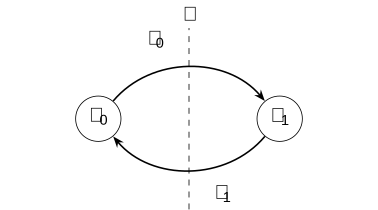
Reflection in the dashed line exchanges the vertices and fixes each arc as an unoriented cell. The arrows specify the two declared edge orientations.
In the ordered vertex and edge bases of the cellular sign model, \[\mathrm {d}_U=\begin {pmatrix}-1&u_0\\u_1&-1\end {pmatrix}, \qquad \mathbf {D}_U=\begin {pmatrix}0&\mathrm {d}_U^{\mathsf t}\\ \mathrm {d}_U&0\end {pmatrix}.\] For the trivial connection the two edge rows are negatives of one another. For \((u_0,u_1)=(1,-1)\), the two rows are orthogonal. Both assignments belong to the same cellular model; the labeled edges remain distinct in each case.
Discussion 2.4. Returning an edge coefficient to its source [fdip-00XP]AGENTDRAFTED
- November 17, 2026
Discussion 2.4. Returning an edge coefficient to its source [fdip-00XP]AGENTDRAFTED
- November 17, 2026
An edge coefficient is based at its source. Reflection reverses that edge, so its new source is the original head. The orientation sign alone therefore does not return the coefficient to its declared fiber. How does the link transport enter the pullback, and how does that pullback act on the paired field generators?
Definition 2.5. The cellular paired anti-reflection [fdip-00XQ]AGENTDRAFTED
- November 17, 2026
Definition 2.5. The cellular paired anti-reflection [fdip-00XQ]AGENTDRAFTED
- November 17, 2026
For the cellular sign model, define the cochain reflection \(\mathscr R_U\) by \[\begin {aligned} (\mathscr R_0 f)(v_j)&=f(v_{1-j}),\\ (\mathscr R_1(U)a)(e_j)&=-u_ja(e_j)\qquad (j=0,1),\\ \mathscr R_U&=\mathscr R_0\oplus \mathscr R_1(U). \end {aligned}\] The edge sign reverses orientation; its link factor transports from the reflected source back to the declared source.
Use the common algebra \(\mathscr A=\operatorname {Fun}(\Omega ,\mathcal A(V))\) with pointwise exterior multiplication. Its cellular paired anti-reflection is conjugate-linear on coefficients, fixes the link functions, and has generator rules \[\begin {aligned} \Theta _U(\psi _c)&=\sum _a(\mathscr R_U)_{ac}\bar \psi _a,\\ \Theta _U(\bar \psi _c)&=\sum _a(\mathscr R_U)_{ac}\psi _a,\\ \Theta _U(ab)&=\Theta _U(b)\Theta _U(a). \end {aligned}\] Thus \((\Theta a)(U)=\Theta _U(a(U))\). Its strict positive half-algebra \(\mathscr A_+\) consists of constant families generated over \(k\) by \(\psi _{v_1},\bar \psi _{v_1}\). The edge generators belong to the full algebra, not this open half.
Let \(\mathcal I_V\) be the ring paired coefficient. The cellular paired functional is \[\begin {aligned} Z&=\sum _{U\in \Omega }\det K_U,\\ \ell (a)&=Z^{-1}\sum _{U\in \Omega } \mathcal I_V\bigl (a(U)\operatorname {Exp}_{\Lambda }(\theta _{K_U})\bigr ) \qquad \text {when }Z\ne 0. \end {aligned}\] Here \(\operatorname {Exp}_{\Lambda }\) is the finite exterior exponential and \(\theta _{K_U}=-\bar \psi (K_U\psi )\).
Example 2.6. Vertex and boundary generators [fdip-00XR]AGENTDRAFTED
- November 17, 2026
Example 2.6. Vertex and boundary generators [fdip-00XR]AGENTDRAFTED
- November 17, 2026
The cellular anti-reflection acts on every paired generator by \[\begin {aligned} \Theta \psi _{v_j}&=\bar \psi _{v_{1-j}},& \Theta \bar \psi _{v_j}&=\psi _{v_{1-j}},\\ \Theta \psi _{e_j}&=-u_j\bar \psi _{e_j},& \Theta \bar \psi _{e_j}&=-u_j\psi _{e_j} \qquad (j=0,1). \end {aligned}\] The strict positive half has basis \(1,\psi _{v_1},\bar \psi _{v_1},b_1\), where \(b_j=\bar \psi _{v_j}\psi _{v_j}\). Its even subalgebra is spanned by \(1,b_1\). Each \(b_j\) is invariant under the local sign gauge action, and order reversal gives \(\Theta b_1=b_0\).
Both edges are reflection-boundary cells. Their generators are integrated in \(\ell \), even though neither edge is in an open half. Exchanging their barred and unbarred labels does not move those geometric cells off the boundary.
Lemma 2.7. Cochain reflection and gauge transport [fdip-00XS]AGENTDRAFTED
- November 17, 2026
Lemma 2.7. Cochain reflection and gauge transport [fdip-00XS]AGENTDRAFTED
- November 17, 2026
The cochain reflection is an orthogonal involution and commutes with \(\mathbf {D}_U\) and \(K_U\). For a vertex gauge \(g=(g_0,g_1)\in C_2^2\), its joint covariance is \[\mathscr R_{U^g}G_g=G_{\vartheta g}\mathscr R_U,\qquad \vartheta g=(g_1,g_0),\] where \(G_g\) multiplies each cell coefficient by the sign at that cell's source.
Proof.
- November 17, 2026
Proof.
- November 17, 2026
The vertex swap and signed edge actions square to the identity and preserve the cell pairing. Directly from the source-based edge formula, \[\mathrm {d}_U\mathscr R_0 =\begin {pmatrix}u_0&-1\\-1&u_1\end {pmatrix} =\mathscr R_1(U)\mathrm {d}_U.\] Transposing gives \(\mathscr R_0\mathrm {d}_U^{\mathsf t} =\mathrm {d}_U^{\mathsf t}\mathscr R_1(U)\). These are the two off-diagonal blocks of commutation with \(\mathbf {D}_U\); adding the scalar mass preserves commutation.
Gauge transformation replaces both links by \(u_j^g=g_0g_1u_j\). On vertices the covariance equation is \(\mathscr R_0\operatorname {diag}(g_0,g_1) =\operatorname {diag}(g_1,g_0)\mathscr R_0\). On edges it is \[-\operatorname {diag}(g_0g_1u_0,g_0g_1u_1) \operatorname {diag}(g_0,g_1) =-\operatorname {diag}(g_1,g_0) \operatorname {diag}(u_0,u_1).\] Each equality follows entry by entry from \(g_j^2=1\). Together they prove the joint identity.
Lemma 2.8. Compatibility of the full paired functional [fdip-00XT]AGENTDRAFTED
- November 17, 2026
Lemma 2.8. Compatibility of the full paired functional [fdip-00XT]AGENTDRAFTED
- November 17, 2026
The cellular paired anti-reflection is an algebraic anti-reflection. Whenever \(Z\ne 0\), its normalized functional satisfies \(\ell (\Theta a)=\overline {\ell (a)}\). Consequently its reflection form is Hermitian on the strict positive half and on its even gauge-invariant part.
Proof.
- November 17, 2026
Proof.
- November 17, 2026
The generator images are odd, square to zero and anticommute, so order reversal extends through the exterior relations. Since the links are fixed and \(\mathscr R_U\) is real with square \(\mathbb {I}_V\), applying the map twice fixes every generator and coefficient. It fixes the unit.
Order reversal sends a barred-first quadratic term to another barred-first term. Its coefficient operator becomes \(\mathscr R_U K_U^{\mathsf t}\mathscr R_U^{\mathsf t}\). The real symmetry of \(K_U\) and Lemma 2.7 identify this operator with \(K_U\), so \(\Theta _U\theta _{K_U}=\theta _{K_U}\). The finite exponential is therefore fixed.
In the cell basis put \(\theta =\sum _c\psi _c\bar \psi _c\). Orthogonality gives \[\Theta _U\theta =\sum _{a,b,c}(\mathscr R_U)_{ac}(\mathscr R_U)_{bc} \psi _a\bar \psi _b =\theta .\] Thus the paired top generator \(\Omega _V=\theta ^4/4!\) is fixed. The map preserves exterior degree, hence \(\mathcal I_V(\Theta _U a)=\overline {\mathcal I_V(a)}\). The finite exponential is even and central, so reversing its order with \(a\) changes nothing. Summing the coefficient identity over the pointwise fixed connection space and dividing by the real nonzero \(Z\) proves compatibility. The Hermitian assertion is Theorem 1.4.
Remark 2.9. Boundary cells and the declared action [fdip-00XU]AGENTDRAFTED
- November 17, 2026
Remark 2.9. Boundary cells and the declared action [fdip-00XU]AGENTDRAFTED
- November 17, 2026
The cellular sign model uses the full cochain operator \(5\mathbb {I}+\mathbf {D}_U\), periodic fields and counting link weights. Its edge pullback contains source transport, and its strict half contains only a vertex. A Wilson spinor action with time projectors, or a reflection that mixes cochain degrees, would define a different quadratic-form problem. Positivity for either construction requires its own action, reflection and observable correspondence.
3. An exact matter obstruction and a positive marginal [fdip-00XV]AGENTDRAFTED
- November 17, 2026
3. An exact matter obstruction and a positive marginal [fdip-00XV]AGENTDRAFTED
- November 17, 2026
The two-cell operator has only \(4\) connection backgrounds. Its determinant and two local insertions determine a reflection Gram matrix on the even positive half. The connection marginal can then be tested separately with the same geometric reflection.
Lemma 3.1. The determinant and two vertex coefficients [fdip-00XW]AGENTDRAFTED
- November 17, 2026
Lemma 3.1. The determinant and two vertex coefficients [fdip-00XW]AGENTDRAFTED
- November 17, 2026
For the cellular sign model, put \(s=u_0+u_1\) and \(b_j=\bar \psi _{v_j}\psi _{v_j}\). Then \[\begin {aligned} \det K_U&=529-s^2,\\ \mathcal I_V\bigl (b_j\operatorname {Exp}_{\Lambda }(\theta _{K_U})\bigr )&=-115 \quad (j=0,1),\\ \mathcal I_V\bigl (b_0b_1\operatorname {Exp}_{\Lambda }(\theta _{K_U})\bigr )&=25. \end {aligned}\] In particular every background determinant is strictly positive.
Proof.
- November 17, 2026
Proof.
- November 17, 2026
The edge matrix gives \[\mathrm {d}_U^{\mathsf t}\mathrm {d}_U =\begin {pmatrix}2&-s\\-s&2\end {pmatrix}.\] Eliminating the invertible edge block \(5\mathbb {I}_2\) in \(K_U\) yields \[\det K_U =\det (25\mathbb {I}_2-\mathrm {d}_U^{\mathsf t}\mathrm {d}_U) =23^2-s^2.\] Since \(s^2\) is \(0\) or \(4\), the possible values are \(529\) and \(525\).
Perturb the two vertex diagonal entries by independent scalar indeterminates \(t_0,t_1\). The same block elimination calculates the entire determinant polynomial: \[\det \bigl (K_U+\operatorname {diag}(t_0,t_1,0,0)\bigr ) =(23+5t_0)(23+5t_1)-s^2.\] The finite exponential changes by the factor \((1-t_0b_0)(1-t_1b_1)\), because each \(b_j\) squares to zero and the two even elements commute. Apply the paired determinant identity of Theorem [fdip-00TL] over \(k[t_0,t_1]\) and compare coefficients. The coefficients of \(t_j\) are \(115\), giving the minus sign in the single insertion; the coefficient of \(t_0t_1\) is \(25\), and the two minus signs cancel.
Example 3.2. The four-background partition and inverse block [fdip-00XX]AGENTDRAFTED
- November 17, 2026
Example 3.2. The four-background partition and inverse block [fdip-00XX]AGENTDRAFTED
- November 17, 2026
There are two equal-sign backgrounds with determinant \(525\), and two opposite-sign backgrounds with determinant \(529\). Hence the cellular paired functional is defined and normalized, with \[Z=2\cdot 525+2\cdot 529=2108=4\cdot 527.\] The vertex block of its fixed-background inverse is \[\mathrm {pr}_0K_U^{-1}\iota _0 =\frac 5{529-s^2} \begin {pmatrix}23&-s\\-s&23\end {pmatrix},\] where \(\iota _0\) includes vertex cochains and \(\mathrm {pr}_0\) projects onto them. Indeed the inverse of the vertex Schur complement is \(5(25\mathbb {I}_2-\mathrm {d}_U^{\mathsf t}\mathrm {d}_U)^{-1}\). Its diagonal is \(115/(529-s^2)\), and its determinant is \(25/(529-s^2)\). The paired coefficient signs in Theorem [fdip-00TQ] therefore agree with the polynomial calculation of Lemma 3.1.
Theorem 3.3. A negative even gauge-invariant reflection square [fdip-00XY]AGENTDRAFTED
- November 17, 2026
Theorem 3.3. A negative even gauge-invariant reflection square [fdip-00XY]AGENTDRAFTED
- November 17, 2026
The cellular paired functional is not reflection positive, even on the gauge-invariant even part of its strict positive half. For \(b_1=\bar \psi _{v_1}\psi _{v_1}\), the element \[f=115+527b_1\] belongs to that part and satisfies \[\ell ((\Theta f)f)=-50.\]
Proof.
- November 17, 2026
Proof.
- November 17, 2026
Local gauge transformation multiplies both generators at \(v_1\) by the same sign, so \(b_1\) is gauge invariant. It is even, and its support is the strict positive vertex. Order reversal in the declared reflection gives \(\Theta b_1=b_0\). By Lemma 3.1 and the partition sum in Example 3.2, \[\ell (b_0)=\ell (b_1)=-\frac {115}{527},\qquad \ell (b_0b_1)=\frac {25}{527}.\] Thus the reflection Gram matrix on \(1,b_1\) is \[\begin {pmatrix} 1&-115/527\\-115/527&25/527 \end {pmatrix},\qquad \det =\frac {-50}{527^2}.\] More directly, the stated vector has quadratic value \[115^2-2\cdot 115^2+25\cdot 527=-50.\] This is negative in both declared ground fields. The compatibility already proved in Lemma 2.8 makes it a negative value of a Hermitian reflection form.
The same element disproves positivity on any larger positive half containing this vertex algebra and retaining the same reflection and functional.
Theorem 3.4. Reflection positivity of the connection marginal [fdip-00XZ]AGENTDRAFTED
- November 17, 2026
Theorem 3.4. Reflection positivity of the connection marginal [fdip-00XZ]AGENTDRAFTED
- November 17, 2026
The connection marginal of the cellular paired functional is a reflection-positive probability law on the full connection function algebra, with masses \[\nu (U)=\begin {cases} 525/2108,&u_0=u_1,\\ 529/2108,&u_0=-u_1. \end {cases}\] It is therefore reflection positive on any specified connection half-subalgebra.
Proof.
- November 17, 2026
Proof.
- November 17, 2026
Restricting the paired functional to a scalar function of \(U\) integrates the exterior weight to \(\det K_U\). The values and their sum are Lemma 3.1 and Example 3.2. They are positive and sum to one. The geometric reflection fixes each \(U\) pointwise, so for any connection function \(h\), \[B_\nu (h,h)=\sum _{U\in \Omega }\nu (U) \overline {h(U)}h(U)\ge 0.\] This is the claimed form on the whole algebra. Restriction preserves the inequality.
The rank-one kernel component is
TauCeti.posSemidef_rankOne.
Its use requires the pointwise-fixed reflection and the
computed nonnegative weights.
Example 3.5. A positive invariant density can destroy reflection positivity [fdip-00Y0]AGENTDRAFTED
- November 17, 2026
Example 3.5. A positive invariant density can destroy reflection positivity [fdip-00Y0]AGENTDRAFTED
- November 17, 2026
Return to the independent uniform signs \((x,y)\) with reflection exchanging them in Example 1.3. Their unweighted law is reflection positive on functions of \(x\). The density \[w(x,y)=1-\frac {xy}{2}\] is positive, reflection invariant and normalized, since \(\ell (xy)=0\). Nevertheless the positive-half function \(h(x)=x\) has weighted reflection square \[\ell \bigl (w(x,y)(\Theta h)(x,y)h(x,y)\bigr ) =\ell \bigl ((1-xy/2)xy\bigr )=-\frac 12.\] Thus even positive reflection-invariant reweighting need not preserve reflection positivity. The pointwise-fixed reflection in Theorem 3.4 supplies a stronger hypothesis than invariance of the density.
Remark 3.6. What the two forms distinguish [fdip-00Y1]AGENTDRAFTED
- November 17, 2026
Remark 3.6. What the two forms distinguish [fdip-00Y1]AGENTDRAFTED
- November 17, 2026
The same sign connections give the positive marginal of Theorem 3.4 and the negative matter insertion of Theorem 3.3. The latter is already even, locally gauge invariant and strictly supported in the positive half. Neither a restriction excluding odd observables nor a choice to leave boundary-edge fields outside that half removes it.
These conclusions concern the declared cellular anti-reflection and full cochain operator. They give no positivity statement for arbitrary reflection-paired gauge averages and no obstruction to a different, explicitly constructed fermionic reflection or transfer operator.
4. Majorana and transfer comparisons [fdip-00Y2]AGENTDRAFTED
- November 17, 2026
4. Majorana and transfer comparisons [fdip-00Y2]AGENTDRAFTED
- November 17, 2026
Majorana trace functionals, Grassmann coefficient functionals and transfer operators carry different multiplications and reflection data. Their positivity results can be compared only with those data visible. The elementary exterior obstruction gives a starting point for the Majorana comparison; the lattice sources specify the additional action and boundary hypotheses.
Lemma 4.1. The obstruction to an odd exterior substitution [fdip-00Y3]AGENTDRAFTED
- November 17, 2026
Lemma 4.1. The obstruction to an odd exterior substitution [fdip-00Y3]AGENTDRAFTED
- November 17, 2026
Let \(k\) be a nonzero field of characteristic different from \(2\), and let \(E\) be a finite-dimensional \(k\)-space. Every odd element of \(\Lambda _k(E)\) squares to zero. Consequently, if an algebra contains an element \(c\) with \(c^2=1\), no unital algebra homomorphism from it to \(\Lambda _k(E)\) can send \(c\) to an odd element. Reversal on an exterior monomial of degree \(p\) multiplies it by \((-1)^{p(p-1)/2}\); in particular reversal need not act trivially on the even subalgebra.
Proof.
- November 17, 2026
Proof.
- November 17, 2026
Two odd exterior monomials anticommute: disjoint monomials acquire the sign \(-1\), and a repeated generator makes both products zero. Expanding in monomials gives \(ab=-ba\) for odd \(a,b\). For \(a=b\), invertibility of \(2\) implies \(a^2=0\). A unital homomorphism would then send \(c^2=1\) to both \(0\) and \(1\), which is impossible.
Reversing a length-\(p\) word uses \(p(p-1)/2\) transpositions. Each transposition of distinct exterior generators contributes a minus sign. For two independent generators \(u,v\), their nonzero product \(uv\) is even, but reversal gives \(vu=-uv\).
Remark 4.2. The Jaffe-Janssens criterion and its multiplication [fdip-00Y4]AGENTDRAFTED
- November 17, 2026
Remark 4.2. The Jaffe-Janssens criterion and its multiplication [fdip-00Y4]AGENTDRAFTED
- November 17, 2026
Jaffe and Janssens work in a finite complex Majorana algebra whose self-adjoint generators satisfy \(c_ic_j+c_jc_i=2\delta _{ij}\). The generator index involution is fixed-point free, and its two exchanged halves partition all generators. Their reflection is antilinear and multiplicative. Their normalized trace \(\tau \) gives the Boltzmann functional \(a\mapsto \tau (a\mathrm {e}^{-H})\), and division by \(Z_H=\tau (\mathrm {e}^{-H})\) gives the Gibbs functional when \(Z_H\ne 0\). See [jaffejanssens2015characterization, pp. 2-3, (1.4)-(1.6); p. 5, (1.9)].
Their global gauge invariance means evenness under \(c_i\mapsto -c_i\). It is distinct from a local lattice gauge action. Their half-product uses one fixed \(\zeta \in \{\mathrm {i},-\mathrm {i}\}\) on an odd-odd product; its extension to the full algebra is nonassociative [jaffejanssens2015characterization, Sections 1.2 and 1.5, Definition 1.2, pp. 5-6].
As a cited input, Theorem 4.2(a) says that for an even, reflection-invariant \(H\), positivity of the cross-plane coupling block suffices for reflection positivity of the unnormalized functional at the fixed coupling. The block excludes the empty monomial on both sides. Theorem 4.4 adds \(Z_H\ne 0\) for the normalized conclusion and then obtains \(Z_H>0\). Self-adjointness of \(H\) is not a general hypothesis of these results. The converse in Theorem 4.2(b) requires positivity for every inverse temperature in a neighborhood of zero; Theorem 1.1 summarizes an all-positive-temperature equivalence. A single positive form does not give that converse [jaffejanssens2015characterization, Theorems 1.1, 4.2 and 4.4; Remark 4.5, pp. 3, 19-21].
For the cellular paired reflection, the ordinary exterior product, order reversal and fixed boundary-edge cells differ from those hypotheses. Lemma 4.1 rules out the immediate odd-generator algebra substitution and shows why evenness alone does not remove the reversal sign. A symbol correspondence would have to identify multiplication, the functional, normalization, reflection and positive half. The source's operator-exponential argument also uses a series and an approximation [jaffejanssens2015characterization, (3.13)-(3.14), p. 16; proof of Theorem 4.2, pp. 19-20]. No such correspondence with the finite exterior weight has been established here.
Remark 4.3. The even-half theorem of Jaffe and Pedrocchi [fdip-00Y5]AGENTDRAFTED
- November 17, 2026
Remark 4.3. The even-half theorem of Jaffe and Pedrocchi [fdip-00Y5]AGENTDRAFTED
- November 17, 2026
Jaffe and Pedrocchi use an antilinear multiplicative reflection on Majorana operators. Their self-adjoint Hamiltonian decomposes into two even reflected half terms and cross terms pairing a monomial with its reflection. The cross coefficients are real and diagonal in that monomial description, with the prescribed \(\mathrm {i}\)-power determined by parity. Their sign condition requires all odd-length cross coefficients to have one common sign, while the even-length ones are nonpositive [jaffepedrocchi2013reflection, (II.4)-(II.7), (III.1)-(III.8), pp. 3-4].
Under these hypotheses, Theorem 3 proves positivity of the trace of \(a\Theta (a)\mathrm {e}^{-H}\) for \(a\) in the even half-algebra, using ordinary multiplication.
In [jaffepedrocchi2013reflection, Theorem 3 and (VI.9), p. 6], the one-generator odd example has the nonreal value \(-2\mathrm {i}\sinh (1)\). Thus the even-half restriction is material. It does not remove the cellular obstruction in Theorem 3.3, whose negative element is already even and locally gauge invariant. The source gives no identification of its Majorana trace with this paired exterior coefficient.
Remark 4.4. The centered Grassmann action of Osterwalder and Seiler [fdip-00Y6]AGENTDRAFTED
- November 17, 2026
Remark 4.4. The centered Grassmann action of Osterwalder and Seiler [fdip-00Y6]AGENTDRAFTED
- November 17, 2026
Osterwalder and Seiler use a centered nearest-neighbor Euclidean spinor action, a supplied unitary internal gauge representation and a real mass, including zero. Their Grassmann integral is specified by its paired top coefficient. Terms whose neighboring site lies outside the finite lattice are omitted, giving free boundaries [osterwalder1978gauge, Section 2.2, (2.13)-(2.14), pp. 446-447].
Their positive half contains field generators at strictly positive time and bond observables with both endpoints there. The reflection is antilinear, exchanges the two field types, inserts the time Dirac element and reverses Grassmann product order. Theorem 2.1 proves reflection positivity for gauge-invariant observables in that half under the full integrated gauge-plus-fermion expectation. Its proof uses temporal radiation gauge and a positive cone [osterwalder1978gauge, (2.15) and Theorem 2.1, pp. 447-448].
The shared order-reversing convention is a useful comparison with the cellular reflection. The centered spinor operator, time Dirac element, free boundaries and gauge treatment still require a separate correspondence. This source is neither a Wilson-fermion action nor a periodic cochain-circle theorem.
Remark 4.5. Wilson time projectors at a site plane [fdip-00Y7]AGENTDRAFTED
- November 17, 2026
Remark 4.5. Wilson time projectors at a site plane [fdip-00Y7]AGENTDRAFTED
- November 17, 2026
Menotti and Pelissetto fix the four-dimensional Wilson action with Wilson parameter \(1\). Their field reflection is antilinear, exchanges the field types, inserts the time Dirac element and reverses Grassmann order. The observable is gauge invariant and supported at strictly positive time. The hopping parameter is strictly below \(1/6\); the comparison here uses its nonnegative regime [menottipelissetto1987positivity, (2.1)-(2.6), p. 370].
Their link-plane discussion permits a Wilson parameter between \(0\) and \(1\), including the centered endpoint. The site-plane argument instead uses the Wilson time projectors to separate the boundary fields, then integrates them through the positive spatial boundary matrix. The bound on that matrix is the reason for the hopping restriction [menottipelissetto1987positivity, p. 371; (2.22)-(2.25), pp. 372-373]. The argument integrates gauge variables, names no gauge group and gives no finite periodic temporal prescription.
The two fixed slices of the torus site reflection therefore need their own boundary proof. The cellular sign model instead swaps vertices and fixes unoriented edges, and its full cochain action has no Wilson time projectors. Neither geometric resemblance identifies those quadratic forms with the source's one.
Remark 4.6. Two free staggered transfer constructions [fdip-00Y8]AGENTDRAFTED
- November 17, 2026
Remark 4.6. Two free staggered transfer constructions [fdip-00Y8]AGENTDRAFTED
- November 17, 2026
Sharatchandra, Thun and Weisz set gauge fields aside at the start of their transfer construction. They assert that including them introduces no new features; that sentence supplies no gauged proof [sharatchandrathunweisz1981susskind, Section 4, p. 220].
In [sharatchandrathunweisz1981susskind, (4.3)-(4.6), p. 221], they construct a Fock-space and Grassmann-symbol relation on a finite lattice with specified boundary conditions. This is additional operator-to-symbol data, rather than an equality of ordinary products.
When both one-component field types occupy every site, auxiliary Grassmann variables enter their transfer representation. Its one-step operator is Hermitian and has negative eigenvalues; its square is positive and advances two fine temporal spacings [sharatchandrathunweisz1981susskind, p. 222; (4.10), (4.12)-(4.13), p. 223]. The alternate-site construction changes the field placement and has a Hermitian positive definite transfer operator [sharatchandrathunweisz1981susskind, (4.14)-(4.17), pp. 223-224]. These are distinct transfer results. A correspondence with \(\mathbf {D}=\mathrm {d}+\mathrm {d}^{\dagger }\) requires an actual operator intertwiner, together with matching fields and boundaries.
Remark 4.7. Heller's two-time-slice transfer sketch [fdip-00Y9]AGENTDRAFTED
- November 17, 2026
Remark 4.7. Heller's two-time-slice transfer sketch [fdip-00Y9]AGENTDRAFTED
- November 17, 2026
Heller explicitly calls Appendix B a sketch. It treats staggered fermions with the standard flavor-degenerate mass and Wilson gauge action, pairs times \(2j\) and \(2j+1\), and uses temporal gauge with unit time links. Its CAR and coherent-state formulas are part of that construction [heller1997schrodinger, Appendix B, (B.1)-(B.9), pp. 21-22].
Writing the source's transfer operators as \(\mathcal T\), \(\mathcal T_G\) and \(\mathcal T_F\) to distinguish them from lattice translations, the displayed factorization is \[\mathcal T=\mathcal T_G^{1/2}\mathcal T_F^\dagger \mathcal T_G\mathcal T_F\mathcal T_G^{1/2}.\] The dagger is the Hilbert-space adjoint in the source. The text identifies this operator as self-adjoint and positive, with \(\mathcal T=\mathrm {e}^{-2a_tH}\) [heller1997schrodinger, (B.10)-(B.12), pp. 22-23]. The factor \(2\) describes two fine temporal spacings, not a one-fine-step positivity assertion.
The Schrödinger-functional setup has an even number of time slices, an odd labeled time extent with sites from zero through that extent, and an even spatial extent with twisted periodic spatial boundaries [heller1997schrodinger, Section 2, (2.6), p. 3]. Parity of the torus time period alone does not identify these boundaries. On a periodic circle, nontrivial holonomy also prevents setting every temporal link to the identity. The pure-gauge transfer factor, slice pairing and observable correspondence remain additional data for a cochain construction.
Remark 4.8. The remaining reconstruction question [fdip-00YA]AGENTDRAFTED
- November 17, 2026
Remark 4.8. The remaining reconstruction question [fdip-00YA]AGENTDRAFTED
- November 17, 2026
The finite reflection criterion in Theorem 1.4 applies to a declared algebra, functional and half. The cellular cochain choices give the exact negative even element in Theorem 3.3, alongside the separately positive connection marginal in Theorem 3.4. They do not supply a fermionic Hilbert space or transfer evolution.
A different reflection or transfer construction must identify its multiplication, adjoint, boundaries, gauge constraint and observable map before a source positivity theorem can apply. The fermionic transfer question in Remark [fdip-00JB] therefore remains open beyond the stated cellular result; a two-time-slice transfer operator, if constructed with other reflection data, would require its own test.