Example. Short periods add winding terms [fdip-0073]
AGENTDRAFTED
On an \(L\times L\) square torus, write \(1\) for the connection
with all links equal to one and \(U_{\mathrm {flip}}\) for the
connection obtained by changing one horizontal link to minus one.
Use the real scalar convention with mass \(m>0\). Two adjacent
plaquettes change sign, so
\(\sum _p(U_{\mathrm {flip}})_p-\sum _p1=-4\). For \(L\ge 6\), the
induced plaquette theorem gives
\[\begin {aligned}
\mathcal {W}(U_{\mathrm {flip}})-\mathcal {W}(1)
&=\frac {4}{(4+m^2)^4}+O((4+m^2)^{-6}),\\
\frac {\mathcal {W}(U_{\mathrm {flip}})-\mathcal {W}(1)}{4/(4+m^2)^4}
&\longrightarrow 1\qquad (m\to \infty ).
\end {aligned}\]
The constants in the error bound may depend on the fixed volume.
For \(L=4\), there are also straight four-step walks winding
around a periodic row or column. The changed edge lies in one
horizontal winding cycle. It has 4 starting vertices and two
orientations, so 8 based walks change holonomy from one to minus
one. Their contribution to \(\operatorname {tr}(H_{U_{\mathrm {flip}}}^4)-\operatorname {tr}(H_1^4)\) is
\(-16\), in addition to the plaquettes' \(8(-4)=-32\).
There are no odd closed walks because this torus is bipartite.
The finite trace identity of Theorem [fdip-0071], with \(K=5\), gives
\[\begin {aligned}
\mathcal {W}(U_{\mathrm {flip}})-\mathcal {W}(1)
&=\frac {6}{(4+m^2)^4}+O((4+m^2)^{-6}),\\
\frac {\mathcal {W}(U_{\mathrm {flip}})-\mathcal {W}(1)}{4/(4+m^2)^4}
&\longrightarrow \frac 32\qquad (m\to \infty ).
\end {aligned}\]
The extra leading term is winding holonomy, not a different local
plaquette coefficient.
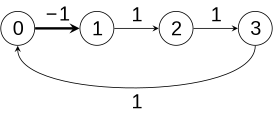
The diagram shows one horizontal row of the \(4\times 4\) torus;
vertical edges are omitted. The curved edge is the periodic join.
The four-step winding product is minus one, independently of the
two neighboring plaquette products.
For \(L=5\), length-4 winding is absent, but each periodic
row or column has straight winding walks of length 5. The changed
row has 10 such based oriented walks, so
\(\operatorname {tr}(H_{U_{\mathrm {flip}}}^5)-\operatorname {tr}(H_1^5)=-20\). No other five-step return can
wind: displacement 5 requires all 5 steps along that axis.
The plaquette change remains \(\operatorname {tr}(H_{U_{\mathrm {flip}}}^4)-\operatorname {tr}(H_1^4)=-32\).
Using the same finite identity at \(K=5\) gives
\[\begin {aligned}
\mathcal {W}(U_{\mathrm {flip}})-\mathcal {W}(1)
&=\frac {4}{(4+m^2)^4}+\frac {2}{(4+m^2)^5}\\
&\qquad +O((4+m^2)^{-6}).
\end {aligned}\]
Thus a period-5 hypothesis would leave an order \((4+m^2)^{-5}\) term
outside the claimed order \((4+m^2)^{-6}\) remainder. This is why the
preceding theorem requires both periods to be at least 6.