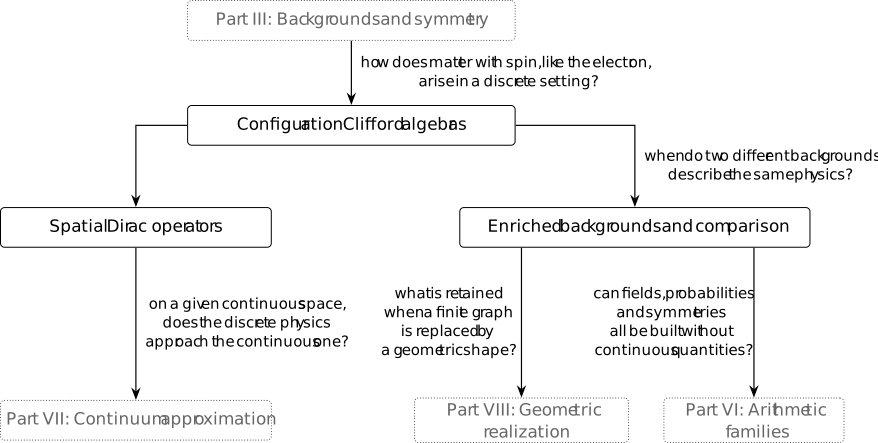
Configuration Clifford algebras [fdip-001B]
✍️sourceAGENTDRAFTED
- October 20, 2026
Configuration Clifford algebras [fdip-001B]
✍️sourceAGENTDRAFTED
- October 20, 2026
How might a discrete first-order equation acquire the internal components used to describe matter with spin? For two commuting centered differences, try \(D=a\nabla _1+b\nabla _2\). Relations \(a^2=b^2=I\) and \(ab+ba=0\) cancel the mixed term in its square. Real or complex scalars cannot satisfy them, but the two-by-two matrices \(X,Z\) do. This is an algebraic two-component example, not a derivation of electron spin. With these self-adjoint matrices and skew-adjoint centered differences, the positive square is \(-D^2\); it uses two-step shifts and differs from the nearest-neighbor Laplacian.
The common algebraic question is how a quadratic form can be encoded by products of generators. Here the configuration quadratic form determines a Clifford algebra through its square relation. Keeping the polar normalization explicit lets form-preserving maps act functorially, without identifying a quadratic map with a chosen coordinate array. This algebra encodes the supplied configuration form; it does not choose the spatial Clifford module used for Dirac operators.
Example 1. The configuration quadratic form and its polar forms [fdip-000O]AGENTDRAFTED
- October 17, 2026
Example 1. The configuration quadratic form and its polar forms [fdip-000O]AGENTDRAFTED
- October 17, 2026
For the alternating four-cycle, let \(V=\mathbb R^4\) be the space of vertex fields and let \(\delta _i(j)=\delta _{ij}\) be its coordinate vectors. These are distinct from the oriented edges \(e_i\) and the spectral vectors \(u_a\) of Example [fdip-0037]. With \(t,m>0\), put \(a=m^2\) and \(s=1+t+a\). The massive precision gives the quadratic form \[\begin {aligned} q_{t,m}(v)&=v^TQ_{t,m}v,\\ Q_{t,m}&=\begin {pmatrix} s&-1&0&-t\\-1&s&-t&0\\0&-t&s&-1\\-t&0&-1&s \end {pmatrix}. \end {aligned}\] The Euclidean action is \(\mathcal A(v)=q_{t,m}(v)/2\). The factor \(1/2\) belongs to the action; the quadratic form used below is \(q_{t,m}\) itself.
Write \(q=q_{t,m}\) and \(Q=Q_{t,m}\). The unhalved polar form and the half-polar form are respectively \[\begin {aligned} B_q(u,v)&=q(u+v)-q(u)-q(v)\\ &=2u^TQv,\\ b_q(u,v)&=\tfrac 12 B_q(u,v)=u^TQv. \end {aligned}\] Thus \(q(v)=b_q(v,v)\), while \(B_q(v,v)=2q(v)\). This is the polarization dictionary: the symmetric bilinear form called \(B\) by Meinrenken is \(b_q\), not \(B_q\). His Clifford relation uses \(2B\) [meinrenken2013clifford, Definition 2.1, p. 27].
Proof.
- October 17, 2026
Proof.
- October 17, 2026
The matrix \(Q\) is symmetric. Expanding \((u+v)^TQ(u+v)\) and canceling the two diagonal terms gives \(u^TQv+v^TQu=2u^TQv\). This is bilinear, and \(q(cv)=c^2q(v)\) for every real \(c\), so \(q\) is a quadratic form. The edge energy also gives \[\begin {aligned} q(v)={}&(v_1-v_0)^2+t(v_2-v_1)^2\\ &{}+(v_3-v_2)^2+t(v_0-v_3)^2\\ &{}+m^2\sum _{i=0}^3v_i^2. \end {aligned}\] Every term is nonnegative. If \(v\ne 0\), the last term is positive because \(m>0\); hence \(q\) is positive definite.
Mathlib's Matrix.toQuadraticForm' constructs this
matrix quadratic form. Its underlying
LinearMap.BilinMap.toQuadraticMap sends a bilinear map
\(b\) to \(v\mapsto b(v,v)\); here \(b(u,v)=u^TQv\).
The definition QuadraticMap.polar is unhalved.
These generic constructions supply the conventions; the displayed
matrix and positivity calculation specify this example.
The 4 coordinates are configuration directions, one per vertex. Positive definiteness therefore describes a form on field space. It supplies no Lorentzian spacetime metric. Changing \(t,m\) changes this form and the Gaussian state, even though the half-turn action stays fixed.
Proposition 2. The Clifford algebra of the configuration form [fdip-000P]AGENTDRAFTED
- October 17, 2026
Proposition 2. The Clifford algebra of the configuration form [fdip-000P]AGENTDRAFTED
- October 17, 2026
Let \(k\) be a commutative ring, \(M\) a \(k\)-module and \(q:M\to k\) a quadratic form. Use the tensor algebra and the square-quotient convention for the Clifford algebra: \[\operatorname {Cl}(q)=T_k(M)/I_q,\] where \(I_q\) is the two-sided ideal generated by \(v\otimes v-q(v)1\) for all \(v\in M\). The canonical linear map \(\iota _q:M\to \operatorname {Cl}(q)\) satisfies \(\iota _q(v)^2=q(v)1\). Scalars in this formula mean their images under the algebra's structure map. No invertibility of \(2\) is required for this construction.
For every unital associative \(k\)-algebra \(A\), a linear map \(f:M\to A\) extends to a unique unital \(k\)-algebra homomorphism \(\widehat f:\operatorname {Cl}(q)\to A\) if and only if \[f(v)^2=q(v)1_A\qquad (v\in M).\] This is the Clifford lift and its universal property.
Proof.
- October 17, 2026
Proof.
- October 17, 2026
Necessity follows by applying an algebra homomorphism to the square relation. For sufficiency, send a pure tensor to its ordered product, \[v_1\otimes \cdots \otimes v_r\longmapsto f(v_1)\cdots f(v_r),\] and send \(c\in k=T_k^0(M)\) to \(c1_A\). The product is multilinear because \(f\) is linear, multiplication in \(A\) is distributive, and the scalar images are central. The tensor-product universal property therefore gives a linear map on each tensor power. Their direct sum defines a linear map \(F:T_k(M)\to A\). Concatenation of pure tensors becomes multiplication of their ordered products. Distributivity then proves multiplicativity on all finite sums, and the degree-zero formula preserves the unit and scalars. Every generator of \(I_q\) maps to \(f(v)^2-q(v)1_A=0\); multiplicativity makes every element of the two-sided ideal map to zero. Thus \(F\) descends to \(\widehat f\). Every tensor is a finite linear combination of pure tensors, whose images in the quotient are products of the \(\iota _q(v)\). An algebra map with the prescribed generator values must have the displayed value on each such product and on every scalar. This proves uniqueness.
Linearity and the square relation give the anticommutator: \[\begin {gathered} \iota _q(u)\iota _q(v)+\iota _q(v)\iota _q(u)\\ =\bigl (q(u+v)-q(u)-q(v)\bigr )1\\ =B_q(u,v)1. \end {gathered}\] Indeed, expand \((\iota _q(u)+\iota _q(v))^2\) and subtract the two squares. This uses no division by \(2\). When \(2\) is invertible, \(b_q=B_q/2\) exists and the relation becomes \(\iota _q(u)\iota _q(v)+\iota _q(v)\iota _q(u)=2b_q(u,v)1\). Conversely that relation with \(u=v\) recovers the square relation by cancellation of \(2\). Thus the two presentations agree in this case. Without that hypothesis, the anticommutator alone need not recover the squares.
Meinrenken gives the bilinear presentation in
[meinrenken2013clifford, Definition 2.1, p. 27]
and the universal property in
[meinrenken2013clifford, Proposition 2.2 and Remark 2.2, p. 29].
His chapter assumes a finite-dimensional vector space over a
characteristic-zero field (p. 23); Remark 2.2 includes the ordinary
algebra formulation. The direct argument above supplies the stated
commutative-ring generality. Mathlib's
CliffordAlgebra.ι_sq_scalar,
CliffordAlgebra.lift,
CliffordAlgebra.lift_unique and
CliffordAlgebra.ι_mul_ι_add_swap
provide these respective generic square, extension, uniqueness and
unhalved-polar statements.
Now take the real configuration form and put \(c_i=\iota _q(\delta _i)\). Write \(\{x,y\}=xy+yx\) for the anticommutator. The matrix entries give \[\begin {aligned} c_i^2&=s1\quad (i=0,1,2,3),\\ \{c_0,c_1\}&=\{c_2,c_3\}=-2\,1,\\ \{c_1,c_2\}&=\{c_3,c_0\}=-2t\,1,\\ \{c_0,c_2\}&=\{c_1,c_3\}=0. \end {aligned}\] These follow from \(q(\delta _i)=Q_{ii}=s\) and \(b_q(\delta _i,\delta _j)=Q_{ij}\). In particular the squares are positive in this convention. The opposite-sign convention would use \(-q\).
For this real form, both the scalar map and \(\iota _q\) are
injective. Here is the exterior algebra argument of
[meinrenken2013clifford, Proposition 2.1, p. 28], with its
operator identities made explicit. On \(\bigwedge V\), let
\(\epsilon (v)\omega =v\wedge \omega \), and define contraction by
\[d_v(1)=0,\]
\[\begin {gathered}
d_v(w_1\wedge \cdots \wedge w_r)\\
=\sum _{j=1}^r(-1)^{j-1}b_q(v,w_j)\\
\quad \cdot w_1\wedge \cdots \widehat {w_j}\cdots \wedge w_r.
\end {gathered}\]
The alternating multilinear expression defines a linear operator
on the exterior algebra. Exterior alternation gives
\(\epsilon (v)^2=0\). In \(d_v^2\), each pair of removed positions
occurs twice with opposite signs and the same scalar coefficient,
so \(d_v^2=0\). Separating the first term of \(d_v(v\wedge \omega )\)
gives
\[d_v\epsilon (v)+\epsilon (v)d_v=b_q(v,v)I.\]
Consequently \(C(v)=\epsilon (v)+d_v\) is linear in \(v\) and
\(C(v)^2=q(v)I\). The universal property gives a unital algebra
map \(\rho :\operatorname {Cl}(q)\to \operatorname {End}_{\mathbb R}(\bigwedge V)\).
It satisfies \(\rho (\iota _q(v))1=v\) and \(\rho (r1)1=r1\).
Since \(\bigwedge ^1 V=V\) and \(\bigwedge ^0V=\mathbb R\),
these equations prove both injections. The contraction identities
are also recorded in [meinrenken2013clifford, Section 2.1.3, pp. 25-26].
TauCeti's CliffordAlgebra.ι_injective and
CliffordAlgebra.algebraMap_injective
give the corresponding injections for an arbitrary quadratic form
over a commutative ring with invertible \(2\).
The exterior action just used proves faithfulness on vectors and scalars; it does not assert that \(\rho \) is a faithful algebra representation. Nor does this construction select a physical spinor module, a positive expectation on the Clifford algebra, or a differential operator. The earlier Gaussian expectation acts on polynomial observables of vertex fields; an expectation on this new algebra would require a specified construction.
Theorem 3. Form-preserving maps and the half-turn Clifford automorphism [fdip-000Q]AGENTDRAFTED
- October 17, 2026
Theorem 3. Form-preserving maps and the half-turn Clifford automorphism [fdip-000Q]AGENTDRAFTED
- October 17, 2026
Let \(k\) be a commutative ring, \(M_1,M_2\) be \(k\)-modules with quadratic forms \(q_1,q_2\), and let \(f:M_1\to M_2\) be linear with \[q_2(f(v))=q_1(v)\qquad (v\in M_1).\] This form-preserving map induces a unique unital \(k\)-algebra map \[\operatorname {Cl}(f):\operatorname {Cl}(q_1)\longrightarrow \operatorname {Cl}(q_2)\] satisfying \(\operatorname {Cl}(f)(\iota _1(v))=\iota _2(f(v))\). This is the underlying Clifford map in isometry transport. It requires no inverse for \(f\). The defining square is:
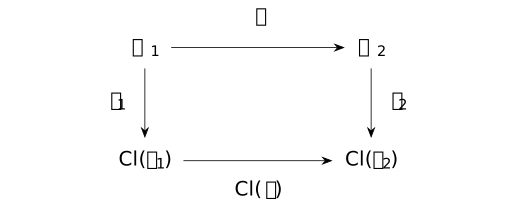
The top and vertical arrows are linear maps; the bottom arrow is a unital algebra map. The square commutes as a square of linear maps. For composable form-preserving maps \(f,g\), \[\begin {aligned} \operatorname {Cl}(\operatorname {id})&=\operatorname {id},\\ \operatorname {Cl}(g\circ f)&=\operatorname {Cl}(g)\circ \operatorname {Cl}(f). \end {aligned}\] If \(f\) is a linear isomorphism, \(\operatorname {Cl}(f)\) is an algebra isomorphism with inverse \(\operatorname {Cl}(f^{-1})\).
Proof.
- October 17, 2026
Proof.
- October 17, 2026
The linear map \(v\mapsto \iota _2(f(v))\) has square \(q_2(f(v))1=q_1(v)1\). Apply the universal property to obtain the unique extension. For the identity, the induced map and the identity algebra map agree on every generator, hence are equal by uniqueness. For composition, both proposed maps send \(\iota _1(v)\) to \(\iota _3(g(f(v)))\); uniqueness again proves equality. If \(f\) is invertible, set \(v=f^{-1}(w)\) in form preservation to get \(q_1(f^{-1}(w))=q_2(w)\). Thus the inverse is also form-preserving. The two composition identities give mutually inverse algebra maps.
Meinrenken derives this functoriality for bilinear-form-preserving
maps in [meinrenken2013clifford, Section 2.2.2, p. 29].
Over his characteristic-zero field, polarization equates that
condition with preservation of \(q\). The proof here applies
directly to quadratic forms over commutative rings. Mathlib's
CliffordAlgebra.map,
CliffordAlgebra.map_apply_ι,
CliffordAlgebra.map_id,
CliffordAlgebra.map_comp_map and
CliffordAlgebra.equivOfIsometry
provide the extension, generator equation, identity, composition
and inverse construction. Their input is a linear map preserving
the quadratic form, or a linear equivalence for the last result.
Return to \(q=q_{t,m}\) on \(V=\mathbb R^4\). The same half-turn sends \(\delta _i\) to \(\delta _{i+2}\), with indices modulo \(4\). It satisfies \(P^2=I\) and \(P^TQP=Q\), so \(q(Pv)=q(v)\). Therefore \[\begin {aligned} \Theta &=\operatorname {Cl}(P),\\ \Theta (c_i)&=c_{i+2},\qquad \Theta ^2=\operatorname {id}. \end {aligned}\] The matrix equation follows by shifting both indices of \(Q\) by two: its diagonal, its paired off-diagonal entries \(-1\) and \(-t\), and its zeros are preserved. Composition gives \(\Theta ^2=\operatorname {Cl}(P^2)=\operatorname {id}\). Moreover \(\delta _0\ne \delta _2\), so injectivity of \(\iota _q\) gives \(c_0\ne c_2\). Thus \(\Theta \) is nontrivial and has order exactly two.
The real half-turn sectors
\(V_\pm =\ker (P\mp I)\) are orthogonal for \(b_q\). Indeed,
\(P^TQP=Q\) gives \(b_q(Pu,Pv)=b_q(u,v)\). For
\(u\in V_+\) and \(v\in V_-\), the left side is
\(b_q(u,-v)=-b_q(u,v)\). Over \(\mathbb R\) this forces
\(b_q(u,v)=0\), and hence
\[\iota _q(u)\iota _q(v)=-\iota _q(v)\iota _q(u).\]
This is the generic orthogonality consequence
CliffordAlgebra.ι_mul_ι_comm_of_isOrtho.
The cross-sector vector generators anticommute; the direct sum
of sectors does not make them commuting factors of an ordinary
tensor-product algebra.
Preservation of the form is essential. Compare \(q_{1,1}\) and \(q_{2,1}\) while keeping the coordinate labels unchanged. At \(\delta _0\), \[q_{1,1}(\delta _0)=3,\qquad q_{2,1}(\delta _0)=4.\] Thus the identity linear map is not form-preserving. Write \(c_i^{(1)},c_i^{(2)}\) for the two sets of generators. A unital real algebra map with \(c_i^{(1)}\mapsto c_i^{(2)}\) would send \((c_0^{(1)})^2=3\,1\) to \((c_0^{(2)})^2=3\,1\), but the target square is \(4\,1\). Its injective scalar map rules this out. This excludes precisely the unchanged-label assignment. It does not exclude other isometries between the positive forms or an abstract isomorphism of their Clifford algebras.
The construction transports a supplied configuration form and its discrete symmetry. It supplies no spacetime derivative, Dirac operator or Lorentzian interpretation. Those structures need additional data and compatibility conditions.