Finite fields with a fixed boundary [fdip-00HS]
✍️sourceAGENTDRAFTED
- November 9, 2026
Finite fields with a fixed boundary [fdip-00HS]
✍️sourceAGENTDRAFTED
- November 9, 2026
A massive graph field records both internal bonds and boundary data in its energy. On a square, setting exterior values to zero leaves an energy contribution at every missing neighbor. Which positive operator and quartic weight retain those contributions as the mesh shrinks?
Discussion 1. The energy at the edge of a square [fdip-00HT]AGENTDRAFTED
- November 9, 2026
Discussion 1. The energy at the edge of a square [fdip-00HT]AGENTDRAFTED
- November 9, 2026
In the finite spatial chain, each bond penalizes a difference of field values. A bond from a retained site to a fixed zero value penalizes that site's value itself. At a corner of a square, two such penalties remain even though only two neighbors are retained. How should the Gaussian precision express this boundary energy together with a fixed physical square and its changing mesh?
Definition 2. The square Dirichlet form and sampled fields [fdip-00HU]AGENTDRAFTED
- November 9, 2026
Definition 2. The square Dirichlet form and sampled fields [fdip-00HU]AGENTDRAFTED
- November 9, 2026
Fix \(m_0>0\), \(\ell >0\) and an odd integer \(N\ge 5\). Put \[\begin {aligned} \Lambda _\ell &=(-\ell /2,\ell /2)^2,&\epsilon &=\frac {\ell }{N+1},\\ V_{\ell ,N}&=\Lambda _\ell \cap \epsilon \mathbb Z^2,& H_{\ell ,N}&=L^2(V_{\ell ,N},\epsilon ^2\text { counting};\mathbb R). \end {aligned}\] The set \(V_{\ell ,N}\) has \(N^2\) points. Write \(h_\epsilon \) for the Hilbert pairing and \(j\) for extension by zero to the whole lattice. Let \(E\) contain each undirected nearest-neighbor bond with at least one endpoint in \(V_{\ell ,N}\) exactly once, and choose an orientation for each bond. The incidence map \(\mathrm {d}_D:H_{\ell ,N}\to \mathbb R^E\) sends \(\phi \) to the oriented differences of \(j\phi \); the edge space has its counting pairing.
The square Dirichlet form and its Riesz operator are \[\begin {aligned} \mathfrak q_{\epsilon ,D}(\phi ,\psi ) &=m_0^2h_\epsilon (\phi ,\psi ) +\langle \mathrm {d}_D\phi ,\mathrm {d}_D\psi \rangle _E,\\ Q_{\epsilon ,D}&=m_0^2\mathbb {I}+\mathrm {d}_D^{\dagger }\mathrm {d}_D,\qquad \mathfrak q_{\epsilon ,D}(\phi ,\psi ) =h_\epsilon (\phi ,Q_{\epsilon ,D}\psi ). \end {aligned}\] Here the adjoint uses the declared vertex and edge metrics. The Gaussian probability law \(\mu _{Q_{\epsilon ,D}}\) has covariance operator \(Q_{\epsilon ,D}^{-1}\) on \(H_{\ell ,N}\). For a test function \(f\), let \(R_\epsilon f=f|_{V_{\ell ,N}}\) be the restriction map. The point-sampled field is the linear map from tests to linear observables \[\Phi _\epsilon (f):\phi \longmapsto h_\epsilon (R_\epsilon f,\phi ).\] Initially \(f\in C_c^\infty (\mathbb R^2;\mathbb R)\).
[guerra1975euclideanII, (IV.3)-(IV.8), pp. 192-193; Theorem IV.9, p. 202] gives this killed-lattice construction and point-sampling convention. The metric identifies the energy form with its positive operator; its coordinate expression is calculated in Example 3.
Example 3. A boundary site retains four bonds [fdip-00HV]AGENTDRAFTED
- November 9, 2026
Example 3. A boundary site retains four bonds [fdip-00HV]AGENTDRAFTED
- November 9, 2026
Choose the site-indicator basis of the square field space. It is orthogonal with squared norm \(\epsilon ^2\). For the values \(\phi _x=\phi (x)\), the precision and its coordinate quadratic matrix are \[\begin {aligned} (Q_{\epsilon ,D}\phi )_x &=m_0^2\phi _x+\epsilon ^{-2} \left (4\phi _x-\sum _{|y-x|=\epsilon }(j\phi )_y\right ),\\ A_{\epsilon ,D}&=\epsilon ^2Q_{\epsilon ,D},& C_{\epsilon ,D}&=A_{\epsilon ,D}^{-1} =\epsilon ^{-2}Q_{\epsilon ,D}^{-1}. \end {aligned}\] The entries of \(C_{\epsilon ,D}\) are covariances of the site evaluations; \(Q_{\epsilon ,D}^{-1}\) remains the covariance operator for the weighted Hilbert metric.
At a retained corner \(x\), only two nearest neighbors are retained. The diagonal of \(A_{\epsilon ,D}\) is still \(4+m_0^2\epsilon ^2\): the two zero-exterior bonds contribute \(2\phi _x^2\) to the form. Using the internal-edge graph alone would give \(2+m_0^2\epsilon ^2\) at this corner and a different law.
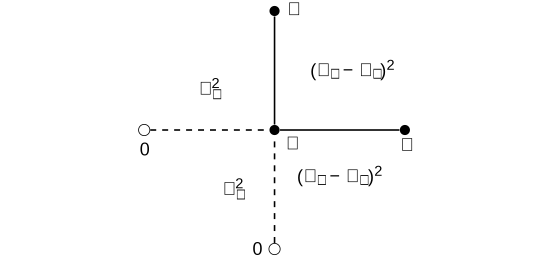
Solid bonds join retained sites; dashed bonds end at prescribed zero values. Each label gives its contribution to the quadratic form before the action's factor \(1/2\).
On the same \(N=5\) site set, periodic identification adds wrap couplings. The next picture shows the 25 sites, internal bonds, and one horizontal and one vertical wrap bond; the same wrap construction is repeated in every row and column. Each site then still has degree 4. In the killed form the two boundary penalties for a paired pair of edge sites are replaced by \((\phi _x-\phi _y)^2\); the diagonal is preserved and the term \(-2\phi _x\phi _y\) is added.
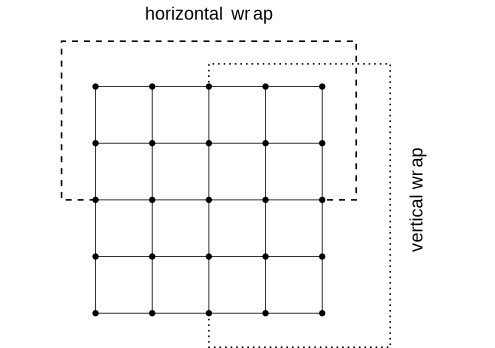
The crossing of the two exterior wrap paths is not a vertex; only the 25 filled dots carry field values.
For a one-site algebraic illustration the variance is \((4+m_0^2\epsilon ^2)^{-1}\), rather than \((m_0^2\epsilon ^2)^{-1}\). The periodic comparison uses \(N\ge 5\); no one-site or two-site periodic edge convention is substituted. These calculations unpack [guerra1975euclideanII, Theorem IV.9] for the stated form.
Discussion 4. A quartic weight at a changing mesh [fdip-00HW]AGENTDRAFTED
- November 9, 2026
Discussion 4. A quartic weight at a changing mesh [fdip-00HW]AGENTDRAFTED
- November 9, 2026
The onsite quartic multiplies a finite Gaussian law by a positive weight. The Gaussian variance at a lattice point changes as the mesh shrinks. Subtracting the corresponding quadratic term and retaining the constant term ties the quartic to that variance. Which reference covariance fixes these subtractions when the Gaussian itself has a boundary? The whole-space and boundary covariances are distinguished in [guerra1975euclideanII, (IV.9), (IV.36)-(IV.37)].
Definition 5. Whole-space Wick ordering and the half-Dirichlet state [fdip-00HX]AGENTDRAFTED
- November 9, 2026
Definition 5. Whole-space Wick ordering and the half-Dirichlet state [fdip-00HX]AGENTDRAFTED
- November 9, 2026
On \(H_\infty =\ell ^2(\epsilon \mathbb Z^2,\epsilon ^2;\mathbb R)\), let \(Q_{\epsilon ,\infty }=m_0^2\mathbb {I} -\nabla ^{2}_\epsilon \) be the positive operator represented by the whole-lattice incidence form. For the evaluation functional \(\delta _0:u\mapsto u(0)\), write \(\delta _0^\sharp \) for its Riesz vector. The whole-space Wick variance is \[c_\epsilon (m_0) =\delta _0\bigl (Q_{\epsilon ,\infty }^{-1}\delta _0^\sharp \bigr ).\] Translation covariance makes the same variance apply at every site.
For \(\phi \in H_{\ell ,N}\), multiplication by the real function \(\phi \) is a self-adjoint endomorphism \(M_\phi \) of the finite function algebra. Put \(p_c(u)=u^4-6cu^2+3c^2\). The whole-space Wick quartic is the function \[V_\epsilon (\phi )=\frac {\epsilon ^2}{24} \operatorname {tr} p_{c_\epsilon (m_0)}(M_\phi ).\] For \(\lambda >0\), the half-Dirichlet law and its state are \[\begin {aligned} Z_{\ell ,N}&=\int \mathrm {e}^{-\lambda V_\epsilon }\,\mathrm {d}\mu _{Q_{\epsilon ,D}},\\ \mathrm {d}\nu _{\ell ,N}&=Z_{\ell ,N}^{-1}\mathrm {e}^{-\lambda V_\epsilon } \mathrm {d}\mu _{Q_{\epsilon ,D}},\\ \omega _{\ell ,N}(F)&=\int F\,\mathrm {d}\nu _{\ell ,N}. \end {aligned}\] The last map is a complex algebraic state on bounded measurable observables, with complex conjugation as involution. Its polynomial extension and positivity of the normalizer follow in Proposition 7. It is a weighted Gaussian law with the square Dirichlet form as precision data.
These choices are exactly [guerra1975euclideanII, (IV.9), (IV.36)-(IV.37), pp. 193, 204-205]. The Wick variance comes from the whole lattice; the Gaussian measure comes from the killed form. The distinction is part of the law.
Remark 6. Three boundary prescriptions [fdip-00HY]AGENTDRAFTED
- November 9, 2026
Remark 6. Three boundary prescriptions [fdip-00HY]AGENTDRAFTED
- November 9, 2026
In the site basis of Example 3, the whole-space Wick variance is \[c_\epsilon (m_0)=\frac 1{(2\pi )^2} \int _{[-\pi ,\pi ]^2} \frac {\mathrm {d} k}{m_0^2\epsilon ^2+4\sin ^2(k_1/2)+4\sin ^2(k_2/2)}.\] This is the covariance of a site evaluation, including the \(\epsilon ^{-2}\) conversion from an operator to its kernel for weighted counting measure. The Fourier formula is [guerra1975euclideanII, (IV.6)-(IV.7), p. 193].
The half-Dirichlet law uses this constant with the Dirichlet Gaussian covariance \(C_{\epsilon ,D}\). Full Dirichlet ordering would instead use \(c_{\epsilon ,D}(x)=(C_{\epsilon ,D})_{xx}\) in each Wick polynomial. The two interactions differ by quadratic and constant terms depending on \(x\); they need not give the same finite law.
Restricting the whole-space free covariance to the retained sites gives a third Gaussian. For a finite exterior approximation, write its precision in the retained/exterior decomposition as \[\begin {pmatrix}A&B\\B^{\dagger }&D\end {pmatrix}.\] Its marginal precision is \(A-BD^{-1}B^{\dagger }\), by Theorem [fdip-000D] and the conditional Gaussian kernel; the killed precision is \(A\). The outward-exterior limit is the boundary correction of [guerra1975euclideanII, (IV.16), (IV.18)-(IV.21), Theorem IV.7, pp. 195-199].
Proposition 7. Finite-cutoff coercivity and exact normalizers [fdip-00HZ]AGENTDRAFTED
- November 9, 2026
Proposition 7. Finite-cutoff coercivity and exact normalizers [fdip-00HZ]AGENTDRAFTED
- November 9, 2026
For every \(m_0,\ell ,\lambda >0\) and odd \(N\ge 5\), the square Dirichlet form satisfies \(Q_{\epsilon ,D}\ge m_0^2\mathbb {I}\). The half-Dirichlet law has every absolute polynomial moment and every exponential moment of a real linear functional. Writing \(c=c_\epsilon (m_0)\) and \(n=N^2\), one has \[V_\epsilon \ge -\frac {\epsilon ^2nc^2}{4},\qquad 0<Z_{\ell ,N}\le \exp \left (\frac {\lambda \epsilon ^2nc^2}{4}\right ).\] The total action obeys, for a finite constant \(K_{\ell ,N}\), \[\tfrac 12\mathfrak q_{\epsilon ,D}(\phi ,\phi ) +\lambda V_\epsilon (\phi ) \ge \frac {\lambda }{48}\|\phi \|_{L^4(V_{\ell ,N},\epsilon ^2)}^4 -K_{\ell ,N}.\] For the canonical Euclidean volume, \[\begin {aligned} \int \mathrm {e}^{-\mathfrak q_{\epsilon ,D}(\phi ,\phi )/2}\,\mathrm {d}\operatorname {vol}_{h_\epsilon } &=(2\pi )^{n/2}\det (Q_{\epsilon ,D})^{-1/2},\\ \int \mathrm {e}^{-\mathfrak q_{\epsilon ,D}(\phi ,\phi )/2-\lambda V_\epsilon (\phi )} \,\mathrm {d}\operatorname {vol}_{h_\epsilon } &=(2\pi )^{n/2}\det (Q_{\epsilon ,D})^{-1/2}Z_{\ell ,N}. \end {aligned}\] No constant in the coercivity or weight bound is asserted uniform in the mesh.
Proof.
- November 9, 2026
Proof.
- November 9, 2026
The incidence term is nonnegative, proving the operator lower bound. Choose the site-indicator basis. Let \(E_{\mathrm {int}}\) contain internal bonds and \(E_\partial \) bonds with one exterior endpoint, each counted once. Then \[\mathfrak q_{\epsilon ,D}(\phi ,\phi ) =m_0^2\epsilon ^2\sum _x\phi _x^2 +\sum _{\{x,y\}\in E_{\mathrm {int}}}(\phi _x-\phi _y)^2 +\sum _{(x,y)\in E_\partial }\phi _x^2.\] Every retained site has 4 incident bonds including the exterior ones, giving the diagonal and neighbor entries in Example 3.
The scalar identity \[u^4-6cu^2+3c^2=(u^2-3c)^2-6c^2\] gives the stated lower bound on \(V_\epsilon \). Thus \(0<\mathrm {e}^{-\lambda V_\epsilon }\le \mathrm {e}^{\lambda \epsilon ^2nc^2/4}\), and Proposition [fdip-00GI] proves positive finite normalization and all polynomial moments. A real linear functional has every exponential moment under a finite-dimensional positive Gaussian. The same bounded weight estimate proves the assertion for the interacting law. Splitting the leading quartic into two equal parts absorbs all finite quadratic coefficients into one part and a constant, leaving the displayed quartic coercivity bound.
The Gaussian integral and multiplication by its normalized weight give both raw integrals by Proposition [fdip-00GI]. In the chosen site basis, \(\mathrm {d}\operatorname {vol}_{h_\epsilon }=\epsilon ^n\prod _x\mathrm {d}\phi _x\); counting-coordinate Lebesgue volume therefore multiplies both raw integrals by \(\epsilon ^{-n}\). The constant term of the Wick quartic contributes \[\exp \left (-\frac {\lambda \epsilon ^2nc^2}{8}\right )\] to \(Z_{\ell ,N}\). It cancels from normalized moments and remains in the unnormalized integral.
The Gaussian normalization and bounded-weight argument are the suppliers in Proposition [fdip-00GI]; the square-completion and coercivity estimates above apply them to the Wick interaction of [guerra1975euclideanII, (IV.9), (IV.36)].