Example. Dihedral symmetry refines the four-cycle sectors [fdip-004X]
AGENTDRAFTED
Take the cycle with \(n=4\), \(w=m=1\).
Let \(D_4=\langle r,s:r^4=s^2=1,\ srs=r^{-1}\rangle \), of
order 8, act on vertices by \(r(v)=v+1\), \(s(v)=-v\).
On the oriented edges \(e_v:v\to v+1\), rotation sends
\(e_v\) to \(e_{v+1}\) with positive sign, while reflection sends
\(e_v\) to \(e_{-v-1}\) with negative sign. The latter edge runs
from \(-v-1\) to \(-v\), the reverse of the transported endpoints.
The 4 rotations restore each edge; two reflections restore its label
and give positive sign. Reflecting, rotating, then reflecting sends
\(e_v\) to \(e_{v-1}\) with two negative signs, hence agrees with the
inverse rotation. The vertex maps obey the same relations, so these
maps define a signed endpoint action. This uses the dihedral
presentation in [serre1977linear, Section 5.3, p. 36];
the edge signs and precision calculation are explicit here.
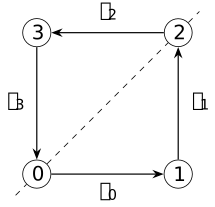
The dashed diagonal is the reflection axis: \(s\) fixes vertices
\(0,2\), exchanges \(1,3\), and sends \(e_0\) to \(e_3\) with reversed
orientation. All 4 weights and the mass are one.
An orthonormal basis, grouped by real irreducible type, is
\[\begin {aligned}
u&=(1,1,1,1)/2,&a&=(1,-1,1,-1)/2,\\
c&=(1,0,-1,0)/\sqrt 2,&b&=(0,1,0,-1)/\sqrt 2.
\end {aligned}\]
The line \(\mathbb Ru\) is trivial. On \(\mathbb Ra\), rotation
acts by \(-1\) and reflection by \(+1\); call this the alternating
line. On \(K=\operatorname {span}(c,b)\),
\[\rho (r)|_K=\begin {pmatrix}0&-1\\1&0\end {pmatrix},\qquad
\rho (s)|_K=\begin {pmatrix}1&0\\0&-1\end {pmatrix}.\]
There is no real rotation-invariant line, so \(K\) is irreducible.
A real matrix commuting with the rotation is \(xI+y\rho (r)\);
commuting also with the reflection forces \(y=0\). Thus its
commuting algebra is \(\mathbb R I\), the real-type case.
The two distinct lines and \(K\) are pairwise nonisomorphic, each
occurring once.
Direct substitution in the cycle precision gives
\[Qu=u,\qquad Qa=5a,\qquad Qc=3c,\qquad Qb=3b.\]
The three orthogonal projectors are \(uu^T\), \(aa^T\), and
\(cc^T+bb^T=I-uu^T-aa^T\); their ranges have dimensions \(1,1,2\)
and precision eigenvalues \(1,5,3\), respectively.
For the subgroup generated by \(r^2\), the positive sector is
\(\operatorname {span}(u,a)\) and the negative sector is \(K\).
The half-turn calculation therefore has two
\(2\times 2\) blocks, whereas the full dihedral action separates
its positive block into two lines. Changing the acting group changes
the isotypic decomposition without changing this precision.