Backgrounds and symmetry [fdip-0019]
✍️sourceAGENTDRAFTED
- October 20, 2026
Backgrounds and symmetry [fdip-0019]
✍️sourceAGENTDRAFTED
- October 20, 2026
Which changes preserve the model while transporting its equations, expectations and retained law? A symmetry preserves the specified data; it transports observables rather than fixing every observable function individually. Relabellings of a finite carrier are discrete permutations, although finite-dimensional field fibres can also admit continuous internal actions. Here endpoint transport, coherent edge reversals and preserved weights control incidence and operator transport; the half-turn of the alternating cycle gives a concrete action. With compatible perfect pairings and transport of the chosen retained split, the observable functionals and marginal transport as well. The duality, split-map and normalized-functional conventions are assumed.
A finite background records the supplied data. The Gaussian integral and marginal theorem identify transported functionals with normalized laws. Fixed labels, broken weights and nonstable partitions give different failures. The trace ratio distinguishes weighted cycles even under a broader comparison allowing positive scaling. These examples prepare enriched-background comparisons, where the permitted arrows must specify exactly what survives.
Definition 1. Signed arrows preserve endpoints before incidence [fdip-003B]AGENTDRAFTED
- October 29, 2026
Definition 1. Signed arrows preserve endpoints before incidence [fdip-003B]AGENTDRAFTED
- October 29, 2026
Reversing an oriented edge changes the sign of its difference, but does not erase its endpoints. Fix a commutative unital ring \(k\) and two finite incidence presentations \((V,E,s,h)\) and \((V',E',s',h')\). Equip them with weights \(w:E\to k\), \(w':E'\to k\), scalars \(\mu ,\mu '\in k\), and retained subsets \(R\subseteq V\), \(R'\subseteq V'\). Empty carriers, loops and distinct parallel edge labels are allowed.
Write \(C_2=\{+,-\}\) for the abstract group with \(-\cdot -=+\), and \(\sigma :C_2\to k^\times \) for \(\sigma (+)=1\), \(\sigma (-)=-1\). A signed endpoint arrow consists of bijections \(p:V\to V'\), \(q:E\to E'\) and signs \(\varepsilon :E\to C_2\) such that \[\begin {aligned} \varepsilon (e)=+&:\quad s'q(e)=ps(e),\quad h'q(e)=ph(e),\\ \varepsilon (e)=-&:\quad s'q(e)=ph(e),\quad h'q(e)=ps(e),\\ w'q&=w,\qquad \mu '=\mu ,\qquad pR=R'. \end {aligned}\] The signs are abstract orientation data, even when \(1=-1\) in \(k\). An arrow with all signs \(+\) is directed. For the real Gaussian backgrounds, directed arrows are their exact relabelings, with \(\mu =m^2\); positivity of mass then recovers \(m'=m\).
Composition applies the right arrow first. The composite with \((p',q',\varepsilon ')\) is \[\bigl (p'p,q'q,\ e\mapsto \varepsilon '(q(e))\varepsilon (e)\bigr ).\] Identity arrows have identity bijections and all signs \(+\). The inverse of \((p,q,\varepsilon )\) has bijections \(p^{-1},q^{-1}\) and the sign \(\varepsilon (e)\) at \(q(e)\). These operations make the declared objects and arrows a groupoid: composition is associative, identities exist, and every arrow is invertible, as for an action groupoid.
Proof.
- October 29, 2026
Proof.
- October 29, 2026
For two arrows, zero, one or two endpoint exchanges occur according as their signs are \((+,+)\), \((+,-)\) or \((-,+)\), and \((-,-)\). These give, respectively, the product signs \(+,-,+\). Thus composition has the required endpoints. Also \(w''q'q=w'q=w\) and \(p'pR=p'R'=R''\); the scalar stays fixed. The inverse applies the same sign twice, so restores endpoints and gives sign \(+\). For three arrows either parenthesization gives the sign \[\varepsilon ''(q'q(e))\varepsilon '(q(e))\varepsilon (e).\] Associativity in \(C_2\) and of the bijections proves associativity; the stated identities and inverses satisfy both unit and inverse laws.
Let \(M=k^V\), \(N=k^E\) and similarly \(M',N'\), with incidence maps \((df)(e)=f(h(e))-f(s(e))\). The induced ordinary linear maps are \[\begin {aligned} (Pf)(p(v))&=f(v),&P&:M\to M',\\ (Ja)(q(e))&=\sigma (\varepsilon (e))a(e),&J&:N\to N'. \end {aligned}\] They are isomorphisms: \(P^{-1}f'=f'\circ p\) and \((J^{-1}a')(e)=\sigma (\varepsilon (e))a'(q(e))\). Evaluation at \(q(e)\), in the two endpoint cases, gives \[d'P=Jd:M\longrightarrow N'.\] Both differences vanish on a loop; the endpoint condition still remembers where that loop is attached.
For a left action of a group \(\Gamma \), take actions \(p_g,q_g\) on the vertex and edge sets. A signed endpoint action additionally requires \[\varepsilon _1(e)=+,\qquad \varepsilon _{gk}(e)=\varepsilon _g(q_k(e))\varepsilon _k(e).\] Thus the arrow assigned to \(gk\) is the composite of those assigned to \(g\) and \(k\). The induced maps satisfy \(P_gP_k=P_{gk}\) and \(J_gJ_k=J_{gk}\). Indeed evaluation at \(p_{gk}(v)\) gives \(f(v)\) on both sides of the first equation; at \(q_{gk}(e)\) the second has coefficient \(\sigma (\varepsilon _g(q_k(e)))\sigma (\varepsilon _k(e))a(e)\). Identity signs and maps give the identity operators. These are linear representations on two distinct carriers; no faithfulness is assumed.
A weaker signed-incidence symmetry requires the same actions, abstract sign cocycle and weight preservation, but only the incidence equation \(dP_g=J_gd\), instead of the endpoint equations. It is an incidence intertwiner and suffices for operator transport. It need not be a graph automorphism; loops and characteristic two distinguish the requirements. The concrete half-turn satisfies the stronger endpoint conditions.
The left-action and equivariance conventions are [milne2025group, Definition 4.1, pp. 57-58]. [milne2025group, Example 7.1(b), p. 101] gives a permutation representation over a field; the ring and signed endpoint construction above is proved directly. The incidence convention in [spielman2009effective, Section 2.1, pp. 4-5] concerns a connected undirected positive-weight graph with a chosen orientation; the endpoint-difference definition here also allows loops, parallel labels and arbitrary coefficients.
Mathlib's Representation.ofMulAction sends the free
basis vector at \(v\) to that at \(g\cdot v\).
Finsupp.linearEquivFunOnFinite identifies its coefficients
with functions on a finite set, yielding inverse precomposition for a
group action. Representation.IntertwiningMap bundles an
intertwiner between already supplied representations. Neither supplies
the endpoint equations or abstract sign cocycle above.
Example 2. What zero incidence and scalar signs forget [fdip-003C]AGENTDRAFTED
- October 29, 2026
Example 2. What zero incidence and scalar signs forget [fdip-003C]AGENTDRAFTED
- October 29, 2026
The signed endpoint equations retain information that an incidence operator alone can lose. Take vertices \(\{0,1\}\) and one loop \(e\) attached at \(0\). Its incidence map is zero over every ring. Swapping the vertices, fixing \(e\) and choosing sign \(+\) therefore intertwines incidence and preserves any weight on \(e\). Nevertheless \(s(q(e))=0\ne 1=p(s(e))\); the same obstruction holds for sign \(-\), since both endpoints of the loop are \(0\). This is a signed-incidence symmetry, but not a signed endpoint arrow.
A separate loss concerns composition. Let \(C_3=\{1,g,g^2\}\) fix a single loop and its vertex. Assign abstract signs \(\varepsilon _1=+\), \(\varepsilon _g=\varepsilon _{g^2}=-\). Every endpoint and zero-incidence equation holds separately. But the action cocycle at \(g\cdot g=g^2\) would require \[\varepsilon _{g^2}=\varepsilon _g\varepsilon _g=+,\] contrary to the assigned \(-\). Thus these arrows do not define a \(C_3\)-action. Over a ring of characteristic two the scalar maps all become the identity because \(-1=1\); even their representation equations then conceal the failed abstract cocycle. Orientation data remain subject to the abstract \(C_2\) law.
By contrast, one edge \(e:0\to 1\) admits the vertex swap with fixed edge label and sign \(-\). Its endpoints reverse as required, and using this arrow twice gives sign \(+\) and identity bijections. For fields, \[(dPf)(e)=f(0)-f(1)=-(df)(e)=(Jdf)(e).\] It is a valid signed symmetry. Parallel labels are still distinct: an edge bijection may permute them, but never identifies two labels. Each sign must satisfy its own endpoint rule and the composition law.
These calculations use the endpoint-difference construction of Definition 1.
[spielman2009effective, Section 2.1, pp. 4-5] allows an arbitrary orientation of each edge. The calculations explain its extension in the signed endpoint construction.
[milne2025group, Definition 4.1, p. 57] gives the group-law requirement. Neither source is being asserted to contain these loop or characteristic-two examples.
Example 3. The half-turn on vertex and edge fields [fdip-000J]AGENTDRAFTED
- October 17, 2026
Example 3. The half-turn on vertex and edge fields [fdip-000J]AGENTDRAFTED
- October 17, 2026
The alternating four-cycle has a symmetry for every \(t>0\), including unequal weights. Let \(C_2=\{1,r\}\) with \(r^2=1\). Its left actions on the distinct vertex and edge sets \(V=\mathbb Z/4\mathbb Z\) and \(E=\{e_0,e_1,e_2,e_3\}\) are \[r\cdot i=i+2,\qquad r\cdot e_i=e_{i+2}.\] Indices are modulo \(4\). These permutations square to the identity, preserve the endpoints \(e_i:i\to i+1\), and preserve the weights \((1,t,1,t)\). Milne's [milne2025group, Definition 4.1, p. 57] gives the left-action convention; his [milne2025group, Example 7.1(b), p. 101] constructs the associated permutation representation.
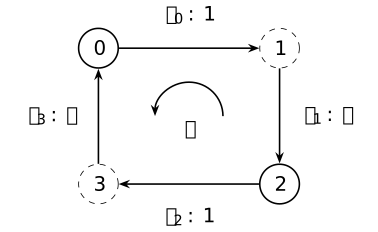
The half-turn exchanges \(0,2\) and \(1,3\), and exchanges \(e_0,e_2\) and \(e_1,e_3\). Directed arrows and their weights agree after rotation. Solid vertices form the retained set \(\{0,2\}\); the dashed vertices form its complement. Each set is preserved.
The induced maps on real fields use inverse precomposition: \[\begin {aligned} P:\mathbb R^V&\to \mathbb R^V,&(P\phi )_i&=\phi _{i-2},\\ U:\mathbb R^E&\to \mathbb R^E,&(Ua)(e_i)&=a(e_{i-2}). \end {aligned}\] Both maps have the coordinate array \[\begin {pmatrix} 0&0&1&0\\0&0&0&1\\1&0&0&0\\0&1&0&0 \end {pmatrix},\] but their domains differ. They satisfy \(P^2=I\) and \(U^2=I\). Sending \(1\) to the identity and \(r\) to these maps gives two real linear representations of \(C_2\).
Write \(\delta _i(j)=\mathbf 1_{j=i}\) for the vertex coordinate basis and \(\eta _i(e_j)=\mathbf 1_{j=i}\) for the edge coordinate basis. Then \(P\delta _0=\delta _2\ne \delta _0\) and \(U\eta _0=\eta _2\ne \eta _0\). Since \(r\) is the only nonidentity element of \(C_2\), both representations are faithful. Finite coordinate reindexing preserves the counting pairings; weight preservation gives \[\begin {aligned} P^TP&=I,\qquad U^TU=I,\\ U^TWU&=W, \end {aligned}\] where \(W=\operatorname {diag}(1,t,1,t)\). The last identity also preserves the weighted edge pairing.
The two representations interact through the incidence matrix. With its edge-by-vertex convention from [spielman2009effective, Section 2.1, p. 4], \[\begin {aligned} (BP\phi )(e_i)&=\phi _{i+1-2}-\phi _{i-2}\\ &=(UB\phi )(e_i). \end {aligned}\] Thus \(BP=UB\): the incidence map is equivariant between the vertex and edge actions.
The same formulas define linear representations over any nonzero commutative unital ring, with any period-two weights in that ring. The delta witnesses still prove faithfulness because \(1\ne 0\). Over the zero ring the two field modules have one element, so this faithfulness assertion is excluded. The positive real weights above are the specialization used for Gaussian laws.
This is the all-positive case of a signed endpoint action. The general endpoint composition, abstract orientation cocycle and weaker signed-incidence symmetry have that defining address. The loop and reversal examples explain why endpoint and sign coherence cannot be inferred from the incidence intertwiner alone.
Mathlib's Representation.ofMulAction sends a coordinate
basis vector at \(v\) to the one at \(g\cdot v\). Its finitely supported
coefficient module is identified with all functions on a finite set by
Finsupp.linearEquivFunOnFinite, giving the inverse-precomposition
convention above. Representation.IntertwiningMap bundles
a linear map with the equation \(B P_g=U_gB\). These interfaces do not
provide the particular incidence identity or the coherent signed-edge
action without their proofs.
Theorem 4. Pairing isometries transport incidence operators [fdip-003D]AGENTDRAFTED
- October 29, 2026
Theorem 4. Pairing isometries transport incidence operators [fdip-003D]AGENTDRAFTED
- October 29, 2026
Let \(k\) be a commutative unital ring. Give \(M,N,M',N'\) chosen perfect symmetric pairings, and let \(d:M\to N\), \(d':M'\to N'\) be ordinary linear maps. Suppose the linear isomorphisms \(P:M\to M'\), \(J:N\to N'\) preserve these pairings and satisfy \(d'P=Jd\). Let \(W:N\to N\), \(W':N'\to N'\) be self-adjoint maps with \(W'J=JW\). For a fixed \(\mu \in k\), put \[L=d^\dagger Wd,\qquad Q=L+\mu I_M,\] and define \(L',Q'\) by the primed data. Then \[\begin {aligned} (d')^\dagger &=Pd^\dagger J^{-1}:N'\to M',\\ L'&=PLP^{-1},\qquad Q'=PQP^{-1}. \end {aligned}\] If \(Q\) is an isomorphism, so is \(Q'\), and its inverse response satisfies \[G'=(Q')^{-1}=PQ^{-1}P^{-1}=PGP^{-1}.\] Consequently \(Qf=j\) implies \(Q'(Pf)=Pj\).
Proof.
- October 29, 2026
Proof.
- October 29, 2026
For \(z'\in M'\), pairing preservation gives \(b_{M'}(Px,z')=b_M(x,P^{-1}z')\). The uniqueness of the adjoint therefore gives \(P^\dagger =P^{-1}\), and similarly \(J^\dagger =J^{-1}\). From \(d'=JdP^{-1}\), the adjoint product law gives \((d')^\dagger =Pd^\dagger J^{-1}\). Thus \[\begin {aligned} L'&=Pd^\dagger J^{-1}W'JdP^{-1}\\ &=Pd^\dagger WdP^{-1}=PLP^{-1}. \end {aligned}\] Here \(J^{-1}W'J:N\to N\) equals \(W\); every composition is typed. The same scalar \(\mu \) gives the assertion for \(Q\). Multiplication in either order proves that \(PQ^{-1}P^{-1}\) is the inverse of \(Q'\). Finally \(Q'Pf=PQf=Pj\).
For signed endpoint arrows, the finite function modules have perfect counting duality, including empty carriers. Reindexing gives \[\begin {aligned} b_{M'}(Pf,Pg)&=\sum _{v\in V}f(v)g(v),\\ b_{N'}(Ja,Jb)&=\sum _{e\in E}\sigma (\varepsilon (e))^2a(e)b(e) =b_N(a,b). \end {aligned}\] Multiplication by transported weights obeys \(W'J=JW\), by evaluation at \(q(e)\). Thus the theorem applies without inverting any weight. It also applies to the weaker signed-incidence symmetries. The weighted edge pairing is \(b_W(a,b)=b_N(a,Wb)\); its adjoint of \(d\) into the counting vertex pairing is \(d^\dagger W\), whereas \(d^\dagger \) uses the counting edge pairing. The expression \(d^\dagger Wd\) does not require \(b_W\) to be perfect.
The inverse hypothesis cannot be replaced by a unit mass scalar. Over \(\mathbb Z\), a unit-weight edge on two vertices with \(\mu =1\) has \(Q=\begin {pmatrix}2&-1\\-1&2\end {pmatrix}\). Solving \(Q(x,y)=(1,0)\) would require \(x=2y\) and \(3y=1\), which is impossible in \(\mathbb Z\). This \(Q\) is not even surjective.
For automorphisms the conjugacies are commutation identities. They concern symmetric bilinear pairings over fixed coefficients. A grading is preserved only if \(P\) preserves its graded pieces; a star is preserved only if \(P\) commutes with that star. A nontrivial coefficient involution and Hermitian adjoint need their own conventions.
The proof uses the chosen duality construction in Proposition [fdip-001P],
with the Hom convention of
[stacks2017stacks, Section 10.10], Tag 0581.
For real graph incidence, the energy convention is
[spielman2009effective, Section 2.1, pp. 4-5]; the displayed
ring transport is a direct deduction, not a positivity theorem.
Mathlib's Matrix.reindexLinearEquiv and
Matrix.reindexRingEquiv support its coordinate reindexing
specialization, without supplying the endpoint or pairing hypotheses.
Proposition 5. Transport of the retained Schur map [fdip-003E]AGENTDRAFTED
- October 29, 2026
Proposition 5. Transport of the retained Schur map [fdip-003E]AGENTDRAFTED
- October 29, 2026
Over a commutative unital ring \(k\), give \(M=X\oplus Y\) and \(M'=X'\oplus Y'\) chosen splittings. Suppose isomorphisms \(P:M\to M'\), \(P_X:X\to X'\), \(P_Y:Y\to Y'\) preserve the inclusions and projections: \[\begin {aligned} P\iota _X&=\iota '_XP_X,&P\iota _Y&=\iota '_YP_Y,\\ \pi '_XP&=P_X\pi _X,&\pi '_YP&=P_Y\pi _Y. \end {aligned}\] Let \(Q'=PQP^{-1}\). Write its 4 split components and those of \(Q\) as \(A:X\to X\), \(B:Y\to X\), \(E:X\to Y\), \(C:Y\to Y\), and their primed versions. Then \[\begin {aligned} A'&=P_XAP_X^{-1},&B'&=P_XBP_Y^{-1},\\ E'&=P_YEP_X^{-1},&C'&=P_YCP_Y^{-1}. \end {aligned}\] If \(C\) is invertible, the split Schur maps obey \[S'=P_XSP_X^{-1},\qquad S=A-BC^{-1}E.\] For \(K=C^{-1}E:X\to Y\), \(K'=(C')^{-1}E'\), \[K'P_X=P_YK,\qquad -K'(P_Xx)=P_Y(-Kx).\] Thus the eliminated-equation field \(y_*(x)=-Kx\), the unique solution of the lower equation with zero source, is transported with its sign intact.
Proof.
- October 29, 2026
Proof.
- October 29, 2026
For indices \(i,j\in \{X,Y\}\), the inclusion and projection identities give \[\pi '_iQ'\iota '_j =P_i(\pi _iQ\iota _j)P_j^{-1}.\] Taking \((i,j)=(X,X),(X,Y),(Y,X),(Y,Y)\) gives all 4 typed identities. Inverting the last one gives \((C')^{-1}=P_YC^{-1}P_Y^{-1}\). Substitution cancels each adjacent \(P_Y^{-1}P_Y\) in \(B'(C')^{-1}E'\), proving the Schur formula. The same substitution in \(K'\) proves \(K'P_X=P_YK\) and hence the transport identity for this field.
When \(Q\) is also invertible, the inverse-compression theorem says \[S^{-1}=\pi _XQ^{-1}\iota _X.\] Conjugating and using the split maps gives \[(S')^{-1}=P_XS^{-1}P_X^{-1} =\pi '_X(Q')^{-1}\iota '_X.\] This uses an actual inverse. No pairing has been assumed; only for an orthogonal split and self-adjoint \(Q\) does one further have \(E=B^\dagger \), by Proposition [fdip-001X]. For an orthogonal split of finite-dimensional real inner-product spaces and a positive self-adjoint \(Q\), this field is also stationary for the quadratic action in the eliminated variable, by the real square-completion argument.
For a vertex bijection \(p:V\to V'\), let \(R'=pR\), \(X=k^R\), \(X'=k^{R'}\), and let \(P_R\) be inverse precomposition by \(p|_R\). At \(p(v)\), \(v\in R\), both sides of \[\pi _{R'}P=P_R\pi _R\] take the value \(f(v)\). The target space is \(k^{pR}\), even if the labels of \(R\) and \(pR\) differ. This equation supplies the moving projection square in Gaussian marginal transport.
If a group action preserves \(R\), its restrictions compose on \(k^R\) and the square becomes \(\pi _RP_g=P_{g,R}\pi _R\). Faithfulness of the full action need not survive restriction: a permutation moving only eliminated vertices acts trivially on retained fields. The opposite-pair half-turn has a separate nontrivial retained action.
Stable subsets and equivariance follow the convention of [milne2025group, p. 58]. The real Schur convention is [boyd2004convex, Appendix A.5.5, pp. 650-651], with the source's first pivot exchanged to the eliminated \(C\) block. The typed transport proof above uses only the chosen splitting, and does not by itself supply any integral or Gaussian normalizer.
Proposition 6. Transport of polynomial observables and functionals [fdip-003F]AGENTDRAFTED
- October 29, 2026
Proposition 6. Transport of polynomial observables and functionals [fdip-003F]AGENTDRAFTED
- October 29, 2026
Let \(k\) be a commutative unital ring. For a \(k\)-module \(M\), write \(\mathcal P_k(M)\) for the unital \(k\)-subalgebra of functions \(M\to k\) generated by ordinary linear functionals. This extends the intrinsic real polynomial functions using the same pointwise operations. These are actual functions: over finite fields, distinct formal polynomials can have identical evaluations.
For a linear isomorphism \(P:M\to M'\), pullback gives a unital algebra isomorphism \[P^*:\mathcal P_k(M')\longrightarrow \mathcal P_k(M),\qquad P^*F'=F'\circ P.\] An already supplied normalized functional \(\omega \) on \(\mathcal P_k(M)\) transports to \(\omega '=\omega \circ P^*\). For the moving split square, the retained functionals \(\omega _X=\omega \circ \pi ^*\) and \(\omega '_{X'}=\omega '\circ (\pi ')^*\) satisfy \[\omega '_{X'}=\omega _X\circ P_X^*.\] Here \(\pi :M\to X\), \(\pi ':M'\to X'\) are the specified projections, and \(\pi 'P=P_X\pi \).
Proof.
- October 29, 2026
Proof.
- October 29, 2026
Precomposition preserves sums, scalar multiples, products and the constant function \(1\), by evaluation. A linear functional on \(M'\) composed with \(P\) is linear on \(M\), so pullback preserves the generated polynomial algebras. Its inverse is \((P^{-1})^*\). For composable maps, \((P'P)^*F''=F''\circ P'\circ P=P^*((P')^*F'')\); identity pullback is identity. This proves contravariance as well.
Linearity of \(\omega '\) and \(\omega '(1)=\omega (1)=1\) follow directly, or by algebra-map pullback. The section \(\iota _X\) of \(\pi \) makes \(\pi ^*\) injective: \(f\circ \pi =g\circ \pi \) implies \(f=g\) after composition with \(\iota _X\). Thus \(\omega _X\) is restriction to the image of \(\pi ^*\), identified with \(\mathcal P_k(X)\). Finally, for each \(f'\in \mathcal P_k(X')\) and \(x\in M\), \[\begin {aligned} P^*(\pi ')^*f'(x) &=f'(\pi 'Px)\\ &=f'(P_X\pi x)=(\pi ^*P_X^*f')(x). \end {aligned}\] Applying \(\omega \) gives the asserted retained-functional equality.
Over \(\mathbb R\) with the identity involution, or over \(\mathbb C\) with pointwise conjugation, suppose the chosen observable algebras are closed under that involution. Pullback then commutes with star. If \(\omega \) is an algebraic state, \[\begin {aligned} \omega '(F'^*F') &=\omega \bigl ((P^*F')^*(P^*F')\bigr )\geq 0, \end {aligned}\] and the star compatibility of the functional is preserved too. Holomorphic polynomial functions on a complex vector space are not automatically closed under conjugation; closure is an extra hypothesis. One can instead generate an algebra by both linear functionals and their conjugates; precomposition preserves those generators as well. No positivity over an arbitrary ring or existence of a measure is asserted. For the real Gaussian, absolute moments first give its polynomial state; the transported law then identifies this algebraic transport with expectation. Integrable functions as a whole are not an algebra, and restriction here is neither conditional expectation nor partial trace.
The algebra and state conventions are [stacks2017stacks, Section 22.2], Tag 09JF and [waldmann2004states, Definitions 3.7 and 3.9, p. 11]. The composition and split-square calculations are direct extensions of Proposition [fdip-002A] and Proposition [fdip-0027]; their linear-dual and star-algebra interfaces do not supply a Gaussian measure.
Definition 7. Finite Gaussian backgrounds and relabelings [fdip-000G]AGENTDRAFTED
- October 17, 2026
Definition 7. Finite Gaussian backgrounds and relabelings [fdip-000G]AGENTDRAFTED
- October 17, 2026
To compare two discrete Gaussian models, specify which data a change of labels must carry. A finite Gaussian background consists of a finite incidence presentation \((V,E,s,h)\), positive weights \(w:E\to \mathbb R_{>0}\), a mass \(m>0\), and a nonempty proper retained subset \(R\subsetneq V\). Put \(U=V\setminus R\); both retained and eliminated carriers are nonempty. The specified reference structures are the counting inner products on vertex and edge fields, the weighted edge inner product, and the induced Borel Euclidean volume \(\lambda _V\) on \(\mathbb R^V\). The orthogonal coordinate split identifies it with the product of the retained and eliminated volumes.
Let \(d:\mathbb R^V\to \mathbb R^E\) be incidence, \((df)(e)=f(h(e))-f(s(e))\), and let \(W\) multiply edge fields by \(w\). The derived operators are \[L=d^\dagger Wd,\qquad Q=L+m^2I>0,\] where \(d^\dagger \) is the counting adjoint. In counting bases, \(d\) has array \(D\) and \(L=D^TWD\). The action \(\mathcal A_Q(f)=b_V(f,Qf)/2\), finite positive normalizer \(Z_Q\), Gaussian law \(\mu _Q\), and retained marginal \(\mu _S\) are derived data. For the 4 split components, \(S=A-BC^{-1}E\); the real orthogonal specialization has \(E=B^\dagger \); the block \(B:Y\to X\) is distinct from incidence.
An exact relabeling to a primed background consists of bijections \(p:V\to V'\), \(q:E\to E'\) satisfying \[\begin {aligned} s'q&=ps,&h'q&=ph,\\ w'q&=w,&m'&=m,\qquad pR=R'. \end {aligned}\] It is the all-positive specialization of a signed endpoint arrow. It preserves the attachment of a loop even when its incidence is zero. The induced maps are \[(Pf)(p(v))=f(v),\qquad (Ja)(q(e))=a(e).\] They preserve both counting pairings, the weighted edge pairing, and by isometry of reference volume the reference volume. Allowing coherent endpoint reversals gives the larger signed relation; it does not change what an exact directed relabeling means.
Evaluation at \(q(e)\) gives \((d'Pf)(q(e))=f(h(e))-f(s(e))=(Jdf)(q(e))\). Weight preservation gives \(W'J=JW\). Thus paired transport yields \[L'=PLP^{-1},\qquad Q'=PQP^{-1}.\] Counting isometry gives \(P^{-1}=P^T\), \(J^{-1}=J^T\) in the coordinate bases, recovering \(D'=JDP^T\) and \(W'=JWJ^T\). The normalized-law theorem carries the laws and moving marginals. Identity, inverse and composition are the directed cases of the proved signed-arrow laws, so existence of an exact relabeling is an equivalence relation on backgrounds.
Two broader comparisons retain less data. The positive-scaling Laplacian relation forgets mass, state and partition, and compares nonzero Laplacians by \(L'=cPLP^{-1}\) with \(c>0\) and a vertex permutation. Its cycle trace ratio still separates two examples. An arbitrary invertible real field map \(y=T\phi \) instead changes precision to \(T^{-T}QT^{-1}\) and the counting pairing to \(y^TT^{-T}T^{-1}z\). Its reference Jacobian is \(dy=|\det T|\,d\phi \). Such a map can transport the normalized law by Jacobian compensation, while losing the reference pairing or retained projection. It is not thereby an enriched background arrow.
The covariance-parameter Gaussian density in
[friedli2017statistical, Proposition B.55, p. 505] agrees with
these conventions after the inverse-precision theorem
identifies \(\Sigma =Q^{-1}\). Its change-of-variables argument does
not specify the endpoint, mass or retained-subset data.
Mathlib's Matrix.reindexLinearEquiv and
Matrix.reindexRingEquiv support the coordinate reindexing
identities. The extra background requirements are those stated here.
Theorem 8. Relabeling transports the state and its marginal [fdip-000H]AGENTDRAFTED
- October 17, 2026
Theorem 8. Relabeling transports the state and its marginal [fdip-000H]AGENTDRAFTED
- October 17, 2026
Let \(M,M'\) be finite-dimensional real positive inner-product spaces with their induced Borel Euclidean volumes \(\lambda ,\lambda '\). Let \(Q:M\to M\) be positive and self-adjoint, and let \(P:M\to M'\) be a linear isometry equivalence. Put \(Q'=PQP^{-1}\). Then \(Q'\) is positive and self-adjoint, and the Gaussian laws satisfy \[Z_{Q'}=Z_Q,\qquad P_*\mu _Q=\mu _{Q'}.\] Borel pushforward means \((P_*\mu )(A)=\mu (P^{-1}(A))\) for every Borel set \(A\), extending the finite convention. For every real or complex Borel function \(F'\), \[\begin {aligned} \int |F'|\,d\mu _{Q'}&=\int |F'\circ P|\,d\mu _Q,\\ F'\in L^1(\mu _{Q'})&\Longleftrightarrow F'\circ P\in L^1(\mu _Q). \end {aligned}\] The first identity allows infinity. Under the equivalent finite absolute-integral conditions, \[\omega _{Q'}(F')=\omega _Q(F'\circ P).\] In particular, the target observable transported from \(F\) is \(F'=F\circ P^{-1}\). Exact and signed arrows of real backgrounds supply such isometries.
Proof.
- October 17, 2026
Proof.
- October 17, 2026
The adjoint identity gives \(P^\dagger =P^{-1}\), so \(Q'\) is self-adjoint. For \(z'=Px\ne 0\), \(b_{M'}(z',Q'z')=b_M(x,Qx)>0\); this also proves equality of Gaussian actions at \(Px\) and \(x\). The isometry-volume theorem gives \(P_*\lambda =\lambda '\). Consequently, for every nonnegative Borel \(h'\), \[\begin {aligned} &\int h'(z')e^{-\mathcal A_{Q'}(z')}\,d\lambda '(z')\\ &\qquad =\int h'(Px)e^{-\mathcal A_Q(x)}\,d\lambda (x). \end {aligned}\] Take \(h'=1\); the positive Gaussian integral gives finite nonzero normalizers, and this equality proves \(Z_{Q'}=Z_Q\). Then take \(h'=\mathbf 1_A/Z_Q\) to obtain \(\mu _{Q'}(A)=\mu _Q(P^{-1}(A))\) for every Borel \(A\).
Taking \(h'=|F'|/Z_Q\) gives the extended absolute-integral identity and hence the integrability equivalence. If finite, positive and negative parts give the expectation identity; real and imaginary parts give the complex version. Every real polynomial function is integrable by absolute Gaussian moments. On that algebra the expectation identity agrees with the previously proved functional transport. No algebra structure on all of \(L^1\) is required.
For linear functionals \(\ell ',r'\in (M')^\vee \), finite second moments and the pushforward give the intrinsic covariance identity \[\operatorname {Cov}_{Q'}(\ell ',r') =\operatorname {Cov}_{Q}(\ell '\circ P,r'\circ P).\] The inverse-precision covariance theorem says that, relative to the specified pairings, \(\operatorname {Cov}_Q(b_M(u,-),b_M(v,-))=b_M(u,Q^{-1}v)\). Since \(b_{M'}(u',Px)=b_M(P^{-1}u',x)\), this yields \[G'=PGP^{-1},\qquad G=Q^{-1}.\] In orthonormal coordinates this is \(G'=PGP^T\); an arbitrary linear coordinate map gives covariance congruence instead, as in Proposition 17. Equality of second moments was not used to infer the pushforward law.
Now let \(M=X\oplus Y\) and \(M'=X'\oplus Y'\) be orthogonal splittings that \(P\) carries by isometries \(P_X,P_Y\), so the split-square hypotheses hold. For the 4 components, \[\begin {aligned} A'&=P_XAP_X^{-1},&B'&=P_XBP_Y^{-1},\\ E'&=P_YEP_X^{-1},&C'&=P_YCP_Y^{-1}. \end {aligned}\] Here \(E=B^\dagger \), and \(C>0\). The retained precisions and eliminated Gaussian factors satisfy \[\begin {aligned} S'&=P_XSP_X^{-1},& S&=A-BC^{-1}E>0,\\ c_{C'}&=c_C,&c_C&=\frac {(2\pi )^{\dim Y/2}}{\sqrt {\det C}},\\ Z_{S'}&=Z_S,&(P_X)_*\mu _S&=\mu _{S'}. \end {aligned}\] Thus the complete fiber scalar and the additive effective-action constant \(-\log c_C\) are preserved, along with the normalized law.
Proof.
- October 17, 2026
Proof.
- October 17, 2026
The 4 blocks and Schur conjugacy are Proposition 5. A basis of \(Y\) and its image under \(P_Y\) give the same array for \(C\) and \(C'\), hence equal determinants; the dimensions are also equal. This proves \(c_{C'}=c_C\). The first part of the theorem applied on \(X\) proves \(Z_{S'}=Z_S\). The exact integration formula, for the induced product volumes, is \[\int _Y e^{-\mathcal A_Q(x,y)}\,d\lambda _Y(y) =c_Ce^{-b_X(x,Sx)/2}.\] The event marginal theorem proves \(\pi _*\mu _Q=\mu _S\) and \(\pi '_*\mu _{Q'}=\mu _{S'}\). Pushforwards compose by inverse images of Borel sets. Using \(\pi 'P=P_X\pi \), one obtains \[\begin {aligned} (P_X)_*\mu _S &=(P_X\pi )_*\mu _Q\\ &=(\pi 'P)_*\mu _Q=\pi '_*\mu _{Q'}=\mu _{S'}. \end {aligned}\] This proves moving marginal transport from actual measures, rather than from Schur or covariance identities alone. The same marginal supplier gives the extended absolute-integral identity for retained observables and the polynomial-state restriction.
For vertex bijections \(p:V\to V'\), take a nonempty proper \(R\subsetneq V\), set \(R'=pR\), and use the coordinate splits. The map \(P_R:\mathbb R^R\to \mathbb R^{R'}\) has the genuine moving target \(\mathbb R^{pR}\). At \(p(v)\), \(v\in R\), both \(\pi _{R'}Pf\) and \(P_R\pi _Rf\) have value \(f(v)\). Thus:
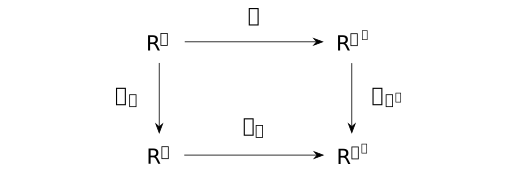
The lower map exists because the retained subset is transported. Keeping the target labels fixed can select an inequivalent marginal; the adjacent-versus-opposite example gives both the precision calculation and a failure of projection factorization.
These conclusions use positive precisions and the stated product volumes. Fixing an eliminated field, taking a conditional-density kernel, and taking a marginal are different operations. A singular full-fiber integral is not repaired by a pseudoinverse: changing the integration space changes the measure. The massless projected cycle law has its proved density on the specified retained image, and is not obtained by inserting a mean-zero constraint into the unconstrained marginal formula.
[friedli2017statistical, Proposition B.55, p. 505] gives the Gaussian change-of-variables convention.
[tao2011measure, Theorem 1.7.15, pp. 200-202] gives the nonnegative integration convention on the Borel product measures; absolute integrability precedes signed subtraction.
[boyd2004convex, Appendix A.5.5, pp. 650-651] gives the real block convention, with its first pivot exchanged to \(C\).
Mathlib's LinearIsometryEquiv.measurePreserving
supplies volume preservation for finite-dimensional real linear
isometry equivalences. TauCeti's
TauCeti.Probability.map_affine_multivariateGaussian
supplies covariance-parameter transport. Set mean and shift to zero,
linear map to \(P\), and covariance to \(Q^{-1}\); the
precision-density identification and the proved inverse
identity align it with this law. These interfaces do not supply the
endpoint data, declared partition or its counterexample.
Theorem 9. Symmetry survives the Gaussian marginal [fdip-000K]AGENTDRAFTED
- October 17, 2026
Theorem 9. Symmetry survives the Gaussian marginal [fdip-000K]AGENTDRAFTED
- October 17, 2026
Let a group \(\Gamma \) act by a signed-incidence symmetry on a finite incidence presentation with positive real weights and nonempty vertex set. Use the counting pairings, their induced Borel volume and a scalar mass \(m>0\). The positive massive precision and inverse-precision covariance are \[L=d^\dagger Wd,\qquad Q=L+m^2I,\qquad G=Q^{-1}.\] For every \(g\in \Gamma \), \[\begin {aligned} LP_g&=P_gL,&QP_g&=P_gQ,\\ GP_g&=P_gG,&P_gGP_g^\dagger &=G. \end {aligned}\] Thus \(Qf=j\) implies \(Q(P_gf)=P_gj\). The Gaussian law is invariant: \((P_g)_*\mu _Q=\mu _Q\). For every real or complex Borel observable \(F\), \[\begin {aligned} \int |F\circ P_g|\,d\mu _Q&=\int |F|\,d\mu _Q,\\ \omega _Q(F\circ P_g)&=\omega _Q(F) \end {aligned}\] with extended integrals in the first equality, and finite absolute integral required in the second.
Proof.
- October 17, 2026
Proof.
- October 17, 2026
The signed action gives counting isometries and \(dP_g=J_gd\), \(WJ_g=J_gW\). The paired transport theorem gives the stated commutations; \(P_g^\dagger =P_g^{-1}\) gives the covariance congruence. The unique sourced solution is \(f=Gj\). At zero source this is zero, although the action on the entire field carrier need not be trivial.
The scalar Euclidean action \(\mathcal A_Q(f)=b(f,Qf)/2\) satisfies \(\mathcal A_Q(P_gf)=\mathcal A_Q(f)\) by pairing isometry and commutation. This scalar function differs from the group action \(g\mapsto P_g\). The Gaussian transport theorem, with \(Q'=Q\), proves event-law invariance and the extended absolute integral before the expectation assertion. Its proof applies to the weaker incidence intertwiners and therefore to signed endpoint actions; no directed-endpoint claim is inferred from the weaker hypotheses.
Suppose further that a nonempty proper retained subset \(R\subsetneq V\) is stable under every \(p_g\). Its complement \(D=V\setminus R\) is also stable. The restricted maps \(P_{g,R},P_{g,D}\) give the orthogonal split correspondence. For the split components \(A,B,E,C\), with \(E=B^\dagger \), and \(S=A-BC^{-1}E>0\), one has \[\begin {aligned} P_{g,R}SP_{g,R}^{-1}&=S,\\ P_{g,R}S^{-1}P_{g,R}^{-1}&=S^{-1},\\ (P_{g,R})_*\mu _S&=\mu _S. \end {aligned}\] The retained equation \(Sx=k\) is equivariant as well. The full fiber factor \(c_C=(2\pi )^{|D|/2}/\sqrt {\det C}\) and the stationary eliminated field are compatible with the action: \[y_*(P_{g,R}x)=P_{g,D}y_*(x),\qquad y_*(x)=-C^{-1}Ex.\]
Proof.
- October 17, 2026
Proof.
- October 17, 2026
The four-block transport identities give Schur conjugacy, its inverse conjugacy, and stationary-field transport. Its actual projection identity is \(\pi _RP_g=P_{g,R}\pi _R\). By the normalized marginal theorem and full-law invariance, \[\begin {aligned} (P_{g,R})_*\mu _S &=(P_{g,R}\pi _R)_*\mu _Q\\ &=(\pi _RP_g)_*\mu _Q=\pi _{R*}\mu _Q=\mu _S. \end {aligned}\] The real transport theorem also proves invariance of \(\det C\), \(c_C\), the additive action constant and \(Z_S\). For every integrable retained observable \(f\), \[\begin {aligned} \omega _S(f\circ P_{g,R})&=\omega _S(f),\\ \omega _Q(f\circ \pi _R)&=\omega _S(f). \end {aligned}\] The marginal theorem supplies the absolute-integral equivalence needed here. On actual polynomial functions this is the retained functional square. Gaussian integration proves the law; algebraic Schur conjugacy by itself does not.
For the half-turn, retain \(R=(0,2)\) and eliminate \(D=(1,3)\). Both restrictions are the nonidentity swap \(J=\begin {pmatrix}0&1\\1&0\end {pmatrix}\). Here \(H\) is the array of the split component \(B\). The projection square is
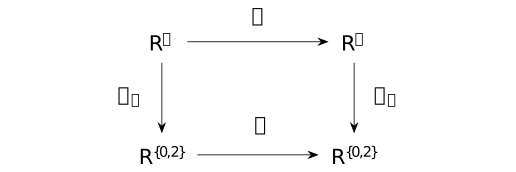
The lower map swaps the two retained coordinates. Put \(a=m^2\) and \(s=1+t+a\). The explicit elimination gives \[\begin {aligned} A=C&=sI_2,\qquad H=-\begin {pmatrix}1&t\\t&1\end {pmatrix},\\ S&=\begin {pmatrix}\alpha &-\beta \\-\beta &\alpha \end {pmatrix},\\ \alpha &=s-\frac {1+t^2}{s},\qquad \beta =\frac {2t}{s}. \end {aligned}\] All three blocks commute with \(J\), hence \(JSJ=S\). Positivity follows also from the two eigenvalues \[\begin {aligned} \alpha -\beta &=\frac {a(a+2+2t)}s>0,\\ \alpha +\beta &=\frac {(a+2)(a+2t)}s>0. \end {aligned}\] Thus the same nontrivial action preserves the full and retained laws. The full covariance obeys \(G_{i+2,j+2}=G_{ij}\). Invariant state does not mean that each observable is pointwise invariant: \(\phi \mapsto \phi _0^2\) is sent to \(\phi \mapsto \phi _2^2\); they differ at \(\delta _0\), but their expectations agree.
At \(t=m=1\), direct inversion gives \[\begin {aligned} S&=\begin {pmatrix}7/3&-2/3\\-2/3&7/3\end {pmatrix},\\ S^{-1}&=\begin {pmatrix}7/15&2/15\\2/15&7/15\end {pmatrix}. \end {aligned}\] Both swapped squared coordinates have expectation \(7/15\). The observable \(\phi _0\phi _2\) is itself invariant under the half-turn and has expectation \(2/15\). These expectations agree before and after elimination.
The full and retained half-turns are both faithful: their nonidentity maps send \(\delta _0\) to \(\delta _2\). A general full faithful action can restrict trivially, for instance when it moves only eliminated vertices. These two assertions are compatible.
Three concrete obstructions distinguish the hypotheses: keeping fixed target labels after relabeling, breaking the alternating weights, and choosing a nonstable retained subset. The last is a failure of descent through that projection and does not exclude accidental symmetry of a marginal density. Extra mass fields or reference pairings would require their own preservation hypotheses.
[milne2025group, Definition 4.1 and p. 58] gives the group-action and stable-subset conventions.
[friedli2017statistical, Proposition B.55, p. 505] gives the Gaussian substitution convention. The incidence, stationary and half-turn computations above use the proved transport results and the exact cycle elimination.
Mathlib's LinearIsometryEquiv.measurePreserving
supplies isometry-volume preservation. TauCeti's
TauCeti.Probability.map_affine_multivariateGaussian
supports covariance-parameter pushforward for the supplied \(P_g\)
or retained projection after the precision-density bridge.
These declarations do not assert the endpoint, weight or stable-subset
hypotheses, or the concrete failures just cited.
Example 10. Fixed labels can select a different marginal [fdip-003J]AGENTDRAFTED
- October 29, 2026
Example 10. Fixed labels can select a different marginal [fdip-003J]AGENTDRAFTED
- October 29, 2026
A global relabeling need not preserve a marginal requested on fixed labels. In the four-cycle, take \(t=m=1\) and retain \(R=\{0,2\}\). Its effective precision is \[S_{\mathrm {opp}}= \begin {pmatrix}7/3&-2/3\\-2/3&7/3\end {pmatrix}.\] Exchange labels \(1,2\), fixing \(0,3\), and form \(Q'=PQP^T\). If the new retained labels are still \(\{0,2\}\), they select the original adjacent variables \(\{0,1\}\). In the old coordinate order \((0,1)\mid (2,3)\), the relevant blocks are \[\begin {aligned} A=C&=\begin {pmatrix}3&-1\\-1&3\end {pmatrix},\\ H&=\begin {pmatrix}0&-1\\-1&0\end {pmatrix},\\ C^{-1}=HC^{-1}H^T &=\frac 18\begin {pmatrix}3&1\\1&3\end {pmatrix}. \end {aligned}\] Subtraction gives \[S_{\mathrm {adj}}= \begin {pmatrix}21/8&-9/8\\-9/8&21/8\end {pmatrix}.\] The diagonal entries \(7/3\) and \(21/8\) differ, so no two-coordinate permutation conjugates these precisions. There is also no map on the old retained fields factoring \(\pi _RP\) through \(\pi _R\): the fields \(0\) and \(\delta _1\) have the same old projection, but their projections after \(P\) are \(0\) and \((0,1)\). Here \(\delta _1\) is the delta field at vertex \(1\), not the edge label \(e_1\). Transporting the retained subset to \(p(R)=\{0,1\}\) in the new labels restores the square and the marginal transport theorem.
The blocks are a direct calculation from the alternating-cycle precision, using the Schur convention of [boyd2004convex, Appendix A.5.5, pp. 650-651] after exchanging its first pivot to \(C\). The example separates a fixed set of labels from the moving retained space required by Proposition 5.
Example 11. Breaking the weights breaks the half-turn [fdip-003K]AGENTDRAFTED
- October 29, 2026
Example 11. Breaking the weights breaks the half-turn [fdip-003K]AGENTDRAFTED
- October 29, 2026
In the alternating four-cycle, take \(t,m>0\) and the half-turn. It fails to preserve the action after a specific positive change of weights. Replace \((1,t,1,t)\) by \((1,t,2,t)\) while keeping the proposed half-turn. Then \(L_{00}=1+t\) and \(L_{22}=2+t\), so \(PLP^T\ne L\) and \(\mathcal A(\delta _2)-\mathcal A(\delta _0)=1/2\). If its Gaussian law were invariant, second moments would give \(PGP^T=G\); inversion would give \(PQP^T=Q\), contradicting those diagonal entries. At \(t=m=1\), retain the opposite pair \(R=(0,2)\) and eliminate \(D=(1,3)\). The blocks in that order are \[\begin {aligned} A=C&=\operatorname {diag}(3,4),\\ H&=-\begin {pmatrix}1&1\\1&2\end {pmatrix},\\ S_{\mathrm {broken}} &=\begin {pmatrix}29/12&-5/6\\-5/6&8/3\end {pmatrix}. \end {aligned}\] Indeed \[HC^{-1}H^T=\begin {pmatrix}7/12&5/6\\5/6&4/3\end {pmatrix},\] and subtracting from \(A\) gives the displayed precision. Its diagonal entries differ by \(1/4\), so its marginal also fails swap invariance. Its positive Gaussian still exists.
[spielman2009effective, Section 2.1, pp. 4-5] gives the edge-once convention.
[boyd2004convex, Appendix A.5.5, pp. 650-651] gives the positive Gaussian elimination convention. The action difference and matrix products are direct calculations with these conventions. Weight preservation is sufficient in the general transport theorem; it need not be necessary for every presentation with redundant loops or parallel edges. This example establishes failure for the stated weights, not a universal necessity.
Example 12. A nonstable retained set need not inherit the action [fdip-003L]AGENTDRAFTED
- October 29, 2026
Example 12. A nonstable retained set need not inherit the action [fdip-003L]AGENTDRAFTED
- October 29, 2026
In the alternating four-cycle with weights \((1,t,1,t)\) and \(t,m>0\), consider the half-turn and the adjacent retained subset \(R=\{0,1\}\). The half-turn preserves the full state, but sends \(R\) to \(D=\{2,3\}\). No map \(T\) of retained fields can satisfy \(\pi _RP=T\pi _R\): the zero field forces \(T(0)=0\), while \(\delta _2\) has retained projection zero and projects to \((1,0)\) after the half-turn. The action transports the marginal to a different subset; it does not descend through this fixed projection. This does not exclude accidental symmetries of an individual two-site density. A general restricted action may also be trivial, unlike the opposite-pair swap. Extra mass fields or reference pairings would require their own preservation hypotheses.
The stable-subset requirement is the equivariance convention of [milne2025group, p. 58]. The two-field witness proves failure of factorization even through a nonlinear function. It differs from the fixed-label relabeling failure: here the full half-turn symmetry is unchanged, and the chosen projection fails to admit its action. The moving square of Proposition 5 remains valid on \(\mathbb R^{pR}\). Over any nonzero commutative unital coefficient ring \(k\), the same delta-field witness works on \(k^V\); over the zero ring all fields coincide.
Definition 13. Intrinsic trace on a finite free module [fdip-003G]AGENTDRAFTED
- October 29, 2026
Definition 13. Intrinsic trace on a finite free module [fdip-003G]AGENTDRAFTED
- October 29, 2026
A trace can be defined before choosing a pairing or displaying a matrix. Let \(k\) be a commutative unital ring and \(M\) a finite free \(k\)-module. A finite dual frame is a finite family \(m_i\in M\), \(\ell _i\in M^\vee \) such that \[x=\sum _i\ell _i(x)m_i\qquad (x\in M).\] A basis and its coefficient functionals supply such a frame; the counting carrier \(k^V\) uses its delta dual frame. For an endomorphism \(T:M\to M\), define its intrinsic trace by \[\operatorname {tr}_M(T)=\sum _i\ell _i(Tm_i).\] This scalar is independent of the frame. It is linear in \(T\), and for maps between finite free modules \(f:M\to N\), \(g:N\to M\), \[\operatorname {tr}_M(gf)=\operatorname {tr}_N(fg).\] In particular, for an isomorphism \(P:M\to M'\), \[\operatorname {tr}_{M'}(PTP^{-1})=\operatorname {tr}_M(T).\]
Proof.
- October 29, 2026
Proof.
- October 29, 2026
Let \(n_j,\psi _j\) be another dual frame of \(M\). Expanding \(m_i\) in this frame and commuting the scalars in \(k\) gives \[\begin {aligned} \sum _i\ell _i(Tm_i) &=\sum _{i,j}\psi _j(m_i)\ell _i(Tn_j)\\ &=\sum _j\psi _j(Tn_j). \end {aligned}\] For the last equality, evaluate \(\sum _i\psi _j(m_i)\ell _i(x)=\psi _j(\sum _i\ell _i(x)m_i)=\psi _j(x)\) at \(x=Tn_j\). This proves frame independence without a pairing. Termwise addition and scalar multiplication give \(\operatorname {tr}(T+U)=\operatorname {tr}(T)+\operatorname {tr}(U)\) and \(\operatorname {tr}(cT)=c\operatorname {tr}(T)\).
Take dual frames \(m_i,\ell _i\) for \(M\) and \(n_j,\psi _j\) for \(N\). Expanding \(fm_i\) and \(gn_j\) gives \[\begin {aligned} \operatorname {tr}_M(gf) &=\sum _{i,j}\psi _j(fm_i)\ell _i(gn_j)\\ &=\operatorname {tr}_N(fg). \end {aligned}\] This is rectangular cyclicity; the two traces may be on different modules. The transported family \(Pm_i,\ell _iP^{-1}\) is a dual frame of \(M'\). Substitution into the defining sum proves the conjugacy formula.
With a basis, \(\ell _i(Tm_i)\) is the \(i\)-th diagonal coefficient, so coordinate trace is recovered as \(\sum _iT_{ii}\). For the zero module the empty frame gives trace zero; the same formulas also make sense over the zero ring. The declared category here is finite free modules. No totalized trace on arbitrary modules and no finite-projective extension are needed.
The duality/evaluation convention is [stacks2017stacks, More on Algebra, Lemma 74.1], Tag 0FNJ. [stacks2017stacks, Exercises, Exercise 22.6], Tag 02DU asks for trace, naturality and cyclicity on finite locally free modules; the finite-free proof above is supplied here, rather than attributed to a proof in that exercise.
Mathlib's LinearMap.trace has a totalized definition.
On the finite-free commutative-ring domain, its
LinearMap.trace_comp_comm' is rectangular cyclicity and
LinearMap.trace_conj' is conjugacy by a linear equivalence.
The definition above uses only this finite-free domain.
Matrix.trace_mul_comm expresses the coordinate rectangular
identity; a trace pairing is not an assumption of either construction.
Proposition 14. The trace ratio on its unit-denominator domain [fdip-003H]AGENTDRAFTED
- October 29, 2026
Proposition 14. The trace ratio on its unit-denominator domain [fdip-003H]AGENTDRAFTED
- October 29, 2026
Let \(L:M\to M\) be an endomorphism of a finite free module over a commutative unital ring \(k\). On the domain \(\operatorname {tr}_M(L)\in k^\times \), define the trace ratio \[R(L)=\operatorname {tr}_M(L^2)\bigl (\operatorname {tr}_M(L)\bigr )^{-2},\] using intrinsic trace. If \(P:M\to M'\) is an isomorphism, \(c\in k^\times \), and \(L'=cPLP^{-1}\), then \(\operatorname {tr}_{M'}(L')\) is a unit and \(R(L')=R(L)\).
Proof.
- October 29, 2026
Proof.
- October 29, 2026
Put \(a=\operatorname {tr}_M(L)\). Linearity, conjugacy and \((L')^2=c^2PL^2P^{-1}\) give \[\begin {aligned} \operatorname {tr}_{M'}(L')&=ca,\\ \operatorname {tr}_{M'}((L')^2)&=c^2\operatorname {tr}_M(L^2). \end {aligned}\] Both \(c\) and \(a\) are units, so \(ca\) is a unit with inverse \(a^{-1}c^{-1}\). Substitution cancels \(c^2\) from the ratio.
Consider a finite-dimensional positive inner-product space over \(\mathbb R\). A nonzero self-adjoint positive-semidefinite operator on it has positive trace. Indeed an orthonormal eigenbasis gives eigenvalues \(\lambda _i\geq 0\); if all were zero the operator would be zero. Hence \(\operatorname {tr}L=\sum _i\lambda _i>0\). This verifies the denominator for a nonzero positive-weight graph Laplacian.
[boyd2004convex, Appendix A.5.2, pp. 646-647] gives the spectral and trace formulas. The exceptional examples show why nonzero alone is insufficient over other rings or without positivity.
For nonzero real positive-semidefinite Laplacians with their counting pairings, write \(L\approx L'\) when \(L'=cPLP^{-1}\) for a positive scalar and a vertex permutation. Identity uses \((1,I)\); inverse uses \((c^{-1},P^{-1})\); composition uses the products of the scalars and permutations. This is an equivalence relation with invariant \(R\). It forgets the mass, normalized state and retained partition of an enriched background. It also differs from arbitrary congruence of bilinear-form arrays: the ratio compares the associated endomorphisms. It is an invariant, not a classification assertion.
The ring calculation is a direct consequence of Definition 13,
whose trace convention is
[stacks2017stacks, Exercise 22.6], Tag 02DU.
Mathlib's Matrix.trace_smul supplies the coordinate scalar
identity; the unit domain and cancellation above are additional
hypotheses and deductions. The cycle comparison computes
the invariant and the associated normalized observables explicitly.
Example 15. Nonzero operators outside the trace-ratio domain [fdip-003I]AGENTDRAFTED
- October 29, 2026
Example 15. Nonzero operators outside the trace-ratio domain [fdip-003I]AGENTDRAFTED
- October 29, 2026
The unit condition in the trace ratio distinguishes several elementary cases. For one unit-weight edge on two vertices, the Laplacian over \(\mathbb Z\) is \[L=\begin {pmatrix}1&-1\\-1&1\end {pmatrix}.\] Its trace is \(2\), which is not a unit in \(\mathbb Z\); the defining formula therefore does not give a \(\mathbb Z\)-valued ratio. After inverting \(2\) it does: \(L^2=2L\) gives ratio \(1\). Reduction over \(\mathbb F_2\) instead gives the nonzero matrix \[\overline L=\begin {pmatrix}1&1\\1&1\end {pmatrix},\] whose trace is zero and whose square is zero. Nonzero incidence energy as an algebraic operator does not imply a unit trace.
Over \(\mathbb R\), the nonzero self-adjoint matrix \(\operatorname {diag}(1,-1)\) has trace zero. It is not positive semidefinite, so it does not contradict the positive-trace proof. For an incidence presentation containing only loops, \(d=0\) and \(L=d^\dagger Wd=0\); the trace is zero whatever the loop weights. The empty carrier likewise has zero trace by the empty dual-frame sum. In each case the ratio is undefined over a nonzero ring.
In the zero ring, \(0=1\) is its sole unit, and every unital module and scalar has one element. The formula for the ratio then has the unique value \(0\). This algebraic convention makes no assertion about a nonzero positive-real Laplacian.
[spielman2009effective, Section 2.1, pp. 4-5] gives the edge-once incidence convention used here, as extended algebraically in Definition 1. These computations also use the directly proved dual-frame trace.
[boyd2004convex, Appendix A.5.2, pp. 646-647] gives the spectral criterion for the real positivity boundary. The ring reductions and zero-ring conclusion are the explicit calculations here, not probability statements from those sources.
Example 16. A trace ratio separates two weighted cycles [fdip-000I]AGENTDRAFTED
- October 17, 2026
Example 16. A trace ratio separates two weighted cycles [fdip-000I]AGENTDRAFTED
- October 17, 2026
The alternating cycles at \(t=1\) and \(t=2\) remain different even under the positive-scaling Laplacian comparison \(L'=cPLP^{-1}\), with \(c>0\) and \(P\) a vertex permutation. Use the trace ratio \[R(L)=\frac {\operatorname {tr}(L^2)}{(\operatorname {tr}L)^2},\] where the trace is the intrinsic endomorphism trace. The positive graph energy gives a nonzero positive-semidefinite \(L_t\) for \(t>0\), so its trace is positive and the ratio is defined. The cited proposition proves invariance by trace conjugacy and scalar cancellation. It compares counting-relative operators, not bilinear-form arrays under arbitrary congruence.
[boyd2004convex, Appendix A.5.2, pp. 646-647] gives the symmetric spectral and trace formulas. The spectral cycle calculation supplies the concrete basis; the following traces and comparisons are direct computations.
For the alternating four-cycle, \(t>0\), the orthonormal spectral basis gives eigenvalues \(0,2,2t,2+2t\), including at \(t=1\). Consequently \[\begin {aligned} \operatorname {tr}L_t&=4(1+t),\\ \operatorname {tr}(L_t^2) &=4+4t^2+4(1+t)^2\\ &=8(t^2+t+1),\\ R(t):=R(L_t)&=\frac {t^2+t+1}{2(t+1)^2}. \end {aligned}\] In particular \[\begin {aligned} R(1)&=\frac 38,\qquad R(2)=\frac 7{18},\\ R(2)-R(1)&=\frac 1{72}>0. \end {aligned}\] There can be no \(c>0\) and vertex permutation \(P\) with \(L_2=cPL_1P^T\). Thus the associated finite Gaussian backgrounds cannot be exactly relabeled into each other either. This calculation separates the stated pair; it does not claim a classification of all backgrounds.
The reciprocal identity \(R(t)=R(1/t)\) is consistent with this comparison. A one-step rotation \(p(i)=i+1\pmod 4\) exchanges the alternating edge weights \(1,t\) and leaves the common diagonal \(1+t\) unchanged. Its coordinate permutation therefore satisfies \[PL_tP^T=tL_{1/t}.\] Since \(1/t>0\), the reciprocal Laplacians are equivalent under \(\approx \). Their equal ratios do not demonstrate a failure of completeness. On the strict enriched slice with weights \((1,t,1,t)\), fixed mass and fixed opposite retained pair, the weight product is \(t^2\), whereas at parameter \(1/t\) it is \(t^{-2}\). A weight-preserving edge bijection would preserve this product; for positive \(t\) equality forces \(t=1\). Thus the broader reciprocal comparison is not a strict background isomorphism for \(t\ne 1\).
A fixed-mass calculation shows what changes in the induced state. Set \(m=1\) and retain the same labeled vertices \(R=\{0,2\}\). The alternate-vertex elimination has \(s=t+2\), giving \[\begin {aligned} \alpha (t)&=s-\frac {1+t^2}{s}=\frac {4t+3}{t+2},\\ \beta (t)&=\frac {2t}{t+2},\\ S_t&=\begin {pmatrix}\alpha (t)&-\beta (t)\\ -\beta (t)&\alpha (t)\end {pmatrix}. \end {aligned}\] Hence the effective coupling changes from \(\beta (1)=2/3\) to \(\beta (2)=1\), and the two precisions are \[\begin {aligned} S_1&=\begin {pmatrix}7/3&-2/3\\-2/3&7/3\end {pmatrix},\\ S_2&=\begin {pmatrix}11/4&-1\\-1&11/4\end {pmatrix}. \end {aligned}\] Their determinants are \(5\) and \(105/16\). The off-diagonal entry of \(S_t^{-1}\) is \(\beta (t)/\det S_t\). By the marginal expectation identity, the same labeled observable therefore has different normalized expectations: \[\begin {aligned} \langle \phi _0\phi _2\rangle _{t=1,m=1}&=\frac {2}{15},\\ \langle \phi _0\phi _2\rangle _{t=2,m=1}&=\frac {16}{105}. \end {aligned}\] This comparison fixes the mass, coordinates, reference pairing and partition. The labeled observable is not itself asserted invariant under every relabeling; the trace ratio already established the broader inequivalence.
Scale invariance of \(R\) does not mean equality of fixed-mass states. On an eigenvector of \(L\) with eigenvalue \(\lambda >0\), replacing \(L\) by \(cL\) changes the covariance eigenvalue from \(1/(\lambda +m^2)\) to \(1/(c\lambda +m^2)\) when \(c\ne 1\). Scaling all of \(Q\) instead gives covariance \(c^{-1}G\) and Schur map \(cS\), by inversion and the Schur formula. Changing mass can also leave \(R(L)\) unchanged while changing the law. The exact finite differences above do not construct a physical map from an environment to the parameter \(t\).
The trace identities and their formalization correspondence are at Definition 13 and Proposition 14. Their unit-domain hypotheses specialize here to positive real trace; the values and normalized expectation comparisons above are additional cycle calculations.
Proposition 17. Jacobian compensation in normalized Gaussian transport [fdip-003M]AGENTDRAFTED
- October 29, 2026
Proposition 17. Jacobian compensation in normalized Gaussian transport [fdip-003M]AGENTDRAFTED
- October 29, 2026
Let \(M,M'\) be finite-dimensional real positive inner-product spaces with induced Borel Euclidean volumes \(\lambda ,\lambda '\). Let \(Q,Q'\) be positive self-adjoint precisions, and suppose a linear isomorphism \(T:M\to M'\) preserves their actions: \[\mathcal A_{Q'}(Tx)=\mathcal A_Q(x).\] It need not preserve the reference pairings. For its absolute Jacobian \(J(T)>0\), one has \[\begin {aligned} T_*\lambda &=J(T)^{-1}\lambda ',\\ Z_{Q'}&=J(T)Z_Q,\qquad T_*\mu _Q=\mu _{Q'}. \end {aligned}\] For every real or complex Borel observable \(F'\), \[\int |F'|\,d\mu _{Q'}=\int |F'\circ T|\,d\mu _Q\] as extended nonnegative integrals. Hence integrability is equivalent on the two sides, and, under that condition, \(\omega _{Q'}(F')=\omega _Q(F'\circ T)\).
Proof.
- October 29, 2026
Proof.
- October 29, 2026
The reference-volume change formula gives the pushforward of volume, equivalently \(\int h'\,d\lambda '=J(T)\int h'\circ T\,d\lambda \) for every nonnegative Borel \(h'\). Apply it to the Gaussian weight; action preservation gives \(Z_{Q'}=J(T)Z_Q\). Both normalizers are finite and positive by Theorem [fdip-002T]. For a nonnegative Borel \(h'\), divide the same substitution by this equality: \[\begin {aligned} \int h'\,d\mu _{Q'} &=\frac {J(T)}{Z_{Q'}}\int h'(Tx)e^{-\mathcal A_Q(x)}\,d\lambda (x)\\ &=\int h'\circ T\,d\mu _Q. \end {aligned}\] Indicators of Borel sets prove the event-pushforward statement. Taking \(h'=|F'|\) proves the extended absolute-integral equality. Only when finite do positive/negative parts, and for complex functions real/imaginary parts, give the stated expectation identity.
In orthonormal coordinates, action preservation means \(T^TQ'T=Q\), so inversion gives \[(Q')^{-1}=TQ^{-1}T^T.\] This is covariance congruence, not generally operator similarity. The scalar Jacobian is computed in the specified reference volumes; independently ordered orthonormal frames may change the signed determinant but not its absolute value. The quadratic-isometry example shows that this normalized transport can lose both counting-pairing and retained-projection compatibility. Such maps are not enriched background arrows.
The volume convention is
[tao2011measure, Exercises 1.2.20-22, p. 41]; the covariance-parameter
Gaussian substitution is
[friedli2017statistical, Proposition B.55, p. 505].
The inverse-precision covariance theorem identifies its
covariance with \(Q^{-1}\) for these reference pairings.
TauCeti's
TauCeti.Probability.map_affine_multivariateGaussian
supports the covariance congruence for a supplied finite real linear
map, even rectangular. That broader covariance result does not assert
invertibility, endpoint preservation or the retained square used here.