The relativistic scalar field [fdip-00IF]
✍️sourceAGENTDRAFTED
- November 9, 2026
The relativistic scalar field [fdip-00IF]
✍️sourceAGENTDRAFTED
- November 9, 2026
The state now has controlled moments, a positive reflected form and mixing. These are properties of Euclidean random distributions. What Hilbert-space field do they determine, and what distinguishes that field from a Gaussian or generalized free theory?
Discussion 1. From reflected observables to relativistic fields [fdip-00IG]AGENTDRAFTED
- November 9, 2026
Discussion 1. From reflected observables to relativistic fields [fdip-00IG]AGENTDRAFTED
- November 9, 2026
The reflection-positive pairing turns positive-time observables into a Hilbert space after its null vectors are removed. For the continuum state, Proposition [fdip-00I8] also controls the dependence on time and Proposition [fdip-00IE] removes persistent correlations at large separation. How do these facts give local quantum field operators and a positive-energy action of spacetime symmetries? The applicable reconstruction theorem is [frohlich1974verification, Theorem 2.6, pp. 290-291].
Theorem 2. An interacting positive-energy scalar Wightman field [fdip-00IH]AGENTDRAFTED
- November 9, 2026
Theorem 2. An interacting positive-energy scalar Wightman field [fdip-00IH]AGENTDRAFTED
- November 9, 2026
For \(m_0>0\) and \(0<\lambda /m_0^2<\eta \), with \(\eta >0\) as in Proposition [fdip-00IC], the sequential state of Proposition [fdip-00I6] reconstructs a neutral scalar Wightman field in \(1+1\) dimensions. It consists of a positive-inner-product complex Hilbert space \(\mathcal H\), a unit cyclic vacuum \(\Omega \), a strongly continuous unitary representation \(U\) of the proper orthochronous Poincaré group, and an operator-valued tempered distribution \(\varphi \) on the common invariant dense domain \[\mathcal D=\operatorname {span}\{ \varphi (f_1)\cdots \varphi (f_n)\Omega : n\ge 0,\ f_j\in \mathcal S(\mathbb R^{1,1};\mathbb C)\}.\] Its smeared operators are linear in tests, satisfy \(\varphi (f)^{\dagger }\supset \varphi (\overline f)\) on \(\mathcal D\), transform as a scalar under \(U\), and obey \[[\varphi (f),\varphi (g)]\big |_{\mathcal D}=0\] whenever the supports are spacelike separated. The self-adjoint translation generators \((H,P)\) have joint spectrum in \[\{(E,p):E\ge |p|\}.\] The invariant vacuum space is \(\mathbb C\Omega \). The Euclidean Schwinger forms are exactly the ultraviolet-then-volume moment limits in Proposition [fdip-00I6]. The Euclidean law is non-Gaussian and the physical field is not generalized free.
Proof.
- November 9, 2026
Proof.
- November 9, 2026
The functional satisfies every actual Axiom A-C by Proposition [fdip-00I8], with the canonical covariance and entire moment estimates of Proposition [fdip-00I6]. Thus [frohlich1974verification, Theorem 2.6, pp. 290-291] applies. It is an abstract theorem about such a functional; its hypotheses do not require the Gaussian displays in Section 3 of that paper.
The theorem supplies the Wightman theory and identifies its Hilbert space, time-zero field and energy-momentum operators with the functional reconstruction. Poincaré covariance, the forward-cone spectral condition and locality are part of its Wightman conclusion. The possible vacuum-uniqueness exception is removed by the mixing of Proposition [fdip-00IE] and Proposition D of the same source. The non-Gaussian and non-generalized-free conclusions follow from Proposition 3, whose proof uses the identified state and mixing rather than these conclusions.
Proposition 3. Non-Gaussianity and non-generalized-freeness [fdip-00II]AGENTDRAFTED
- November 9, 2026
Proposition 3. Non-Gaussianity and non-generalized-freeness [fdip-00II]AGENTDRAFTED
- November 9, 2026
In the coupling domain of Proposition [fdip-00IC], the state \(\omega \) of Proposition [fdip-00I6] is not Gaussian. For some even \(r\ge 4\), its multilinear connected correlation \[(f_1,\ldots ,f_r)\longmapsto \kappa _\omega (\Phi (f_1),\ldots ,\Phi (f_r))\] is nonzero. The reconstructed Wightman field is not a generalized free field, indeed not a Wick polynomial of a generalized free field. In particular, its vacuum correlations are not all given by Wick pairings of a two-point distribution.
Proof.
- November 9, 2026
Proof.
- November 9, 2026
The hypothesis of [frohlich1974verification, Corollary 4.4(1), pp. 308-309] is \(\deg P>3\) together with existence of the infinite-volume interacting positive Borel cylinder measure. The corollary explicitly names its reference [6], Section 4.1, as such a construction; that reference is [frohlich1974schwingerI]. Here \(P(u)=\lambda u^4/24\), and Proposition [fdip-00I6] identifies our square limit with precisely that canonical half-Dirichlet state. The proof on p. 308 obtains its quadratic exponential-integrability input from Sections 2.2, 3.4, 3.5 and 4.1 of the HPA paper, specifically Estimate I, Corollary 3.14(b) and the limit. Thus the application uses the named canonical construction, without changing the Gaussian convention.
The corollary makes this measure mutually singular to the law of every defined Wick polynomial \(Q\) of an invariant ergodic Gaussian field. Part (1) does not impose the quasi-invariance class used in part (2), nor the separate cluster-expansion class. If our law were Gaussian, Euclidean invariance from Proposition [fdip-00I6] and mixing, hence ergodicity, from Proposition [fdip-00IE] would make it an admissible Gaussian comparison law itself. Taking \(Q(u)=u\) would make a probability measure mutually singular with itself, a contradiction.
Every finite-dimensional characteristic functional is entire by Proposition [fdip-00I6]. If all cumulant forms above order two vanished, the logarithm near the origin on each finite test span would be quadratic. The identity theorem would then make each entire characteristic function Gaussian, hence make the cylinder law Gaussian. This contradicts the preceding conclusion. Odd cumulants vanish under \(\phi \mapsto -\phi \), so some even cumulant of order at least 4 is nonzero. This argument does not single out order 4.
Finally, the remark on [frohlich1974verification, p. 310] identifies the associated physical Wightman field as non-generalized-free, and more generally not a Wick polynomial of a generalized free field. Its applicable Euclidean construction and reconstruction are exactly those already identified above.
Example 4. The finite-chain kinetic normalization [fdip-00IJ]AGENTDRAFTED
- November 9, 2026
Example 4. The finite-chain kinetic normalization [fdip-00IJ]AGENTDRAFTED
- November 9, 2026
Compare the finite spacetime action with the interacting slice transfer. Let spatial spacing be \(a\), time spacing \(b\), and choose site coordinates \(q_j=\sqrt a\,\phi _j\). The temporal kinetic term is \[\frac a{2b}\sum _j(\phi _{j,k+1}-\phi _{j,k})^2 =\frac 1{2b}\|q_{k+1}-q_k\|^2.\] At a single time slice the spatial and mass terms become \[b\left [\frac 1{2a^2}\sum _j(q_{j+1}-q_j)^2 +\frac {m_0^2}{2}\sum _jq_j^2\right ],\] and the Wick quartic becomes \[b\sum _j\left [\frac {\lambda q_j^4}{24a} -\frac {\lambda c q_j^2}{4}+\frac {\lambda a c^2}{8}\right ].\] These are direct substitutions in the finite action of Proposition [fdip-00HZ]. Boundary bonds contribute their zero-exterior terms exactly as there. A Dirichlet time boundary gives endpoint Gaussian kernels; the periodic thermal trace has different time-boundary data.
The factor \(1/(2b)\) agrees with the heat normalization in [simon1999feynman, (1.2)] and the transfer in the slice construction. The isotropic GRS limit takes \(a=b=\epsilon \to 0\) at fixed spacetime square. The algebraic matching above does not establish a time-first limit at fixed \(a\), a periodic-trace limit, or a simultaneous mesh/volume limit.
Remark 5. Sequential limits and the relativistic conclusion [fdip-00IK]AGENTDRAFTED
- November 9, 2026
Remark 5. Sequential limits and the relativistic conclusion [fdip-00IK]AGENTDRAFTED
- November 9, 2026
The construction has two successive limits. The finite periodic law supplies an upper bound for two-point forms; it is not identified with the limiting half-Dirichlet law. The diagram distinguishes that comparison from the limits and reconstruction.
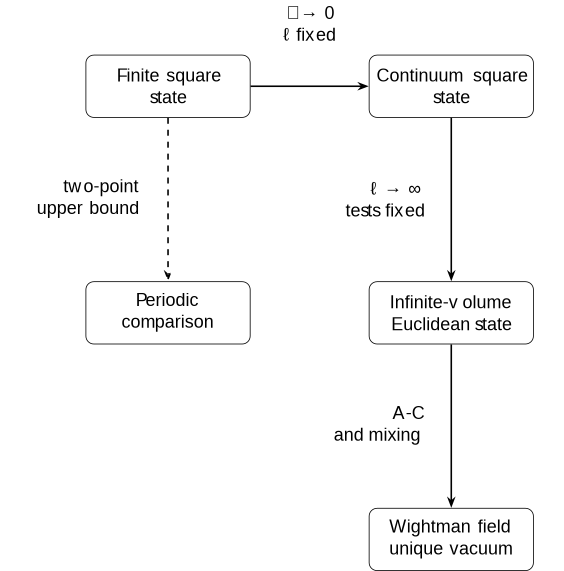
The first arrow is Lemma [fdip-00I4], the second Proposition [fdip-00I6], and the dashed comparison is Proposition [fdip-00IC]. The last arrow uses all the constructive regularity in Proposition [fdip-00I8], mixing in Proposition [fdip-00IE] and [frohlich1974verification, Theorem 2.6].
The finite-chain real-time evolution is unitary on its finite-spatial-volume Hilbert space. The stronger Lorentz-covariant unitarity in Theorem 2 comes from the continuum Poincaré representation and its forward-cone spectrum. The present conclusions give qualitative clustering and a unique vacuum. They supply no exponential clustering rate, interacting spectral mass gap, scattering theory or S-matrix. The positive \(m_0\) is the bare mass of the reference covariance.