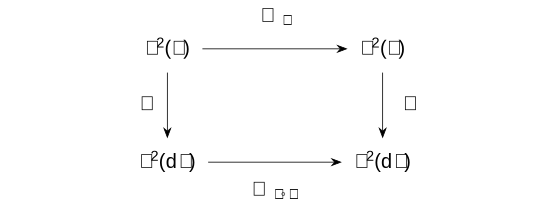
Choose an orthonormal identification \(\mathsf Q\cong \mathbb R^s\).
It preserves volume, norm and the quadratic form
\(\tfrac 12\int |\nabla f|^2+\int U|f|^2\), so
Theorem [fdip-00H2], Theorem [fdip-00H4] and Theorem [fdip-00H6]
apply with the same coercivity bound.
The pushforward identity gives \(\|Jf\|^2=\int |f(Pq)|^2\,\mathrm {d}\nu _0(q)=\|f\|^2\). Hence
\(J^{\dagger }J=\mathbb {I}\), the range is closed, and \(E^{\dagger }=E=E^2\) with exactly that range. For
\(u\in \mathcal H\), \(u/\psi _0\in L^2(\nu _0)\), and the adjoint is characterized by
\[ (J^{\dagger }u)(Pq)=\mathbb E_{\nu _0}[u/\psi _0\mid \sigma (P)] (q)\quad \nu _0\text {-almost everywhere}.\]
Pullback identifies \(L^2(\rho )\) with the closed
subspace of \(\sigma (P)\)-measurable functions in \(L^2(\nu _0)\):
indicator pullbacks generate that subspace, and simple-function
approximation gives surjectivity. Conditional expectation is its
orthogonal projection; pairing against these pullbacks proves
the adjoint identity for every \(u\in \mathcal H\).
When \(P\) is an orthogonal projection, its marginal has density
\[r(x)=\int _Y\psi _0(x+y)^2\,\mathrm {d} y\]
relative to induced Euclidean volume. By Theorem [fdip-00H6],
\(\psi _0\) is continuous, everywhere positive and Gaussian bounded.
The bound is integrable in \(y\), uniformly for \(x\) in compact
sets. Dominated convergence gives finite continuous \(r>0\),
and Tonelli gives \(\int _Xr\,\mathrm {d} x=1\). In this specialization,
for \(\rho \)-almost every \(x\),
\[J^{\dagger }u(x)=\frac 1{r(x)}\int _Y\psi _0(x+y)u(x+y)\,\mathrm {d} y.\]
Fiberwise Cauchy–Schwarz and Fubini justify this density
formula. For general measurable \(P\), positivity preservation
of \(J^{\dagger }\) follows from its conditional-expectation formula.
The kernel in Theorem [fdip-00H4] makes \(S_t\) positivity preserving.
Spectral calculus gives its operator positivity, self-adjointness,
contraction and strong continuity. These pass to \(A_t\).
Finally \(J1=\psi _0\) and \(S_t\psi _0=\psi _0\), so \(A_t1=1\).
For the abstract isometry, \(J^{\dagger }J=\mathbb {I}\) again makes \(E\) the
orthogonal range projection. Spectral calculus gives the asserted
contraction, operator positivity and continuity. Using \(S_{2t}=S_t^2\) gives the defect formula. Since \(\mathbb {I} -E\) is a self-adjoint
projection, its right side equals \(B_t^{\dagger }B_t\). Thus
\[\langle f,(A_{2t}-A_t^2)f\rangle =\|(\mathbb {I} -E)S_tJf\|^2.\]
Consequently (2) implies (3), and (1) implies (2). If (3) holds, then \(ES_uJ=S_uJ\), so
\[A_tA_u=J^{\dagger }S_tES_uJ=J^{\dagger }S_{t+u}J=A_{t+u}.\]
Self-adjointness of \(S_t\) makes the orthogonal complement of an invariant closed
subspace invariant: for \(v\perp \operatorname {im} J\) and \(w\in \operatorname {im} J\),
\(\langle S_tv,w\rangle =\langle v,S_tw\rangle =0\). Thus (3) implies (4); the converse
is immediate. The last assertion is the self-adjoint contraction-semigroup spectral
calculus on this reducing subspace. Its generator domain is precisely
\(J^{-1}(\operatorname {Dom}L\cap \operatorname {im} J)\), with action \(J^{\dagger }LJ\) there.
In the vacuum realization, if \(P\) is constant, \(\mathcal K=\mathbb C\), \(\operatorname {im} J=\mathbb C\psi _0\) and
\(A_t=\mathbb {I}\). For \(P=\mathbb {I}\), multiplication by \(\psi _0\) is unitary from \(L^2(\nu _0)\) onto
\(L^2(\mathrm {d} q)\), so \(A_t\) is the full ground-state transformed semigroup. If \(s=0\), both
Hilbert spaces are one-dimensional and \(S_t=A_t=\mathbb {I}\). An additive constant in \(U\) shifts
\(E_0\) by the same amount and changes neither \(S_t\), \(\nu _0\) nor \(A_t\).