Finite-group symmetry of Gaussian fields [fdip-004R]
✍️sourceAGENTDRAFTED
- October 31, 2026
Finite-group symmetry of Gaussian fields [fdip-004R]
✍️sourceAGENTDRAFTED
- October 31, 2026
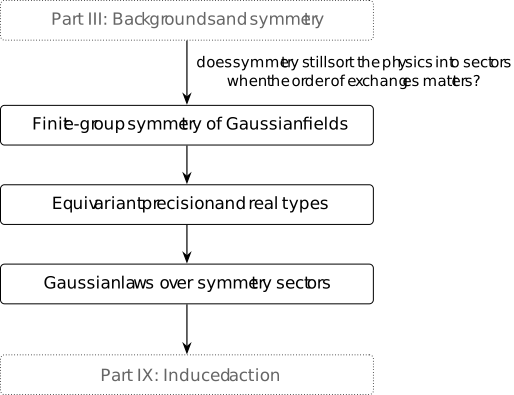
The half-turn splits fields into two sectors that its commuting precision does not mix. Does symmetry still separate the field when the order of exchanges matters? On the uniform cycle, each complex scalar Fourier wave spans a one-dimensional sector labelled by a discrete momentum. Real fields pair the nonexceptional momenta \(k\) and \(-k\) in a two-dimensional sector. For a general finite group, an isotypic sector collects all copies of one irreducible real representation: precision preserves that whole sector but can mix repeated copies within it. Orthogonal projectors recover these sectors from complex characters paired under conjugation. The prerequisites are signed endpoint actions, massive graph precision and the group-algebra extension.
Signed symmetries preserve the quadratic energy even when an edge is reversed. Maschke averaging and the complex central-idempotent formula supply the representation theory; the real projector theorem then gives a complete orthogonal decomposition preserved by precision. The cyclic and dihedral calculations show the resulting subspaces and eigenvalues explicitly.
Definition 1. Finite symmetries of a Gaussian background [fdip-004S]AGENTDRAFTED
- October 31, 2026
Definition 1. Finite symmetries of a Gaussian background [fdip-004S]AGENTDRAFTED
- October 31, 2026
Fix finite incidence data \((V,E,s,h)\), weights \(w_e>0\), a constant mass \(m>0\), and counting pairings on \(H=\mathbb R^V\) and \(\mathbb R^E\). A finite symmetry of a Gaussian background is a finite group \(G\) with a weight-preserving signed endpoint action \(g\mapsto (p_g,q_g,\varepsilon _g)\) on these data. No retained subset is selected here: in the signed-arrow definition one may take \(R=V\). An additional retained subset would have to be \(G\)-stable. The signs belong to the abstract \(C_2\) of that definition, with \(\sigma (+)=1\) and \(\sigma (-)=-1\). This unpartitioned data does not assert preservation of a nonempty proper retained set as in Definition [fdip-000G].
The vertex and edge representations are \[\begin {aligned} (\rho (g)f)(p_g(v))&=f(v),\\ (J_ga)(q_g(e))&=\sigma (\varepsilon _g(e))a(e). \end {aligned}\] Thus \(\rho (g)f=f\circ p_g^{-1}\); in particular \(\rho (g)\delta _v=\delta _{p_g(v)}\). We call \(H\) with this action the vertex permutation module. With \((df)(e)=f(h(e))-f(s(e))\), the endpoint equations give \(d\rho (g)=J_gd\). The sign cocycle gives \(\rho (gk)=\rho (g)\rho (k)\) and \(J_{gk}=J_gJ_k\). These conventions are the real specialization of Definition [fdip-003B], whose proof includes loops and parallel edge labels.
Write \(W=\operatorname {diag}(w_e)\) and \(Q=d^*Wd+m^2I\) for the massive precision. A reflection may reverse the chosen edge orientations; it is then a signed symmetry, not necessarily a directed relabeling in Definition [fdip-000G]. Forgetting those orientations preserves the energy, while still retaining incidence, weights and distinct edge labels. The underlying permutation-representation convention is [milne2025group, Example 7.1(b), p. 101]; the signed extension and its endpoint requirements are proved in Definition [fdip-003B].
Lemma 2. Signed symmetries commute with massive precision [fdip-004T]AGENTDRAFTED
- October 31, 2026
Lemma 2. Signed symmetries commute with massive precision [fdip-004T]AGENTDRAFTED
- October 31, 2026
For a finite symmetry of a Gaussian background, \(\rho (g)\) and \(J_g\) are orthogonal, \(J_gW=WJ_g\), and \[\rho (g)^*Q\rho (g)=Q,\qquad Q\rho (g)=\rho (g)Q.\] The Green operator \(Q^{-1}\) also commutes with every \(\rho (g)\).
Proof.
- October 31, 2026
Proof.
- October 31, 2026
Reindexing the counting sums gives \[\begin {aligned} \langle \rho (g)f,\rho (g)u\rangle _V&=\langle f,u\rangle _V,\\ \langle J_ga,J_gb\rangle _E&=\langle a,b\rangle _E. \end {aligned}\] The edge signs have square one. Since \(w_{q_g(e)}=w_e\), evaluation at \(q_g(e)\) proves \(WJ_g=J_gW\), and hence \(J_g^*WJ_g=W\). Using the incidence intertwiner, \[\begin {aligned} \rho (g)^*Q\rho (g) &=(d\rho (g))^*W(d\rho (g))+m^2I\\ &=d^*J_g^*WJ_gd+m^2I=Q. \end {aligned}\] Multiply on the left by \(\rho (g)\) to obtain commutation. Multiplication by \(Q^{-1}\) on both sides then proves the inverse claim. Equivalently, each reversed difference changes sign in \(\sum _e w_e(f(h(e))-f(s(e)))^2\) and leaves its square unchanged.
This specializes signed operator transport to positive real data. The incidence convention is [spielman2009effective, Section 2.1, pp. 4-5]; the argument above also covers loops and parallel labels.
Remark 3. From the half-turn to a finite group [fdip-004U]AGENTDRAFTED
- October 31, 2026
Remark 3. From the half-turn to a finite group [fdip-004U]AGENTDRAFTED
- October 31, 2026
For the four-cycle half-turn, \(G=C_2=\{1,r\}\) and \(\rho (r)=P\). Its two projectors are \((I+P)/2\) and \((I-P)/2\), with the concrete two-dimensional ranges. A larger symmetry group can split these ranges further; a sector for one chosen group is not an intrinsic label independent of that choice.
The group-algebra extension gives \[\widehat \rho :\mathbb R[G]\longrightarrow \operatorname {End}_{\mathbb R}(H), \qquad \widehat \rho \left (\sum _g a_g[g]\right )=\sum _g a_g\rho (g).\] It uses the group algebra and representation/module correspondence. Since every \(\rho (g)\) commutes with \(Q\), so does every \(\widehat \rho (a)\). The action groupoid organizes transported backgrounds, whereas this representation describes a fixed background's symmetry. The character-projector construction in [serre1977linear, Section 2.6, Theorem 8, pp. 21-22] recovers exactly the two half-turn projectors.
Theorem 4. Maschke averaging [fgap-001K]
L∃∀NAGENTDRAFTED
Theorem 4. Maschke averaging [fgap-001K]
L∃∀NAGENTDRAFTED
Let \(G\) be finite and \(k\) a field in which \(|G|\) is invertible. Every subrepresentation \(W\subseteq V\) has a \(G\)-stable complement. Consequently every finite-dimensional \(k[G]\)-module, and \(k[G]\) itself, is semisimple.
Proof.
Proof.
Choose a \(k\)-linear projection \(P:V\to W\) and average its conjugates: \[ P_G=\frac 1{|G|}\sum _{g\in G}\rho (g)P\rho (g)^{-1}. \] Then \(P_G\) remains the identity on \(W\) and commutes with \(G\). Its kernel is a \(G\)-stable complement. Division by \(|G|\) requires the stated invertibility hypothesis. This is Maschke's theorem as proved in [sengupta2010representations, thm. 3.5.1, pp. 44-46].
Theorem 5. primitive central idempotents as block projectors [fgap-001N]
Theorem 5. primitive central idempotents as block projectors [fgap-001N]
Over a splitting field of characteristic not dividing \(|G|\), an irreducible character \(\chi \) defines the central element \[ e_\chi =\frac {\chi (1)}{|G|}\sum _{g\in G}\chi (g^{-1})[g]. \] It is a nonzero primitive central idempotent. On a simple module with character \(\psi \), it acts as the identity if \(\psi =\chi \) and as zero otherwise. Distinct \(e_\chi \) are therefore orthogonal block projectors. See [lux2010representations, thm. 2.1.6 and cor. 2.1.7, pp. 88-90]. A constructed family of such projectors does not yield a complete block decomposition until a sum-to-1 statement is also known.
Theorem 6. Complete orthogonal real isotypic projectors [fdip-004V]AGENTDRAFTED
- October 31, 2026
Theorem 6. Complete orthogonal real isotypic projectors [fdip-004V]AGENTDRAFTED
- October 31, 2026
Let \(G\) be finite and let \(\rho \) be an orthogonal action on a finite-dimensional real inner-product space \(H\). Let \(Q\) be a linear operator commuting with every \(\rho (g)\). Write \(\operatorname {Irr}_{\mathbb C}(G)\) for the irreducible complex characters. For each orbit \(\Xi \) under \(\chi \mapsto \overline \chi \), put \[\begin {aligned} e_\chi &=\frac {\chi (1)}{|G|}\sum _{g\in G}\chi (g^{-1})[g],\\ \epsilon _\Xi &=\sum _{\chi \in \Xi }e_\chi , & P_\Xi &=\widehat \rho (\epsilon _\Xi ). \end {aligned}\] Then \(\epsilon _\Xi \) belongs to \(\mathbb R[G]\), is central, and is fixed by the real involution \([g]^*=[g^{-1}]\). The operators satisfy \[\begin {aligned} P_\Xi ^2&=P_\Xi =P_\Xi ^*,& QP_\Xi &=P_\Xi Q,\\ P_\Xi P_\Upsilon &=0\quad (\Xi \ne \Upsilon ),& \sum _\Xi P_\Xi &=I_H. \end {aligned}\] Thus \(H\) is the orthogonal direct sum of their ranges; a range may be zero. These ranges are its real isotypic sectors: each is the sum of all irreducible real subrepresentations of one isomorphism type. Complexification of a sector is the sum of the complex isotypic components with characters in \(\Xi \).
Proof.
- October 31, 2026
Proof.
- October 31, 2026
Maschke's theorem and the complex central-idempotent formula give central, pairwise orthogonal idempotents \(e_\chi \) acting on the indicated complex components. Coefficient conjugation sends \(e_\chi \) to \(e_{\overline \chi }\), so it fixes \(\epsilon _\Xi \); its coefficients are real. Average a Hermitian inner product on a complex representation over \(G\). Each group operator becomes unitary, whence \(\chi (g^{-1})=\overline {\chi (g)}\). The complex linear extension of \([g]\mapsto [g^{-1}]\) therefore sends \(e_\chi \) to \(e_{\overline \chi }\), and fixes \(\epsilon _\Xi \). This is coefficient conjugation and inversion separately; the latter restricts to the stated real involution.
For completeness, the regular character is \(r_G(g)=|G|\,\delta _{g,1}\) and decomposes as \(r_G=\sum _\chi \chi (1)\chi \) by [serre1977linear, Section 2.4, Proposition 5 and Corollary 1, p. 18]. Consequently \[\begin {aligned} \sum _\chi e_\chi &=\frac 1{|G|}\sum _{g\in G} \left (\sum _\chi \chi (1)\chi (g^{-1})\right )[g]\\ &=\frac 1{|G|}\sum _{g\in G}r_G(g^{-1})[g]=[1]. \end {aligned}\] Grouping by conjugation orbits preserves this sum. Applying \(\widehat \rho \) gives idempotence, mixed-product zero and sum \(I_H\). Orthogonality gives \(\rho (g)^*=\rho (g^{-1})\), so \(\widehat \rho (a^*)=\widehat \rho (a)^*\) for real coefficients. Thus each \(P_\Xi \) is self-adjoint; distinct ranges are perpendicular because \(\langle P_\Xi x,P_\Upsilon y\rangle =\langle x,P_\Xi P_\Upsilon y\rangle =0\). The sum identity gives existence of the decomposition, and applying each projector gives its uniqueness. Commutation with \(Q\) follows by linearity from commutation with every group operator.
To justify the real isotypic terminology, decompose \(H\) into irreducible real subrepresentations by Maschke. On any such \(U\), the real commuting idempotents \(P_\Xi \) have invariant ranges, so exactly one acts as the identity and the rest as zero. Its complexification therefore has constituents in just that orbit. Two real irreducibles assigned to the same orbit share a complex constituent: complex conjugation on each complexification exchanges the constituents indexed by \(\chi \) and \(\overline \chi \). Semisimplicity over \(\mathbb C\) then gives a nonzero complex intertwiner between their complexifications. In real bases, the real and imaginary parts of its matrix are real intertwiners, at least one nonzero. Its kernel and image are invariant, so irreducibility makes it an isomorphism. Conversely an isomorphism commutes with all the character projectors. This proves precisely the asserted grouping.
Serre's [serre1977linear, Section 2.6, Theorem 8, p. 21]
gives the canonical complex components and their projectors; the
real grouping and adjoint argument above are deductions from it.
TauCeti's
TauCeti.Representation.sum_primitiveCentralIdempotent
proves the complex sum-to-one identity for a finite pairwise inequivalent
family of irreducibles whose cardinality equals the number of conjugacy
classes, over an algebraically closed field with invertible group order.
It supports the completeness step, not the real adjoint or graph claims.
Example 7. Real Fourier sectors of a cycle [fdip-004W]AGENTDRAFTED
- October 31, 2026
Example 7. Real Fourier sectors of a cycle [fdip-004W]AGENTDRAFTED
- October 31, 2026
Let \(n\ge 3\), \(V=E=\mathbb Z/n\mathbb Z\), with edge \(e_v\) from \(v\) to \(v+1\), uniform weight \(w>0\) and mass \(m>0\). The generator \(r\) of \(C_n\) sends \(v\) to \(v+1\) and \(e_v\) to \(e_{v+1}\), with every edge sign positive. Its action on fields is \((\rho (r)f)(v)=f(v-1)\). The cyclic characters in [serre1977linear, Section 5.1, p. 35] and the real projectors yield the following direct calculation.
Set \(\theta _k=2\pi k/n\). The normalized constant vector \(u_0(v)=1/\sqrt n\) spans the trivial sector. For \(1\le k<n/2\), the sector \(H_k\) has orthonormal basis \[c_k(v)=\sqrt {2/n}\cos (\theta _kv),\qquad s_k(v)=\sqrt {2/n}\sin (\theta _kv).\] When \(n\) is even there is also \(u_{n/2}(v)=(-1)^v/\sqrt n\). These give all sectors indexed by \(0\le k\le \lfloor n/2\rfloor \). In the ordered basis \((c_k,s_k)\), the rotation is \[\rho (r)|_{H_k}=\begin {pmatrix} \cos \theta _k&-\sin \theta _k\\ \sin \theta _k&\cos \theta _k \end {pmatrix}.\] For \(0<\theta _k<\pi \) it has no real eigenline, so \(H_k\) is real irreducible. Its complex constituents have characters \(r\mapsto e^{i\theta _k}\) and \(r\mapsto e^{-i\theta _k}\).
Proof.
- October 31, 2026
Proof.
- October 31, 2026
The finite geometric sum \(\sum _{v=0}^{n-1}e^{2\pi i jv/n}\) equals \(n\) when \(n\) divides \(j\) and zero otherwise. Taking real and imaginary parts proves all stated norms and orthogonality. There are \(n\) basis vectors, so they span \(H\). The addition formulas give the displayed rotation. A real rotation through \(0<\theta _k<\pi \) has eigenvalues \(e^{\pm i\theta _k}\), neither real, proving the irreducibility claim.
The precision and each sector eigenvalue are \[\begin {aligned} (Qf)(v)&=(m^2+2w)f(v)-wf(v-1)-wf(v+1),\\ Q|_{H_k}&=q_kI,\\ q_k&=m^2+2w(1-\cos \theta _k). \end {aligned}\] Substitution of each sine, cosine and exceptional one-dimensional mode proves the formula. The orthogonal projector kernels are \[\begin {aligned} P_0(v,u)&=1/n,\\ P_k(v,u)&=\frac 2n\cos (\theta _k(v-u))\quad (0<k<n/2),\\ P_{n/2}(v,u)&=(-1)^{v-u}/n\quad (n\text { even}). \end {aligned}\] They follow by summing the outer products of the displayed orthonormal basis vectors, so their sum is the identity. For \(n=3\), this reads \(P_0=\mathbf 1\mathbf 1^T/3\) and \(P_1=I-P_0\); the eigenvalues are \(m^2\) and \(m^2+3w\), the latter twice. The later circle comparison rescales these same finite modes; no continuum limit is used in this calculation.
Example 8. Dihedral symmetry refines the four-cycle sectors [fdip-004X]AGENTDRAFTED
- October 31, 2026
Example 8. Dihedral symmetry refines the four-cycle sectors [fdip-004X]AGENTDRAFTED
- October 31, 2026
Take the cycle with \(n=4\), \(w=m=1\). Let \(D_4=\langle r,s:r^4=s^2=1,\ srs=r^{-1}\rangle \), of order 8, act on vertices by \(r(v)=v+1\), \(s(v)=-v\). On the oriented edges \(e_v:v\to v+1\), rotation sends \(e_v\) to \(e_{v+1}\) with positive sign, while reflection sends \(e_v\) to \(e_{-v-1}\) with negative sign. The latter edge runs from \(-v-1\) to \(-v\), the reverse of the transported endpoints. The 4 rotations restore each edge; two reflections restore its label and give positive sign. Reflecting, rotating, then reflecting sends \(e_v\) to \(e_{v-1}\) with two negative signs, hence agrees with the inverse rotation. The vertex maps obey the same relations, so these maps define a signed endpoint action. This uses the dihedral presentation in [serre1977linear, Section 5.3, p. 36]; the edge signs and precision calculation are explicit here.
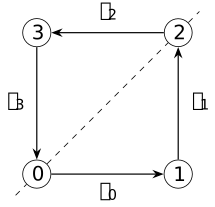
The dashed diagonal is the reflection axis: \(s\) fixes vertices \(0,2\), exchanges \(1,3\), and sends \(e_0\) to \(e_3\) with reversed orientation. All 4 weights and the mass are one.
An orthonormal basis, grouped by real irreducible type, is \[\begin {aligned} u&=(1,1,1,1)/2,&a&=(1,-1,1,-1)/2,\\ c&=(1,0,-1,0)/\sqrt 2,&b&=(0,1,0,-1)/\sqrt 2. \end {aligned}\] The line \(\mathbb Ru\) is trivial. On \(\mathbb Ra\), rotation acts by \(-1\) and reflection by \(+1\); call this the alternating line. On \(K=\operatorname {span}(c,b)\), \[\rho (r)|_K=\begin {pmatrix}0&-1\\1&0\end {pmatrix},\qquad \rho (s)|_K=\begin {pmatrix}1&0\\0&-1\end {pmatrix}.\] There is no real rotation-invariant line, so \(K\) is irreducible. A real matrix commuting with the rotation is \(xI+y\rho (r)\); commuting also with the reflection forces \(y=0\). Thus its commuting algebra is \(\mathbb R I\), the real-type case. The two distinct lines and \(K\) are pairwise nonisomorphic, each occurring once.
Direct substitution in the cycle precision gives \[Qu=u,\qquad Qa=5a,\qquad Qc=3c,\qquad Qb=3b.\] The three orthogonal projectors are \(uu^T\), \(aa^T\), and \(cc^T+bb^T=I-uu^T-aa^T\); their ranges have dimensions \(1,1,2\) and precision eigenvalues \(1,5,3\), respectively. For the subgroup generated by \(r^2\), the positive sector is \(\operatorname {span}(u,a)\) and the negative sector is \(K\). The half-turn calculation therefore has two \(2\times 2\) blocks, whereas the full dihedral action separates its positive block into two lines. Changing the acting group changes the isotypic decomposition without changing this precision.