Theorem. Form-preserving maps and the half-turn Clifford automorphism [fdip-000Q]
Theorem. Form-preserving maps and the half-turn Clifford automorphism [fdip-000Q]
Let \(k\) be a commutative ring, \(M_1,M_2\) be \(k\)-modules with quadratic forms \(q_1,q_2\), and let \(f:M_1\to M_2\) be linear with \[q_2(f(v))=q_1(v)\qquad (v\in M_1).\] This form-preserving map induces a unique unital \(k\)-algebra map \[\operatorname {Cl}(f):\operatorname {Cl}(q_1)\longrightarrow \operatorname {Cl}(q_2)\] satisfying \(\operatorname {Cl}(f)(\iota _1(v))=\iota _2(f(v))\). This is the underlying Clifford map in isometry transport. It requires no inverse for \(f\). The defining square is:
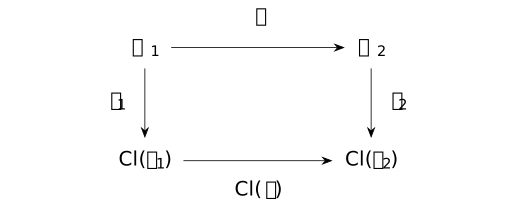
The top and vertical arrows are linear maps; the bottom arrow is a unital algebra map. The square commutes as a square of linear maps. For composable form-preserving maps \(f,g\), \[\begin {aligned} \operatorname {Cl}(\operatorname {id})&=\operatorname {id},\\ \operatorname {Cl}(g\circ f)&=\operatorname {Cl}(g)\circ \operatorname {Cl}(f). \end {aligned}\] If \(f\) is a linear isomorphism, \(\operatorname {Cl}(f)\) is an algebra isomorphism with inverse \(\operatorname {Cl}(f^{-1})\).
Meinrenken derives this functoriality for bilinear-form-preserving
maps in [meinrenken2013clifford, Section 2.2.2, p. 29].
Over his characteristic-zero field, polarization equates that
condition with preservation of \(q\). The proof here applies
directly to quadratic forms over commutative rings. Mathlib's
CliffordAlgebra.map,
CliffordAlgebra.map_apply_ι,
CliffordAlgebra.map_id,
CliffordAlgebra.map_comp_map and
CliffordAlgebra.equivOfIsometry
provide the extension, generator equation, identity, composition
and inverse construction. Their input is a linear map preserving
the quadratic form, or a linear equivalence for the last result.
Return to \(q=q_{t,m}\) on \(V=\mathbb R^4\). The same half-turn sends \(\delta _i\) to \(\delta _{i+2}\), with indices modulo \(4\). It satisfies \(P^2=I\) and \(P^TQP=Q\), so \(q(Pv)=q(v)\). Therefore \[\begin {aligned} \Theta &=\operatorname {Cl}(P),\\ \Theta (c_i)&=c_{i+2},\qquad \Theta ^2=\operatorname {id}. \end {aligned}\] The matrix equation follows by shifting both indices of \(Q\) by two: its diagonal, its paired off-diagonal entries \(-1\) and \(-t\), and its zeros are preserved. Composition gives \(\Theta ^2=\operatorname {Cl}(P^2)=\operatorname {id}\). Moreover \(\delta _0\ne \delta _2\), so injectivity of \(\iota _q\) gives \(c_0\ne c_2\). Thus \(\Theta \) is nontrivial and has order exactly two.
The real half-turn sectors
\(V_\pm =\ker (P\mp I)\) are orthogonal for \(b_q\). Indeed,
\(P^TQP=Q\) gives \(b_q(Pu,Pv)=b_q(u,v)\). For
\(u\in V_+\) and \(v\in V_-\), the left side is
\(b_q(u,-v)=-b_q(u,v)\). Over \(\mathbb R\) this forces
\(b_q(u,v)=0\), and hence
\[\iota _q(u)\iota _q(v)=-\iota _q(v)\iota _q(u).\]
This is the generic orthogonality consequence
CliffordAlgebra.ι_mul_ι_comm_of_isOrtho.
The cross-sector vector generators anticommute; the direct sum
of sectors does not make them commuting factors of an ordinary
tensor-product algebra.
Preservation of the form is essential. Compare \(q_{1,1}\) and \(q_{2,1}\) while keeping the coordinate labels unchanged. At \(\delta _0\), \[q_{1,1}(\delta _0)=3,\qquad q_{2,1}(\delta _0)=4.\] Thus the identity linear map is not form-preserving. Write \(c_i^{(1)},c_i^{(2)}\) for the two sets of generators. A unital real algebra map with \(c_i^{(1)}\mapsto c_i^{(2)}\) would send \((c_0^{(1)})^2=3\,1\) to \((c_0^{(2)})^2=3\,1\), but the target square is \(4\,1\). Its injective scalar map rules this out. This excludes precisely the unchanged-label assignment. It does not exclude other isometries between the positive forms or an abstract isomorphism of their Clifford algebras.
The construction transports a supplied configuration form and its discrete symmetry. It supplies no spacetime derivative, Dirac operator or Lorentzian interpretation. Those structures need additional data and compatibility conditions.