Reference pairings, adjoints and parity [fdip-001N]
✍️sourceAGENTDRAFTED
- October 20, 2026
Reference pairings, adjoints and parity [fdip-001N]
✍️sourceAGENTDRAFTED
- October 20, 2026
To compare a field operator's input and output through a bilinear form, a reference pairing represents its adjoint. This is the return operation used later for incidence and weighted energy. The finite field module has a perfect counting pairing over any commutative unital ring. Its represented adjoint is an ordinary linear product-reversing involution; neither positivity nor division by two is required.
A partition of the carrier splits fields by restriction and extension by zero. It also separates operators that preserve the two parts from those that exchange them, giving a parity grading. The four-cycle calculation exhibits an odd invertible shift and a difference with both parity components. This distinguishes parity from the extra requirement of a square-zero differential, before paired differences and elimination of a chosen summand.
Lemma 1. Perfect counting duality [fdip-001F]AGENTDRAFTED
- October 20, 2026
Lemma 1. Perfect counting duality [fdip-001F]AGENTDRAFTED
- October 20, 2026
Let \(R\) be a commutative unital ring, \(V\) a finite set and \(H=\mathcal F_R(V)\) its field module. The counting bilinear form is \[b(f,g)=\sum _{v\in V}f(v)g(v).\] It is symmetric. Write \(H^\vee =\operatorname {Hom}_R(H,R)\) for the dual module, using ordinary \(R\)-linear maps: both coefficient rings are \(R\) and \(\sigma =\operatorname {id}_R\), as in Remark [ca-001G]. The perfect counting duality is the pair of inverse \(R\)-linear maps \[\begin {aligned} \Phi :H&\longrightarrow H^\vee ,&\Phi (g)(f)&=b(f,g),\\ \Psi :H^\vee &\longrightarrow H,&(\Psi \ell )(v)&=\ell (\delta _v). \end {aligned}\] Here \(\delta _v(u)\) is \(1\) when \(u=v\), and \(0\) otherwise. Perfection means precisely that \(\Phi \) is an isomorphism.
Proof.
- October 20, 2026
Proof.
- October 20, 2026
Commutativity and distributivity in \(R\) give symmetry and bilinearity of \(b\); they also give linearity of \(\Phi \) and \(\Psi \). For \(f\in H\), evaluation at every point proves \(f=\sum _v f(v)\delta _v\). Consequently \[(\Phi \Psi \ell )(f) =\sum _v f(v)\ell (\delta _v) =\ell \left (\sum _v f(v)\delta _v\right )=\ell (f).\] Conversely, \((\Psi \Phi g)(v)=b(\delta _v,g)=g(v)\). Thus both composites are identities.
This proof includes the empty set and the zero ring. It uses no order, positivity or division. A perfect form can have nonzero vectors of zero self-pairing: over \(\mathbb F_2\), the counting form on two points has \(b((1,1),(1,1))=0\). Conversely, separation of vectors alone does not imply perfection over a ring: the form \(b(x,y)=2xy\) on \(\mathbb Z\) cannot represent the functional \(x\mapsto x\). The Hom-module convention is [stacks2017stacks, Section 10.10], Tag 0581; the explicit inverse above supplies the finite counting assertion.
Definition 2. Ordinary linear involutions [fdip-001G]AGENTDRAFTED
- October 20, 2026
Definition 2. Ordinary linear involutions [fdip-001G]AGENTDRAFTED
- October 20, 2026
Let \(R\) be a commutative unital ring and \(A\) an associative unital \(R\)-algebra. An ordinary \(R\)-linear involution on \(A\) is an \(R\)-linear map \(a\mapsto a^\dagger \), with \(\sigma =\operatorname {id}_R\), satisfying \[1^\dagger =1,\qquad (ab)^\dagger =b^\dagger a^\dagger ,\qquad (a^\dagger )^\dagger =a.\] Thus it reverses products, preserves sums and satisfies \((ra)^\dagger =ra^\dagger \). The involution on the coefficient ring is explicitly the identity.
These are ordinary product-reversal laws: no sign depending on degree occurs. Over \(\mathbb C\), this convention is bilinear and does not introduce complex conjugation. A Hermitian adjoint needs different coefficient data. Neither a grading nor freeness selects an involution; the counting adjoint below is constructed from a specified pairing.
Mathlib separates the involutive law InvolutiveStar,
product reversal StarMul, additive compatibility
StarRing and scalar compatibility StarModule.
Its starRingOfComm permits the identity involution on
a commutative ring. These interfaces support the stated convention;
the represented example requires its own proof.
For the library attribution, see [mathlib2020lean].
Example 3. Transpose as an ordinary involution [fdip-004A]AGENTDRAFTED
- October 31, 2026
Example 3. Transpose as an ordinary involution [fdip-004A]AGENTDRAFTED
- October 31, 2026
Let \(R\) be a commutative unital ring and \(A=M_n(R)\). Define \((X^T)_{ij}=X_{ji}\). This gives an ordinary linear involution: \[(rX+Y)^T=rX^T+Y^T,\qquad I^T=I,\qquad (XY)^T=Y^TX^T,\qquad (X^T)^T=X.\]
Proof.
- October 31, 2026
Proof.
- October 31, 2026
The first, second and fourth identities follow by evaluating the \((i,j)\) entry. For product reversal, commutativity gives \[\begin {aligned} ((XY)^T)_{ij}&=\sum _k X_{jk}Y_{ki}\\ &=\sum _k Y_{ki}X_{jk}=(Y^TX^T)_{ij}. \end {aligned}\] The same formulas include \(n=0\), with empty sums.
For instance, transposing \(\left (\begin {smallmatrix}a&b\\c&d\end {smallmatrix}\right )\) exchanges \(b\) and \(c\). Over \(\mathbb C\), transpose is complex-linear, whereas conjugate transpose is not: \((iI)^*=-iI\ne iI^*\) when \(n>0\). Conjugate transpose is nevertheless real-linear, so the coefficient ring matters. The counting adjoint recovers ordinary transpose from its specified bilinear pairing.
These are entrywise deductions from the definition. Mathlib's
Matrix.transpose_add, Matrix.transpose_smul,
Matrix.transpose_mul and Matrix.transpose_transpose
record the corresponding identities; see [mathlib2020lean].
Proposition 4. The represented counting adjoint [fdip-001H]AGENTDRAFTED
- October 20, 2026
Proposition 4. The represented counting adjoint [fdip-001H]AGENTDRAFTED
- October 20, 2026
Let \(R\) be a commutative unital ring, \(V\) a finite set and \(H=\mathcal F_R(V)\). Equip \(H\) with the perfect counting duality \(b,\Phi ,\Psi \), with \(H^\vee =\operatorname {Hom}_R(H,R)\). For \(a\in \operatorname {End}_R(H)\), define \[\begin {aligned} a^\vee :H^\vee &\longrightarrow H^\vee , &a^\vee (\ell )&=\ell \circ a,\\ a^\dagger &=\Psi \circ a^\vee \circ \Phi :H\longrightarrow H. \end {aligned}\] The counting adjoint \(a^\dagger \) is the unique ordinary \(R\)-linear endomorphism satisfying \[b(f,a^\dagger g)=b(af,g)\qquad (f,g\in H).\] It gives an ordinary \(R\)-linear involution on the composition algebra \(\operatorname {End}_R(H)\). Products act with the right factor first.
The real incidence construction in Definition [fdip-0007] starts from \(D:\mathbb R^V\to \mathbb R^E\) and returns an adjoint in the opposite direction. Here \(a:H\to H\) is an endomorphism over the commutative ring \(R\). Both use the characterizing identity that moves the operator between the two counting-pairing slots. The existence and laws below follow from Lemma 1, independently of the real incidence proof.
Proof.
- October 20, 2026
Proof.
- October 20, 2026
The composite \(\ell \circ a\) is linear, and precomposition is linear in \(\ell \); thus all three arrows defining \(a^\dagger \) are linear. Since \(\Phi \Psi =I\), evaluation at \(f\) gives the displayed adjoint identity. Injectivity of \(\Phi \) gives uniqueness for each \(g\). In particular, \[(a^\dagger g)(v)=b(a\delta _v,g).\] For \(a,c\in \operatorname {End}_R(H)\) and \(r\in R\), bilinearity and uniqueness give \[(a+c)^\dagger =a^\dagger +c^\dagger ,\quad (ra)^\dagger =ra^\dagger ,\quad I^\dagger =I.\] Indeed the right-hand sides represent respectively \(b((a+c)f,g)\), \(b((ra)f,g)\) and \(b(f,g)\).
For products, applying the defining identity twice yields \[b(f,c^\dagger a^\dagger g) =b(cf,a^\dagger g)=b(acf,g),\] so \((ac)^\dagger =c^\dagger a^\dagger \). Symmetry of \(b\) gives \[\begin {aligned} b(f,(a^\dagger )^\dagger g) &=b(a^\dagger f,g)=b(g,a^\dagger f)\\ &=b(ag,f)=b(f,ag). \end {aligned}\] Uniqueness therefore gives \((a^\dagger )^\dagger =a\).
The construction also applies when \(V\) is empty or \(R\) is the zero ring. Its representability is supplied by the explicit inverse to \(\Phi \), not by a field hypothesis or a positivity argument. Dual precomposition reverses composition before any pairing is chosen; the Hom convention is [stacks2017stacks, Section 10.10], Tag 0581. The proof here adds the specified symmetric counting identification with the dual.
Lemma 5. A partition splits the field module [fdip-001I]AGENTDRAFTED
- October 20, 2026
Lemma 5. A partition splits the field module [fdip-001I]AGENTDRAFTED
- October 20, 2026
Let \(R\) be a commutative unital ring and choose a partition \(V=V_0\sqcup V_1\) of a finite set. Put \(H=\mathcal F_R(V)\) and \(K_i=\mathcal F_R(V_i)\) for \(i=0,1\). Restriction and extension by zero are ordinary \(R\)-linear maps \[\pi _i:H\to K_i,\qquad \iota _i:K_i\to H,\] with \((\pi _i f)(v)=f(v)\) for \(v\in V_i\), and \((\iota _i u)(v)=u(v)\) on \(V_i\), zero elsewhere. The support submodules are \(H_i=\iota _i(K_i)\subseteq H\). The support projections \(p_i=\iota _i\pi _i:H\to H\) satisfy \[\pi _i\iota _i=I_{K_i},\quad \pi _i\iota _j=0\ (i\ne j),\quad p_i^2=p_i,\quad p_ip_j=0\ (i\ne j),\quad p_0+p_1=I_H.\] Every \(f\in H\) has a unique expression \(f=f_0+f_1\) with \(f_i\in H_i\), namely \(f_i=p_if\).
Proof.
- October 20, 2026
Proof.
- October 20, 2026
Evaluation at a point proves linearity and all the displayed composition identities. A field belongs to \(H_i\) precisely when it vanishes outside \(V_i\). Thus \(H_0\cap H_1=\{0\}\). The identity \(p_0+p_1=I_H\) gives existence of the decomposition. If \(f_0+f_1=g_0+g_1\), then \(f_0-g_0=g_1-f_1\in H_0\cap H_1\), proving uniqueness.
The partition is additional data, not part of the general incidence-field definition. If one part is empty, its field module and support projection are zero. Nothing requires division by \(2\); the same construction works in characteristic \(2\) and over the zero ring. This is the direct finite-function realization of a module decomposition.
[stacks2017stacks, Section 10.10], Tag 0581 supplies the module convention.
Definition 6. Internal parity grading [fdip-001J]AGENTDRAFTED
- October 20, 2026
Definition 6. Internal parity grading [fdip-001J]AGENTDRAFTED
- October 20, 2026
Let \(R\) be a commutative unital ring and \(A\) an associative unital \(R\)-algebra. An internal parity grading consists of \(R\)-submodules \(A_0,A_1\subseteq A\), with operations inherited from \(A\), such that every \(a\in A\) has a unique decomposition \(a=a_0+a_1\), with \(a_i\in A_i\), and \[1\in A_0,\qquad A_iA_j\subseteq A_{i+j}.\] Subscripts are added in \(\mathbb Z/2\mathbb Z\). An element of \(A_i\) is homogeneous of parity \(i\); parity \(0\) is even and parity \(1\) is odd. The zero element lies in both submodules. Scalars \(r1\) belong to \(A_0\).
The multiplication condition controls the component of a product; it does not require \(ab=(-1)^{ij}ba\) for \(a\in A_i\), \(b\in A_j\). Nor does it require an odd element to square to zero. Those are additional equations, tested explicitly by the four-cycle.
The internal-submodule viewpoint and multiplication rule follow
[wieser2022graded, Section 1, accepted-manuscript pp. 1-2],
here specialized to the index group \(\mathbb Z/2\mathbb Z\).
Mathlib's GradedRing and GradedAlgebra encode
graded multiplication and compatible scalar data. The chosen
operator decomposition still needs the proof in
Proposition 7.
Proposition 7. Parity of field endomorphisms [fdip-001K]AGENTDRAFTED
- October 20, 2026
Proposition 7. Parity of field endomorphisms [fdip-001K]AGENTDRAFTED
- October 20, 2026
Let \(R\) be a commutative unital ring, \(V=V_0\sqcup V_1\) a finite partition, and \(H=\mathcal F_R(V)\). Use its support submodules \(H_i\) and support projections \(p_i\). All subscripts below are in \(\mathbb Z/2\mathbb Z\). For \(A=\operatorname {End}_R(H)\) with composition product, put \[A_k=\{a\in A:a(H_i)\subseteq H_{i+k}\text { for }i=0,1\}.\] These submodules give an internal parity grading. The two components of \(a\in A\) are \[a_0=p_0ap_0+p_1ap_1,\qquad a_1=p_1ap_0+p_0ap_1.\] All products are compositions of maps \(H\to H\); these formulas require no choice of ordered basis.
Proof.
- October 20, 2026
Proof.
- October 20, 2026
Each \(A_k\) is a submodule because \(H_{i+k}\) is a submodule. For \(f\in H_i\), the projection identities show that \(a_kf=p_{i+k}af\in H_{i+k}\), so \(a_k\in A_k\). Expanding \((p_0+p_1)a(p_0+p_1)\) gives \(a=a_0+a_1\). If \(a\in A_0\cap A_1\), its value on \(H_i\) belongs to \(H_i\cap H_{i+1}=\{0\}\). Every field is a sum of such inputs, so \(a=0\). This proves uniqueness of the two components.
The identity preserves each \(H_i\), hence lies in \(A_0\). If \(a\in A_k\) and \(c\in A_l\), then \(c(H_i)\subseteq H_{i+l}\) and \(a(H_{i+l})\subseteq H_{i+l+k}\). Thus \(ac\in A_{k+l}\), proving the multiplication rule.
If one part is empty, \(A_1=0\); if both parts are empty, the whole algebra is zero. The argument also allows the zero ring and characteristic \(2\). Graded endomorphism composition appears in [stacks2017stacks, Section 22.25, Example 22.25.5], Tag 09L1. That example is integer-graded; the direct proof here establishes the two-parity, finite-function instance.
Lemma 8. Adjoints preserve the chosen parity [fdip-001L]AGENTDRAFTED
- October 20, 2026
Lemma 8. Adjoints preserve the chosen parity [fdip-001L]AGENTDRAFTED
- October 20, 2026
Let \(R\) be a commutative unital ring and \(V=V_0\sqcup V_1\) a finite partition. Equip \(H=\mathcal F_R(V)\) with its counting pairing \(b\), counting adjoint constructed in Proposition 4, and parity grading \(A_0,A_1\) on \(\operatorname {End}_R(H)\). Then \(p_i^\dagger =p_i\) for the support projections, and \[a\in A_k\quad \Longrightarrow \quad a^\dagger \in A_k.\] Every multiplication operator \(M_f\), for \(f\in H\), is even and satisfies \(M_f^\dagger =M_f\).
Proof.
- October 20, 2026
Proof.
- October 20, 2026
For \(u,v\in H\), restriction of the counting sum gives \[b(p_iu,v)=\sum _{x\in V_i}u(x)v(x)=b(u,p_iv),\] so uniqueness of the adjoint gives \(p_i^\dagger =p_i\). The support summands are orthogonal: if \(u\in H_0\) and \(v\in H_1\), every term of \(b(u,v)\) is zero.
For \(a\in A_k\), evaluation on each support summand gives \[a=\sum _{i=0}^1p_{i+k}ap_i.\] Taking the ordinary adjoint, including its linearity and product reversal, yields \[a^\dagger =\sum _{i=0}^1p_i a^\dagger p_{i+k}.\] Each summand maps \(H_{i+k}\) into \(H_i\) and vanishes on the other support summand. Its degree is \(-k=k\) in \(\mathbb Z/2\mathbb Z\), proving the claim.
Multiplication by a field preserves support, so \(M_f\in A_0\). Commutativity of \(R\) gives \[b(M_fu,v)=\sum _x f(x)u(x)v(x)=b(u,M_fv).\] Uniqueness therefore gives \(M_f^\dagger =M_f\).
The degree statement depends on this orthogonal support decomposition and this symmetric counting pairing. It is not a law for an unspecified grading and involution. The involution on coefficients is the identity, including for complex coefficients; no Hermitian or positive conclusion is inferred. The graded composition convention is [stacks2017stacks, Section 22.25], Tag 09L1; the compatibility with the chosen pairing is proved above.
Example 9. Parity and adjoint on the four-cycle [fdip-001M]AGENTDRAFTED
- October 20, 2026
Example 9. Parity and adjoint on the four-cycle [fdip-001M]AGENTDRAFTED
- October 20, 2026
Let \(R\) be a commutative unital ring. On the four-cycle, take \(V=\mathbb Z/4\mathbb Z\), \(H=\mathcal F_R(V)\) and the additional partition \(V_0=\{0,2\}\), \(V_1=\{1,3\}\). The cyclic shift \(T:H\to H\) is \((Tf)(i)=f(i+1)\). It exchanges the two support submodules: if \(f\) is supported on \(V_j\), then \(Tf\) is supported on \(V_{j+1}\). Hence \(T\) is odd in the chosen operator grading.
For the counting adjoint constructed over \(R\) in Proposition 4, reindexing the finite sum proves \[b(Tf,g)=\sum _i f(i+1)g(i) =\sum _j f(j)g(j-1)=b(f,T^{-1}g),\] so \(T^\dagger =T^{-1}\). Also \(T^4=I\); thus the half-turn \(T^2\) is even and satisfies \((T^2)^\dagger =T^{-2}=T^2\). These unweighted counting identities do not assert that the one-step shift preserves the alternating weights. The weight-preserving half-turn and the one-step counterexample remain those in Example [fdip-0003].
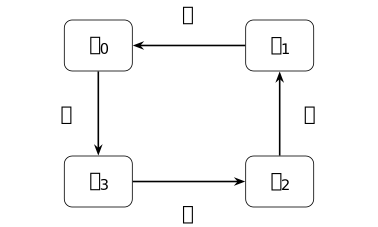
The arrows show the action on basis fields, opposite to the source-to-head orientation on vertices. Every arrow switches support parity; two steps give the half-turn. In particular, over \(\mathbb Z\), \(T^2\delta _0=\delta _2\ne 0\). Thus an odd operator need not square to zero. It need not satisfy a graded commutation law either: that law applied to \(T,T\) would give \(2T^2=0\), whereas \(2T^2\delta _0=2\delta _2\ne 0\).
Identify edge \(i\) with vertex \(i\), with source \(i\) and head \(i+1\), as in Lemma [fdip-0009]. Only after this identification does incidence become the endomorphism \(\Delta =T-I\). Its even component is \(-I\) and its odd component is \(T\). Over \(\mathbb Z\), both are nonzero, so \(\Delta \) is inhomogeneous, and \[\Delta ^2\delta _0=\delta _2-2\delta _3+\delta _0\ne 0.\] The formulas remain valid over every commutative unital ring, but the nonzero witnesses just used are specifically over \(\mathbb Z\); in the zero ring all these fields and maps vanish. This is a direct specialization of the shift-multiplication realization and partition construction, not a square-zero differential supplied by parity.
[wieser2022graded, Section 1, accepted-manuscript pp. 1-2] gives the grading convention; the shift, adjoint and failure witnesses are the computations here.