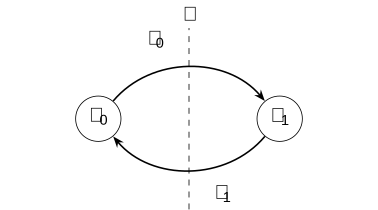
Definition. The cellular paired anti-reflection [fdip-00XQ]
AGENTDRAFTED
For the cellular sign model, define the
cochain reflection \(\mathscr R_U\) by
\[\begin {aligned}
(\mathscr R_0 f)(v_j)&=f(v_{1-j}),\\
(\mathscr R_1(U)a)(e_j)&=-u_ja(e_j)\qquad (j=0,1),\\
\mathscr R_U&=\mathscr R_0\oplus \mathscr R_1(U).
\end {aligned}\]
The edge sign reverses orientation; its link factor transports
from the reflected source back to the declared source.
Use the common algebra
\(\mathscr A=\operatorname {Fun}(\Omega ,\mathcal A(V))\)
with pointwise exterior multiplication. Its
cellular paired anti-reflection is conjugate-linear
on coefficients, fixes the link functions, and has generator
rules
\[\begin {aligned}
\Theta _U(\psi _c)&=\sum _a(\mathscr R_U)_{ac}\bar \psi _a,\\
\Theta _U(\bar \psi _c)&=\sum _a(\mathscr R_U)_{ac}\psi _a,\\
\Theta _U(ab)&=\Theta _U(b)\Theta _U(a).
\end {aligned}\]
Thus \((\Theta a)(U)=\Theta _U(a(U))\).
Its strict positive half-algebra
\(\mathscr A_+\) consists of constant families generated over
\(k\) by \(\psi _{v_1},\bar \psi _{v_1}\). The edge generators
belong to the full algebra, not this open half.
Let \(\mathcal I_V\) be the
ring paired coefficient. The
cellular paired functional is
\[\begin {aligned}
Z&=\sum _{U\in \Omega }\det K_U,\\
\ell (a)&=Z^{-1}\sum _{U\in \Omega }
\mathcal I_V\bigl (a(U)\operatorname {Exp}_{\Lambda }(\theta _{K_U})\bigr )
\qquad \text {when }Z\ne 0.
\end {aligned}\]
Here \(\operatorname {Exp}_{\Lambda }\) is the finite exterior exponential and
\(\theta _{K_U}=-\bar \psi (K_U\psi )\).