Definition. The group-algebra action of the half-turn [fdip-000L]
Definition. The group-algebra action of the half-turn [fdip-000L]
The half-turn acts on fields before a precision or probability law is chosen. Let \(k\) be a nonzero commutative ring and \(C_2=\{1,r\}\), with \(r^2=1\). In its Group Algebra, write \(g=[r]\) and \(1=[1]\). Every element has unique coefficients \(a+bg\), and \[\begin {aligned} (a+bg)(c+dg)&=(ac+bd)\\ &\quad +(ad+bc)g. \end {aligned}\] [sengupta2010representations, Sections 3.1-3.2, pp. 39-41] gives the group basis and linear extension over a field. The ring-module extension supplies the general ring theorem; the following formulas identify its particular faithful actions.
Put \(V_k=k^4\), in vertex order \((0,1,2,3)\), and \(W_k=k^R\), with \(R=(0,2)\) in that order. Let \(\delta _i(j)=\mathbf 1_{j=i}\) be the coordinate basis of \(V_k\); let \(\delta _i^R(j)=\mathbf 1_{j=i}\) for \(i,j\in R\) be the coordinate basis of \(W_k\). These coordinate vectors differ from the real spectral vectors \(u_a\) and from the edge labels \(e_i\). The half-turn and its retained action are \[\begin {aligned} P(\phi _0,\phi _1,\phi _2,\phi _3)&=(\phi _2,\phi _3,\phi _0,\phi _1),\\ J(x_0,x_2)&=(x_2,x_0). \end {aligned}\] Applying either permutation twice returns the original coordinates, so \(P^2=I\) and \(J^2=I\). Their unique unital \(k\)-algebra extensions are \[\begin {aligned} \widehat \rho _V:k[C_2]&\longrightarrow \operatorname {End}_k(V_k),\\ \widehat \rho _V(a+bg)&=aI+bP,\\ \widehat \rho _W:k[C_2]&\longrightarrow \operatorname {End}_k(W_k),\\ \widehat \rho _W(a+bg)&=aI+bJ. \end {aligned}\] The associated left module action is \(z\cdot v=\widehat \rho _V(z)v\), and similarly on \(W_k\). Both algebra actions are faithful, meaning that their defining maps are injective.
Indeed, \(P^2=I\) gives \[\begin {aligned} (aI+bP)(cI+dP) &=(ac+bd)I\\ &\quad +(ad+bc)P. \end {aligned}\] The same calculation uses \(J^2=I\) on \(W_k\). Addition and scalar multiplication are preserved term by term, and \(1\) maps to \(I\). These facts prove the module laws. A linear extension is unique because \(1,g\) are a basis. If \(aI+bP=0\), applying it to \(\delta _0\) gives \(a\delta _0+b\delta _2=0\); coordinates \(0,2\) give \(a=b=0\). Applying \(aI+bJ\) to \(\delta _0^R\) proves injectivity on \(W_k\) in the same way. No absence of zero divisors is required.
Coordinate projection \(\pi _R(\phi )=(\phi _0,\phi _2)\) sends \(\delta _0,\delta _2\) to \(\delta _0^R,\delta _2^R\) and kills \(\delta _1,\delta _3\). Since \(\pi _RP=J\pi _R\), it intertwines the whole algebra action: \[\pi _R\widehat \rho _V(z)=\widehat \rho _W(z)\pi _R \qquad (z\in k[C_2]).\] Thus it is a \(k[C_2]\)-module map by the all-element intertwining theorem. Both coordinate faithfulness witnesses above work with zero divisors; they use more than faithfulness of the group action alone.
Suppose now that \(2\) is a unit in \(k\), and put \(h=2^{-1}\). The element \(g\) is a central involution. Its two idempotents and algebra product are \[e_+=h(1+g),\qquad e_-=h(1-g).\] Their images under the two algebra actions are the following concrete module projectors. Abstract centrality in \(k[C_2]\) supplies commutation with the represented algebra; it does not make \(P\) central in all \(\operatorname {End}_k(V_k)\).
The represented projectors are \[E_\pm =h(I\pm P),\qquad F_\pm =h(I\pm J).\] They give the eigenspace decompositions \[\begin {aligned} V_k&=V_+\oplus V_-,&V_\pm &=\operatorname {im}E_\pm ,\\ W_k&=W_+\oplus W_-,&W_\pm &=\operatorname {im}F_\pm . \end {aligned}\] For either sign \(\varepsilon \in \{1,-1\}\), the concrete half-turn sector is \[\begin {aligned} V_\varepsilon &=\{(x,y,\varepsilon x,\varepsilon y):x,y\in k\},\\ W_\varepsilon &=\{(x,\varepsilon x):x\in k\}. \end {aligned}\] Their free bases are \[\begin {aligned} b_{\varepsilon ,0}&=\delta _0+\varepsilon \delta _2,\\ b_{\varepsilon ,1}&=\delta _1+\varepsilon \delta _3,\\ c_\varepsilon &=\delta _0^R+\varepsilon \delta _2^R. \end {aligned}\] The first two coordinates of \(V_\varepsilon \), and the first coordinate of \(W_\varepsilon \), recover the coefficients uniquely. Consequently the free ranks are two and one.
To verify the splitting, \(E_++E_-=I\) gives
\(v=E_+v+E_-v\). An element in both images is fixed and annihilated
by \(E_+\), so it is zero. Further, \(PE_\varepsilon =\varepsilon
E_\varepsilon \), while \(Pv=\varepsilon v\) gives
\(E_\varepsilon v=h(v+\varepsilon Pv)=v\). This identifies the
images with the displayed coordinate sets; the proof for \(W_k\) is
identical. Mathlib's LinearMap.IsIdempotentElem.isCompl
supplies the abstract complement between an idempotent's range and
kernel. The coordinate bases and ranks above identify its concrete
summands here.
Projection respects these summands: \[\pi _RE_\varepsilon =F_\varepsilon \pi _R.\] Its restriction \(\pi _\varepsilon :V_\varepsilon \to W_\varepsilon \) sends \(b_{\varepsilon ,0}\) to \(c_\varepsilon \) and \(b_{\varepsilon ,1}\) to zero. It is surjective, with \[\ker \pi _\varepsilon =k b_{\varepsilon ,1}.\] The first coefficient of a sector vector proves the kernel formula and the displayed image of \(b_{\varepsilon ,0}\) proves surjectivity. For each sign, the square commutes, with the horizontal codomains restricted to the indicated sectors:
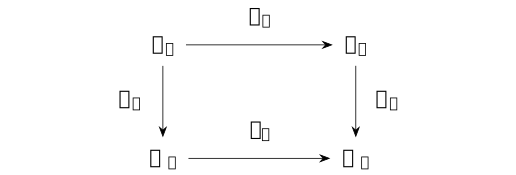
The horizontal maps select a sector; the right map removes one free coordinate within it. The algebra factors \(k\times k\), the full rank-two sectors, and the retained rank-one sectors are different levels of decomposition.