Remark. How to read these notes [fdip-004E]
Remark. How to read these notes [fdip-004E]
The reading route has 14 parts. The diagrams show selected prerequisites for reading, not every premise of every result. An arrow means that its destination uses a construction or comparison from its source. Each statement still gives its precise hypotheses. Questions on the arrows motivate the next topic; they do not assert that the notes already derive the corresponding physics.
The overview includes the full intended route. The prime-by-prime Gaussian extension, Structure and the concluding comparison of fixed and free data are published. The Grassmann integration chapter, fermionic elimination, covariant Dirac operators and the Wilson term develop the fermion part. The compatibility test fixes one finite spinor datum. The larger proposals remain open tests. A solid arrow into open material records an intended prerequisite, not a result already proved. In the part diagrams, a dotted box names a neighboring part; every arrow is solid.
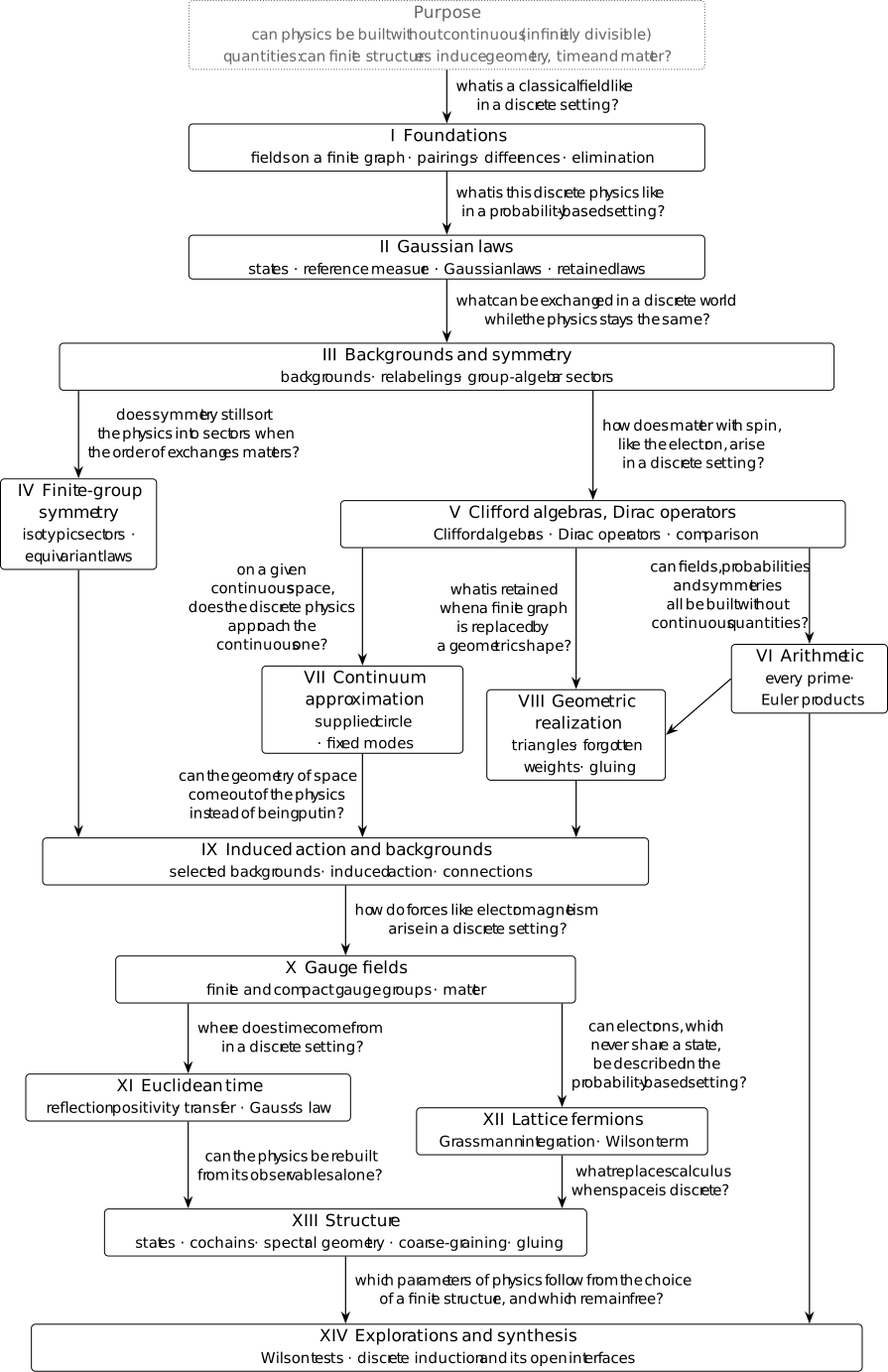
After backgrounds and symmetry, the route separates finite-group sectors from Clifford algebras and spatial Dirac operators. The latter lead to arithmetic, approximation on a supplied circle and geometric realization. These are not three independent branches: the fiber-constancy criterion remains in Arithmetic and is used by Realization. The direct comparison from Part V also remains visible. The figures therefore show selected prerequisites, not an exact transitive reduction of all dependencies.
Finite-group sectors, circle approximation and realization meet in the study of selected backgrounds and induced actions. Connections lead to gauge fields; Euclidean time and the fermion branch then feed the Structure part. The fermion branch currently supplies its Grassmann integration, elimination, covariant Dirac operators and the free Wilson remedy. The arrow from gauge fields to Euclidean time meets the gauge transfer and Gauss's law. Reflection positivity alone does not supply that shift. The arrow from gauge fields to lattice fermions meets the covariant Dirac operator and the free Wilson remedy above, not Grassmann integration or fermionic elimination, and it does not identify those operators with a physical electron. Arithmetic and Structure contribute different questions to the closing explorations. These destinations are earned by specific finite constructions, rather than adopted as starting axioms.
- Part I, Foundations: fields on finite carriers, reference pairings, differences and algebraic elimination.
- Part II, Gaussian laws: states, reference measure, positive and constrained Gaussian laws, and retained observables.
- Part III, Backgrounds and symmetry: transported data, observables and half-turn sectors.
- Part IV, Finite-group symmetry: real isotypic projectors, multiplicities and Gaussian sector laws.
- Part V, Clifford algebras, spatial Dirac operators and enriched comparison: distinct questions about quadratic forms, first-order operators and preserved observables.
- Part VI, Arithmetic families, followed by the Gaussian extension at every prime.
- Part VII, Continuum approximation: a supplied circle and fixed Fourier modes, not a general emergent continuum.
- Part VIII, Geometric realization: which information survives a replacement by a shape, including the weights it can forget.
- Part IX, Selected backgrounds, induced actions and interactions, local laws and gluing, and connections and holonomy.
- Part X, Gauge fields: finite surface laws, matter-induced actions, dynamical connections and compact groups.
- Part XI, Euclidean time: reflected pairings, explicit transfer operators and Gauss's law. Reflection positivity alone does not supply a time shift.
- Part XII, Lattice fermions: finite Grassmann integration, determinants, Pfaffians, Wick identities and elimination, followed by covariant Dirac operators and doubling and the Wilson remedy.
- Part XIII, Structure: operator-algebra, cochain, spectral-geometry, coarse-graining and gluing questions, developed in the chapters of that part. Speculative and optional sections retain those qualifications.
- Part XIV, Explorations and synthesis: the existing conjecture and finite interfaces, the compatibility test, and a comparison of what is fixed or free. The larger proposals remain open tests. The synthesis records the remaining open comparisons: the physical environment map, the continuum question, asked and not answered, with no moduli map claimed, and geometric or moduli structure beyond the published groupoid and realization.
The part diagrams appear at their openings. The Structure diagram routes its time input to the transfer chapter and its fermion input to the Dirac-Kähler chapter, where those suppliers are actually intended. It does not make the earlier states or cochains definitions consequences of time evolution or fermions. The root retains one linear reading order; forward examples and open questions orient that reading without becoming premises of the preceding proofs.