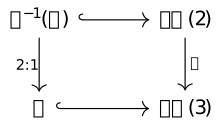
The kernel statement is the restriction of
\(\ker \pi =\{1,-1\}\) from Proposition [fdip-007G]. The same source
identifies \(2T\) with the full preimage \(\pi ^{-1}(R_T)\) and
gives \(|R_T|=12\). The matrix \(M(-1)=-I_2\), so
\(\rho _s(-1)=-I_2\). Conjugation by the quaternion \(-1\) is
the identity, so \(\tau (-1)=I_3\). Therefore
\[P=I_2\oplus 0.\]
On the quaternion module, left multiplication by the quaternion
\(-1\) is \(-1\), so that module's algebra action sends \(e_-\)
to \(1\) and \(e_+\) to \(0\). The abstract involution maps to
that quaternion, and \(\rho =\rho _s\oplus \tau \), so
\[\rho (z)=-I_2\oplus I_3.\]
Hence \(\rho (e_-)=(I-\rho (z))/2=P\), while
\[\rho (e_+)=(I+\rho (z))/2=0\oplus I_3.\]
The scalar \(0\) is the quaternion-module action of \(e_+\),
not this operator.
Label the 4 imaginary vectors of Proposition [fdip-007G] by
\[v_1=(1,1,1),\; v_2=(1,-1,-1),\;
v_3=(-1,1,-1),\; v_4=(-1,-1,1).\]
Their differences
\[v_2-v_1=(0,-2,-2),\; v_3-v_1=(-2,0,-2),\;
v_4-v_1=(-2,-2,0)\]
are linearly independent: after removing the common factor
\(-2\), the determinant of
\[\begin {pmatrix}0&1&1\\1&0&1\\1&1&0\end {pmatrix}\]
equals \(2\). A rotation fixing all 4 vertices therefore
fixes a basis of \(\mathbb R^3\) and is the identity. The
vertex action gives an injective homomorphism
\(R_T\to S_4\).
Conjugation by \(i\) is the coordinate map
\((x,y,z)\mapsto (x,-y,-z)\). Indeed, for
\(v=xi+yj+zk\),
\[iv=(-x)+(yk-zj),\qquad
(iv)(-i)=xi-yj-zk,\]
where the last step uses \(ji=-k\) and \(ki=j\). The same
expansion with cycled units gives
\[j:(x,y,z)\mapsto (-x,y,-z),\qquad
k:(x,y,z)\mapsto (-x,-y,z).\]
On the 4 vertices these are the permutations
\[(1\;2)(3\;4),\qquad (1\;3)(2\;4),\qquad (1\;4)(2\;3).\]
Each is even. Let \(u=-1+i+j+k\) and
\(\omega =u/2\in 2T\). Direct multiplication yields
\[\begin {array}{c|c}
v&uv\overline u/4\\\hline
v_1&v_1\\
v_2&v_4\\
v_3&v_2\\
v_4&v_3
\end {array}\]
so \(\pi (\omega )\) fixes \(v_1\) and acts by the cycle
\((2\;4\;3)\). This cycle is even. Conjugation by it permutes
the three double transpositions:
\[\begin {aligned}
(2\;4\;3)(1\;2)(3\;4)(2\;4\;3)^{-1}&=(1\;4)(2\;3),\\
(2\;4\;3)(1\;4)(2\;3)(2\;4\;3)^{-1}&=(1\;3)(2\;4),\\
(2\;4\;3)(1\;3)(2\;4)(2\;4\;3)^{-1}&=(1\;2)(3\;4).
\end {aligned}\]
The cycle has order \(3\), while every non-identity element of
that Klein subgroup has order \(2\), so the two subgroups meet
only at the identity. These 12 permutations are the vertex
permutations of products in \(R_T\). They are distinct, and
\(|R_T|=12\), so they exhaust the vertex image. All 12 are
even. Combined with injectivity, the vertex map is an
isomorphism \(R_T\cong A_4\). The composite
\(2T\to R_T\to A_4\) has kernel \(\{1,-1\}\).
For the \(d=3\) matrices of Definition [fdip-000R],
\(\gamma _a^2=I\) and
\(\gamma _a\gamma _b=-\gamma _b\gamma _a\) whenever \(a\ne b\).
Set
\[I\mapsto 1,\quad
\gamma _1\gamma _2\mapsto i,\quad
\gamma _2\gamma _3\mapsto j,\quad
\gamma _1\gamma _3\mapsto k.\]
Then
\[(\gamma _1\gamma _2)^2=-\gamma _1^2\gamma _2^2=-I,\]
and the same sign occurs for the other two products. Also
\[(\gamma _1\gamma _2)(\gamma _2\gamma _3)=\gamma _1\gamma _3,\]
and the two cyclic products match \(jk=i\) and \(ki=j\).
These are the quaternion relations. They identify an action
of the same abstract group on the even products. They do not
state an intertwiner between left multiplication and the
spatial operator \(\sum _j\gamma _j\nabla _j\).