Theorem. Gauge projection and periodic-time traces [fdip-0083]
AGENTDRAFTED
For a finite truncation \(k_F\) of
Spatial link fields and their transfer kernel,
with \(F\) nonempty and closed
under dual representations, let \(b\) and \(T_F\) be the
half-weight and truncated transfer operator of that definition.
For bounded Borel \(f:X\to \mathbb C\), the gauge average is
\[(Pf)(U)=\int _K f(h^{-1}\cdot U)\,dh.\]
The matrix coefficients of representations in \(F\), one factor
on each edge, are a finite set \(\mathcal I_F\). For
\(f\) bounded and Borel,
\[(T_Ff)(U)=\sum _{I\in \mathcal I_F}\alpha _I
b(U)\phi _I(U)\int _X b\overline {\phi _I}f\,dU,
\qquad \alpha _I=\prod _{e\in E_s}a_{\rho _e}>0,\]
and \(\sum _{I\in \mathcal I_F}\alpha _I=\kappa _F^{|E_s|}\).
This is a finite sum of integrals. The gauge average preserves
the span of these coefficients. The operator \(S_F\), given by
\(P\), then \(T_F\), then \(P\), has finite rank. Its trace is the
matrix trace on the span of the functions \(P(b\phi _I)\).
For every integer \(N\ge 1\), put \(U_N=U_0\) and take
independent variables \(U_j\in X\) and \(h_j\in K\) for
\(0\le j<N\). Define
\[\begin {aligned}
B_{j,e}&=U_{j,e}h_{j,s(e)}U_{j+1,e}^{-1}h_{j,t(e)}^{-1},\\
\mathcal W_N(F)
&=\prod _{j=0}^{N-1}\mathrm {e}^{-V(U_j)}
\prod _{j=0}^{N-1}\prod _{e\in E_s}k_F(B_{j,e}).
\end {aligned}\]
With normalized product Haar measures,
\[Z_N(F)=\int _{X^N\times K^N}\mathcal W_N(F)\,\mathrm {d} U\,\mathrm {d} h
=\operatorname {tr}(S_F^N).\]
This is a finite identity. If \(|E_s|\ge 1\), then for every finite
\(F'\) properly containing \(F\), with the same dual closure and
\[M=N|E_s|,\qquad
\varepsilon _{F',F}=\kappa _{F'}-\kappa _F,\]
the truncations satisfy
\[|Z_N(F')-Z_N(F)|
\le \|b\|_\infty ^{2N}M\kappa _{F'}^{M-1}\varepsilon _{F',F}.\]
If \(E_s\) is empty, the kernel product is \(1\) and
\(Z_N(F)\) does not depend on \(F\).
For independent gauge changes \(g_j\in K\), with \(g_N=g_0\),
the transformations are
\[\begin {aligned}
U_j&\longmapsto g_j\cdot U_j,\\
h_{j,v}&\longmapsto g_{j,v}h_{j,v}g_{j+1,v}^{-1}.
\end {aligned}\]
Each \(B_{j,e}\) is conjugated by \(g_{j,t(e)}\). Therefore the
truncated weight and the measure are invariant. If
\(f_j:X\to \mathbb C\) are bounded measurable gauge-invariant
functions and \(Z_N(F)\ne 0\), multiplication by \(f_j\) preserves
the gauge-invariant bounded functions, and
\[\mathbb E_N\prod _{j=0}^{N-1}f_j(U_j)
=\frac {1}{Z_N(F)}
\int _{X^N\times K^N}
\prod _{j=0}^{N-1}f_j(U_j)\,\mathcal W_N(F)\,dU\,dh.\]
This is a finite periodic-time identity for the specified spatial
observables, with the temporal links integrated as above. For
\(N=1,2\), the formula retains the indexed temporal steps; it
does not identify them with edges of an ordinary simple cycle.
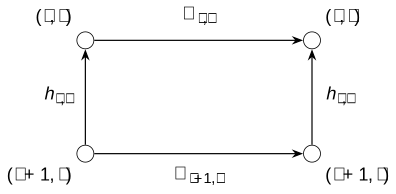
The temporal plaquette based at \((j,t)\) is traversed down
the right edge, backwards along the bottom, up the left edge and
then along the top. With the transport order, the
first transport acts on the right and the product is exactly
\(B_{j,e}\). Temporal averaging is retained at every step, so no
periodic gauge-fixing assumption removes \(P\).
Remark. Continuum comparison. The convergent series and the
\(L^2\) setting are not the statement above. On the
link Hilbert space, normalized gauge
averaging is the orthogonal projection onto
\[\mathcal H_{\mathrm {phys}}
=\{f:R_hf=f\text { for every }h\in K\}
=P\mathcal H_{\mathrm {link}},\]
the physical Hilbert space. For a kernel \(k\) in the continuum comparison of
Spatial link fields and their transfer kernel,
the restriction
\(T_{\mathrm {phys}}\) is positive, injective and trace class, and
\[Z_N=\operatorname {tr}_{\mathrm {phys}}T_{\mathrm {phys}}^N
=\operatorname {tr}_{\mathrm {link}}(PT^N)>0.\]
The rank-one expansion of Theorem [fdip-0080] writes this operator
as a series over all representation blocks. Its kernel expansion
converges uniformly on finite sets of blocks, and the tail is the
corresponding tail of \(\sum _I\alpha _I=\kappa ^{|E_s|}\). The
Hilbert–Schmidt trace identity of Theorem [fdip-007V] identifies the
untruncated periodic trace with the lattice integral of the
untruncated weight. The finite identities above are the partial
sums of that comparison.