Example. Thirty-two neutral states on a two-by-two sign torus [fdip-008D]
Example. Thirty-two neutral states on a two-by-two sign torus [fdip-008D]
Let the spatial vertices be \(V_s=(\mathbb Z/2\mathbb Z)^2\). For each vertex \(x\) and direction \(i\in \{1,2\}\), retain a separate edge \(e_{x,i}\) from \(x\) to \(x+\hat i\). There are 4 vertices and 8 indexed edges. In a period-two direction, \(e_{x,i}\) and \(e_{x+\hat i,i}\) have opposite endpoints but are distinct edges. The underlying graph is a multigraph with two parallel edges on each side of a square, not an ordinary four-cycle.
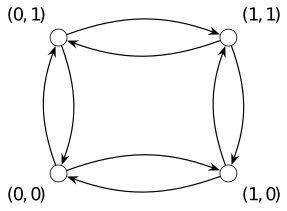
Each directed arc is one indexed edge. Horizontal and vertical arcs represent positive steps in the first and second coordinates, respectively; modulo two, both directions are positive coordinate steps. No face or plaquette constraint is imposed on the spatial link configurations in this example.
Take \(G=\mathbb Z_2\), written additively as \(\mathbb F_2\). A link configuration is \(u\in \mathbb F_2^{E_s}\), so \[\dim _{\mathbb C}\mathcal H_{\mathrm {link}}=2^8=256.\] A gauge function \(a\in \mathbb F_2^{V_s}\) acts by \[u_e\longmapsto u_e+a_{t(e)}+a_{s(e)}.\] The corresponding incidence map \(\delta :\mathbb F_2^{V_s}\to \mathbb F_2^{E_s}\) has kernel the constant functions: vanishing on every edge forces equal values along every path, and the graph is connected. Thus \(\dim \ker \delta =1\), \(\operatorname {rank}\delta =3\) and \(|\operatorname {im}\delta |=8\).
Every gauge orbit is a coset of \(\operatorname {im}\delta \), with 8 elements. The orbit basis therefore gives \[\dim _{\mathbb C}\mathcal H_{\mathrm {phys}} =\frac {256}{8}=32=2^5.\] The exponent is the cycle rank of this multigraph, \(b_1=|E_s|-|V_s|+1=8-4+1=5\). Equivalently, choose a spanning tree with three edges and set their additive link values to zero successively from a root. The remaining 5 chord values are free; the residual constant gauge function changes none of them. This supplies the same 32 representatives. The result counts neutral states of the link Hilbert space; it does not impose a flatness condition or identify opposite indexed edges.