Example. Parity and adjoint on the four-cycle [fdip-001M]
AGENTDRAFTED
Let \(R\) be a commutative unital ring. On the
four-cycle, take \(V=\mathbb Z/4\mathbb Z\),
\(H=\mathcal F_R(V)\) and the additional partition
\(V_0=\{0,2\}\), \(V_1=\{1,3\}\). The
cyclic shift \(T:H\to H\) is
\((Tf)(i)=f(i+1)\). It exchanges the two support submodules:
if \(f\) is supported on \(V_j\), then \(Tf\) is supported on
\(V_{j+1}\). Hence \(T\) is odd in the
chosen operator grading.
For the counting adjoint
constructed over \(R\) in Proposition [fdip-001H],
reindexing the finite sum proves
\[b(Tf,g)=\sum _i f(i+1)g(i)
=\sum _j f(j)g(j-1)=b(f,T^{-1}g),\]
so \(T^\dagger =T^{-1}\). Also \(T^4=I\); thus the half-turn
\(T^2\) is even and satisfies
\((T^2)^\dagger =T^{-2}=T^2\). These unweighted counting
identities do not assert that the one-step shift preserves the
alternating weights. The weight-preserving half-turn and the
one-step counterexample remain those in Example [fdip-0003].
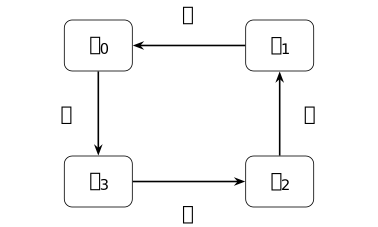
The arrows show the action on basis fields, opposite to the
source-to-head orientation on vertices. Every arrow switches support
parity; two steps give the half-turn.
In particular, over \(\mathbb Z\),
\(T^2\delta _0=\delta _2\ne 0\). Thus an odd operator need not
square to zero. It need not satisfy a graded commutation law
either: that law applied to \(T,T\) would give \(2T^2=0\),
whereas \(2T^2\delta _0=2\delta _2\ne 0\).
Identify edge \(i\) with vertex \(i\), with source \(i\) and
head \(i+1\), as in Lemma [fdip-0009]. Only after this identification
does incidence become the endomorphism \(\Delta =T-I\).
Its even component is \(-I\) and its odd component is \(T\).
Over \(\mathbb Z\), both are nonzero, so \(\Delta \) is
inhomogeneous, and
\[\Delta ^2\delta _0=\delta _2-2\delta _3+\delta _0\ne 0.\]
The formulas remain valid over every commutative unital ring,
but the nonzero witnesses just used are specifically over
\(\mathbb Z\); in the zero ring all these fields and maps vanish.
This is a direct specialization of the
shift-multiplication realization and
partition construction, not a square-zero
differential supplied by parity.
[wieser2022graded, Section 1, accepted-manuscript pp. 1-2] gives the grading convention;
the shift, adjoint and failure witnesses are the computations here.