Gauge actions induced by matter [fdip-006Z]
✍️sourceAGENTDRAFTED
- November 1, 2026
Gauge actions induced by matter [fdip-006Z]
✍️sourceAGENTDRAFTED
- November 1, 2026
A connection background determines a positive matter precision. Integrating out the matter field makes its determinant a function of that fixed connection. On a regular lattice, a convergent expansion writes this function as a sum over closed walks. The shortest walks enclosing a square produce a plaquette term, while walks winding around short periodic directions explain why the lattice periods matter.
Real and complex fields have different determinant exponents. Keeping those exponents and the reference volume explicit fixes both the induced coupling and the derivative interpreted as a current. The following statements are finite-volume identities and a controlled large-mass expansion. A joint probability law for matter and a varying connection requires an additional choice of gauge measure and action.
Definition 1. The determinant action of a fixed connection [fdip-0070]AGENTDRAFTED
- November 1, 2026
Definition 1. The determinant action of a fixed connection [fdip-0070]AGENTDRAFTED
- November 1, 2026
Use a connection background with its fixed invariant fiber metric and mass \(m>0\). Let \(\mathbb K=\mathbb R\) with an orthogonal representation, or \(\mathbb K=\mathbb C\) with a unitary representation. The matter space is \(\mathcal H=F^V\), and \(N=\dim _{\mathbb K}\mathcal H\) includes the fiber dimension. Write \(d\operatorname {vol}\) for the induced real volume on this space, of real dimension \(N\) or \(2N\), respectively. Set \[\begin {array}{c|cc} \mathbb K&\kappa &d\nu \\\hline \mathbb R&1/2&(2\pi )^{-N/2}d\operatorname {vol}\\ \mathbb C&1&\pi ^{-N}d\operatorname {vol} \end {array}\] and define the matter partition function and determinant action by \[\begin {aligned} Z_{\mathrm {mat}}(U) &=\int _{\mathcal H}e^{-\kappa \langle \phi ,Q_U\phi \rangle }\,d\nu (\phi ),\\ W(U)&=-\log Z_{\mathrm {mat}}(U). \end {aligned}\] The connection is fixed in this integral; only \(\phi \) is integrated.
Orthogonal or unitary diagonalization reduces the integral to positive eigenvalues \(\lambda _1,\ldots ,\lambda _N\). Each real coordinate contributes \(\lambda _j^{-1/2}\) by the real Gaussian integral; each complex coordinate contributes \(\lambda _j^{-1}\) by the complex integral. Therefore \[Z_{\mathrm {mat}}(U)=(\det _{\mathbb K}Q_U)^{-\kappa },\qquad W(U)=\kappa \log \det _{\mathbb K}Q_U.\] The determinant is positive even in the complex case, since \(Q_U\) is positive Hermitian. These reference measures make \(Z_{\mathrm {mat}}=1\) when \(Q_U=I\). The normalized matter law has density \(Z_{\mathrm {mat}}(U)^{-1}e^{-\kappa \langle \phi ,Q_U\phi \rangle }\) with respect to \(\nu \), and covariance \(Q_U^{-1}\) over the chosen field. In the complex convention this means \(\mathbb E[\phi \phi ^*]=Q_U^{-1}\).
A gauge transformation acts unitarily on \(\mathcal H\), and gauge covariance gives \(Q_{U^g}=T_gQ_UT_g^{-1}\). Thus \(W(U^g)=W(U)\). Unitary coordinate changes also preserve the declared real volume. The metric, mass, weights and graph remain supplied data; this determinant does not choose them or yet define a probability law on connections.
Theorem 2. A convergent expansion over closed walks [fdip-0071]AGENTDRAFTED
- November 1, 2026
Theorem 2. A convergent expansion over closed walks [fdip-0071]AGENTDRAFTED
- November 1, 2026
Let the vertices be \(\Lambda =\prod _{j=1}^d\mathbb Z/L_j\mathbb Z\), with \(L_j\ge 3\). Give each edge \((x,j):x\to x+e_j\) weight one and a unitary or orthogonal transport \(U_{x,j}\) on a fixed fiber. For the determinant action, put \(D=2d+m^2\), where \(m>0\), and let \(H_U\) be the covariant adjacency operator. Then \[Q_U=DI-H_U,\qquad \|H_U\|\le 2d<D,\] and \[W(U)=\kappa N\log D- \kappa \sum _{k\ge 1}\frac {\operatorname {tr}_{\mathbb K}(H_U^k)}{kD^k}.\] The series is absolutely convergent, uniformly over all such unitary connections. For \(K\ge 0\), its remainder after length \(K\) satisfies \[|R_K(U)|\le \frac {\kappa N}{K+1} \frac {(2d/D)^{K+1}}{1-2d/D}.\] Each trace is the sum of fiber holonomy traces over all based oriented closed nearest-neighbor walks of length \(k\).
Proof.
- November 1, 2026
Proof.
- November 1, 2026
Define the covariant shift \[(T_j\phi )(x)=U_{x-e_j,j}\phi (x-e_j).\] A permutation of sites and the unitary fiber maps preserve the norm, so \(T_j\) is unitary. Expanding the difference energy gives \[H_U=\sum _{j=1}^d(T_j+T_j^*),\qquad Q_U=(2d+m^2)I-H_U.\] Thus \(H_U\) is self-adjoint and the triangle inequality gives \(\|H_U\|\le 2d\). If its eigenvalues are \(h_1,\ldots ,h_N\), then \(|h_i|/D<1\). Apply the scalar Taylor series for \(\log (1-h_i/D)\) to \(\log \det Q_U=N\log D+\sum _i\log (1-h_i/D)\). There are finitely many eigenvalues and \[|\operatorname {tr}(H_U^k)|\le N(2d)^k,\] so the resulting trace series is absolutely convergent. For \(k\ge K+1\), bound \(1/k\le 1/(K+1)\) and sum the geometric tail. This proves the stated uniform remainder.
The matrix block from \(s(e)\) to \(h(e)\) in \(H_U\) is \(U_e\), and the reverse block is \(U_e^*\). Multiplying \(k\) blocks follows an oriented walk; the diagonal blocks are exactly the closed walks. The ordered product agrees with the transport convention, and taking the fiber trace gives the claimed expansion. Reverse walks pair adjoint products, so the total is real even for a complex fiber.
Mathlib's
Real.hasSum_pow_div_log_of_abs_lt_one states, for a real
\(x\) with \(|x|<1\),
\[\sum _{n\ge 0}\frac {x^{n+1}}{n+1}=-\log (1-x).\]
It supplies the scalar series used for each real eigenvalue. Spectral
reduction, the walk interpretation, the lattice norm bound and the
uniform trace remainder are the additional arguments above; the
formal declaration does not state this lattice expansion.
The numerical bound \(2d\) and scalar diagonal \(D\) use this regular lattice and its unit edge weights. For arbitrary weights or degrees one must change the diagonal decomposition and norm estimate; the displayed bound is not asserted unchanged.
Kazakov and Migdal integrate an adjoint matrix field in a different lattice model. Their Section 2, equations (3)–(4), gives a trace-log and loop weights involving \(|\operatorname {tr}U[\Gamma ]|^2\) [kazakov1992induced, p. 2]. This is a comparison with the closed-walk method. The finite real-scalar coefficient below follows from the present proof, not from their large-\(N\) analysis or a continuum identification.
Theorem 3. The induced scalar plaquette coefficient [fdip-0072]AGENTDRAFTED
- November 1, 2026
Theorem 3. The induced scalar plaquette coefficient [fdip-0072]AGENTDRAFTED
- November 1, 2026
On a square torus with both periods at least 6, take a real scalar field and \(G=\{1,-1\}\) in its sign representation. Use unit weights, \(m>0\), \(N=|\Lambda |\) and \(D=4+m^2\). For the plaquette holonomies, \[\begin {aligned} W(U)={}&C(D,N)-\frac 1{D^4}\sum _pU_p+R(U),\\ C(D,N)={}&\frac N2\log D-\frac N{D^2}-\frac {7N}{2D^4},\\ |R(U)|\le {}&\frac N{12}\frac {(4/D)^6}{1-4/D}. \end {aligned}\] Thus the fourth-order induced Wilson coefficient is \(\beta _{\mathrm {ind}}=(4+m^2)^{-4}>0\). The remainder is uniformly \(O(D^{-6})\) in the connection at fixed finite volume as \(D\to \infty \).
Proof.
- November 1, 2026
Proof.
- November 1, 2026
A torus walk of length at most 5 lifts to a walk in \(\mathbb Z^2\) whose displacement in each coordinate is a multiple of the corresponding period. Each displacement has absolute value at most 5, so both must be zero. Such a walk has even length. Consequently \[\operatorname {tr}H_U=\operatorname {tr}H_U^3 =\operatorname {tr}H_U^5=0.\] There are 4 two-step returns at each vertex, each traversing one edge and its inverse, so \(\operatorname {tr}H_U^2=4N\).
There are 36 four-step returns at each vertex of \(\mathbb Z^2\). Of them, 12 use one axis: on either axis there are 6 orderings of two positive and two negative steps. The other 24 use both axes: these are the permutations of the 4 distinct directions. Of those, 8 trace elementary squares; the other 16 retrace edges. All 28 retracing walks have holonomy one. Each plaquette has 4 choices of starting vertex and two orientations, which give the same sign \(U_p\). Hence \[\operatorname {tr}H_U^4=28N+8\sum _pU_p.\] Insert these traces into the closed-walk series, with \(\kappa =1/2\), and use its remainder bound with \(K=5\).
The exact matter factor can therefore be written \[e^{-W(U)}=e^{-C(D,N)} \exp \left (\beta _{\mathrm {ind}}\sum _pU_p\right )e^{-R(U)}.\] The displayed plaquette term favors positive holonomy. Higher closed walks remain in \(R\); the complete determinant is not replaced by a pure plaquette action. Winding walks of length 6 are permitted by the hypothesis and belong to the remainder. On an odd period such as 7, odd winding walks also occur at higher orders; the proof only asserts vanishing through length 5.
Example 4. Short periods add winding terms [fdip-0073]AGENTDRAFTED
- November 1, 2026
Example 4. Short periods add winding terms [fdip-0073]AGENTDRAFTED
- November 1, 2026
Start with all links equal to one on an \(L\times L\) square torus, then change one horizontal link to minus one. Keep the real scalar convention, \(D=4+m^2\), and write \(\Delta W=W(U_{\mathrm {flip}})-W(1)\). Two adjacent plaquettes change sign, so \(\Delta \sum _pU_p=-4\). For \(L\ge 6\), the induced plaquette theorem gives \[\Delta W=\frac 4{D^4}+O(D^{-6}),\qquad \frac {\Delta W}{4/D^4}\longrightarrow 1.\] The constants in the error bound may depend on the fixed volume.
For \(L=4\), there are also straight four-step walks winding around a periodic row or column. The changed edge lies in one horizontal winding cycle. It has 4 starting vertices and two orientations, so 8 based walks change holonomy from one to minus one. Their contribution to \(\Delta \operatorname {tr}H^4\) is \(-16\), in addition to the plaquettes' \(8(-4)=-32\). There are no odd closed walks because this torus is bipartite. The same convergent series therefore gives \[\Delta W=\frac 6{D^4}+O(D^{-6}),\qquad \frac {\Delta W}{4/D^4}\longrightarrow \frac 32.\] The extra leading term is winding holonomy, not a different local plaquette coefficient.
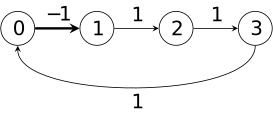
The diagram shows one horizontal row of the \(4\times 4\) torus; vertical edges are omitted. The curved edge is the periodic join. The four-step winding product is minus one, independently of the two neighboring plaquette products.
For \(L=5\), length-4 winding is absent, but each periodic row or column has straight winding walks of length 5. The changed row has 10 such based oriented walks, so \(\Delta \operatorname {tr}H^5=-20\). No other five-step return can wind: displacement 5 requires all 5 steps along that axis. The plaquette change remains \(\Delta \operatorname {tr}H^4=-32\). Consequently \[\Delta W=\frac 4{D^4}+\frac 2{D^5}+O(D^{-6}).\] Thus a period-5 hypothesis would leave an order \(D^{-5}\) term outside the claimed order \(D^{-6}\) remainder. This is why the preceding theorem requires both periods to be at least 6.
Proposition 5. A link current is an action derivative [fdip-0074]AGENTDRAFTED
- November 1, 2026
Proposition 5. A link current is an action derivative [fdip-0074]AGENTDRAFTED
- November 1, 2026
Use a complex scalar field on the unit-weight lattice of Theorem 2, with \(G=U(1)\), \(U_e=e^{iA_e}\) and \(m>0\). Fix an oriented edge \(e:s\to h\), and let its angle \(A_e\) vary while all other angles are fixed. For the complex matter law, write \[S_U(\phi )=\phi ^*Q_U\phi ,\qquad C_U=Q_U^{-1}.\] Define the sign of the link current by \[J_e(\phi ,U)=\frac {\partial S_U(\phi )}{\partial A_e} =2\operatorname {Im}(\overline {\phi _h}U_e\phi _s).\] Then \[\begin {aligned} \frac {\partial W}{\partial A_e} &=\operatorname {tr}_{\mathbb C} \left (C_U\frac {\partial Q_U}{\partial A_e}\right )\\ &=\mathbb E_U[J_e] =2\operatorname {Im}\bigl (U_e(C_U)_{s,h}\bigr ). \end {aligned}\] All expectations here condition on the fixed connection \(U\).
Proof.
- November 1, 2026
Proof.
- November 1, 2026
The only angle-dependent edge energy is \[|\phi _h-e^{iA_e}\phi _s|^2 =|\phi _h|^2+|\phi _s|^2 -2\operatorname {Re}(\overline {\phi _h}e^{iA_e}\phi _s).\] Its derivative is the displayed positive twice-imaginary-part expression, fixing the current sign. The matrix derivative has entries \(-iU_e\) in position \((h,s)\) and \(i\overline {U_e}\) in position \((s,h)\), and zero elsewhere. Since \(C_U\) is Hermitian, its trace pairing with that derivative is \(2\operatorname {Im}(U_e(C_U)_{s,h})\).
The determinant derivative used in the edge-variance identity applies equally to complex invertible matrices. Along this real parameter, \(Q_U\) stays positive Hermitian, so its determinant is positive and \[\frac {\partial }{\partial A_e}\log \det _{\mathbb C}Q_U =\operatorname {tr}_{\mathbb C} \left (Q_U^{-1}\frac {\partial Q_U}{\partial A_e}\right ).\] Finally, the complex Gaussian covariance gives \(\mathbb E_U[\overline {\phi _h}\phi _s]=(C_U)_{s,h}\). Substitution into the explicit current proves the expectation identity.
TauCeti's Matrix.fderiv_det_apply supplies
\(D\det (Q)[B]=\det (Q)\operatorname {tr}(Q^{-1}B)\) over a complete
nontrivially normed field when \(\det Q\) is a unit. Complex positive
definiteness supplies invertibility here. The logarithm, angle direction,
current sign and Gaussian expectation are the additional steps above;
the formal declaration does not state this current law.
For a differentiable real orthogonal family, the corresponding convention uses \(S=\frac 12\langle \phi ,Q\phi \rangle \), \(J=\partial S\) and \(W=\frac 12\log \det _{\mathbb R}Q\). Both sides then carry the same factor \(1/2\). In the complex convention used here, neither the action nor the log determinant has that factor.