Theorem. Symmetry survives the Gaussian marginal [fdip-000K]
Theorem. Symmetry survives the Gaussian marginal [fdip-000K]
Let a group \(\Gamma \) act by a signed-incidence symmetry on a finite incidence presentation with positive real weights and nonempty vertex set. Use the counting pairings, their induced Borel volume and a scalar mass \(m>0\). The positive massive precision and inverse-precision covariance are \[L=d^\dagger Wd,\qquad Q=L+m^2I,\qquad G=Q^{-1}.\] For every \(g\in \Gamma \), \[\begin {aligned} LP_g&=P_gL,&QP_g&=P_gQ,\\ GP_g&=P_gG,&P_gGP_g^\dagger &=G. \end {aligned}\] Thus \(Qf=j\) implies \(Q(P_gf)=P_gj\). The Gaussian law is invariant: \((P_g)_*\mu _Q=\mu _Q\). For every real or complex Borel observable \(F\), \[\begin {aligned} \int |F\circ P_g|\,d\mu _Q&=\int |F|\,d\mu _Q,\\ \omega _Q(F\circ P_g)&=\omega _Q(F) \end {aligned}\] with extended integrals in the first equality, and finite absolute integral required in the second.
Suppose further that a nonempty proper retained subset \(R\subsetneq V\) is stable under every \(p_g\). Its complement \(D=V\setminus R\) is also stable. The restricted maps \(P_{g,R},P_{g,D}\) give the orthogonal split correspondence. For the split components \(A,B,E,C\), with \(E=B^\dagger \), and \(S=A-BC^{-1}E>0\), one has \[\begin {aligned} P_{g,R}SP_{g,R}^{-1}&=S,\\ P_{g,R}S^{-1}P_{g,R}^{-1}&=S^{-1},\\ (P_{g,R})_*\mu _S&=\mu _S. \end {aligned}\] The retained equation \(Sx=k\) is equivariant as well. The full fiber factor \(c_C=(2\pi )^{|D|/2}/\sqrt {\det C}\) and the stationary eliminated field are compatible with the action: \[y_*(P_{g,R}x)=P_{g,D}y_*(x),\qquad y_*(x)=-C^{-1}Ex.\]
For the half-turn, retain \(R=(0,2)\) and eliminate \(D=(1,3)\). Both restrictions are the nonidentity swap \(J=\begin {pmatrix}0&1\\1&0\end {pmatrix}\). Here \(H\) is the array of the split component \(B\). The projection square is
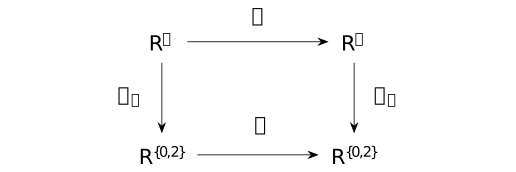
The lower map swaps the two retained coordinates. Put \(a=m^2\) and \(s=1+t+a\). The explicit elimination gives \[\begin {aligned} A=C&=sI_2,\qquad H=-\begin {pmatrix}1&t\\t&1\end {pmatrix},\\ S&=\begin {pmatrix}\alpha &-\beta \\-\beta &\alpha \end {pmatrix},\\ \alpha &=s-\frac {1+t^2}{s},\qquad \beta =\frac {2t}{s}. \end {aligned}\] All three blocks commute with \(J\), hence \(JSJ=S\). Positivity follows also from the two eigenvalues \[\begin {aligned} \alpha -\beta &=\frac {a(a+2+2t)}s>0,\\ \alpha +\beta &=\frac {(a+2)(a+2t)}s>0. \end {aligned}\] Thus the same nontrivial action preserves the full and retained laws. The full covariance obeys \(G_{i+2,j+2}=G_{ij}\). Invariant state does not mean that each observable is pointwise invariant: \(\phi \mapsto \phi _0^2\) is sent to \(\phi \mapsto \phi _2^2\); they differ at \(\delta _0\), but their expectations agree.
At \(t=m=1\), direct inversion gives \[\begin {aligned} S&=\begin {pmatrix}7/3&-2/3\\-2/3&7/3\end {pmatrix},\\ S^{-1}&=\begin {pmatrix}7/15&2/15\\2/15&7/15\end {pmatrix}. \end {aligned}\] Both swapped squared coordinates have expectation \(7/15\). The observable \(\phi _0\phi _2\) is itself invariant under the half-turn and has expectation \(2/15\). These expectations agree before and after elimination.
The full and retained half-turns are both faithful: their nonidentity maps send \(\delta _0\) to \(\delta _2\). A general full faithful action can restrict trivially, for instance when it moves only eliminated vertices. These two assertions are compatible.
Three concrete obstructions distinguish the hypotheses: keeping fixed target labels after relabeling, breaking the alternating weights, and choosing a nonstable retained subset. The last is a failure of descent through that projection and does not exclude accidental symmetry of a marginal density. Extra mass fields or reference pairings would require their own preservation hypotheses.
[milne2025group, Definition 4.1 and p. 58] gives the group-action and stable-subset conventions.
[friedli2017statistical, Proposition B.55, p. 505] gives the Gaussian substitution convention. The incidence, stationary and half-turn computations above use the proved transport results and the exact cycle elimination.
Mathlib's LinearIsometryEquiv.measurePreserving
supplies isometry-volume preservation. TauCeti's
TauCeti.Probability.map_affine_multivariateGaussian
supports covariance-parameter pushforward for the supplied \(P_g\)
or retained projection after the precision-density bridge.
These declarations do not assert the endpoint, weight or stable-subset
hypotheses, or the concrete failures just cited.