Evaluate both sides of the Leibniz identity on an ordered
simplex of dimension \(k+l+1\), with vertices \(v_0\) through
\(v_{k+l+1}\). The coboundary of the product is the
alternating sum of the products on the faces. On the face that omits
\(v_i\) with \(i\le k\), the front face of dimension \(k\) is
\((v_0,\ldots ,\widehat {v_i},\ldots ,v_{k+1})\) and the back begins at
\(v_{k+1}\). Those are the terms \(i\le k\) of \((d\alpha )\cup \beta \).
On the face that omits \(v_i\) with \(i\ge k+1\), write \(j=i-k\). The
front is \((v_0,\ldots ,v_k)\) and the back omits the vertex of index
\(j\) in \((v_k,\ldots ,v_{k+l+1})\). The sign \((-1)^{k+j}\) is the sign
in \((-1)^k\alpha \cup (d\beta )\). The two sums therefore share every
face except the face \(i=k+1\) of \((d\alpha )\cup \beta \) and the face
\(j=0\) of \((-1)^k\alpha \cup (d\beta )\). Those two faces are the same
product
\(\alpha (v_0,\ldots ,v_k)\beta (v_{k+1},\ldots ,v_{k+l+1})\),
with signs \((-1)^{k+1}\) and \((-1)^k\), which add to zero.
On the simplex \((0,1,2)\), let \(\alpha \) and \(\beta \) be
\(1\)-cochains with \(\alpha (0,1)=1\), \(\alpha (1,2)=0\),
\(\beta (0,1)=0\) and \(\beta (1,2)=1\). Then
\((\alpha \cup \beta )(0,1,2)=1\) and \((\beta \cup \alpha )(0,1,2)=0\).
The two products differ as cochains. This note does not prove that
their difference becomes a coboundary after both factors are closed.
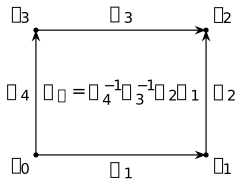
Write \(U_{p}\) for the plaquette holonomy.
For the square with lower-left corner
\((i,j)\), if \(b\) is its bottom edge, \(r\) its right edge, \(t\) its
top edge and \(s\) its left edge, each oriented rightward or upward,
then \(U_p=s^{-1}t^{-1}rb\). The displayed product is proved by
adding columns from the left. A single column has bottom edge
\(b_0\), right edges \(r_0,\ldots ,r_{N-1}\) from bottom to top, top
edge \(t\), and left edges \(s_0,\ldots ,s_{N-1}\). Its boundary
transport is \(s_0^{-1}\cdots s_{N-1}^{-1}t^{-1}r_{N-1}\cdots r_0b_0\).
The path \(\gamma _{0,j}\) is the left side up to height \(j\), with
transport \(\sigma _j=s_{j-1}\cdots s_0\) and \(\sigma _0=1\). One
square is already the boundary word. For several squares the
conjugate by \(\sigma _j^{-1}\) is
\(\sigma _j^{-1}s_j^{-1}t_j^{-1}r_jb_j\sigma _j\). In the product from
the top of the column down to the bottom, the junction of the
square at height \(j\) with the square below it is
\(\sigma _j\sigma _{j-1}^{-1}s_{j-1}^{-1}=1\), because
\(\sigma _j=s_{j-1}\sigma _{j-1}\), and \(b_jt_{j-1}^{-1}=1\),
because the bottom of the upper square is the top of the square
below it. The right edges remain in order from the top down, and
the surviving left edge is the full inverse
\(s_0^{-1}\cdots s_{N-1}^{-1}\). The product is the boundary word.
Suppose the identity holds for the rectangle with \(M-1\) columns,
and attach one column on the right. The conjugating paths of the
columns already present do not use the new column, so the inductive
product is the old boundary transport times the new column product,
the new factor standing on the right. Let \(\beta \) be the transport
along the old bottom, \(S\) the transport up the shared vertical
side, \(T\) the reversed old top and \(L\) the reversed left side.
The old boundary transport is \(LTS\beta \). The new boundary inserts
the new bottom edge \(b_0\) after \(\beta \), replaces the shared side
by the new right side \(R\), and inserts the inverse of the new top
edge \(t\) before \(T\). Its transport is
\(LTt^{-1}Rb_0\beta \). Each new path is the old bottom followed by
the upward path of the previous paragraph, so each new conjugate
is \(\beta ^{-1}\) times the corresponding column factor times
\(\beta \). Between successive squares \(\beta \) meets \(\beta ^{-1}\),
and the product of those conjugates is
\(\beta ^{-1}S^{-1}t^{-1}Rb_0\beta \). Here \(S\) is the upward
transport of the shared side, lowest edge on the right, so
\(\beta ^{-1}S^{-1}\) is the inverse of the path along the old
bottom and then up that side. Multiplying on the left by
\(LTS\beta \) cancels
\(\beta \) against \(\beta ^{-1}\) and \(S\) against \(S^{-1}\), and
leaves the new boundary transport. Finiteness of the group is not
used.