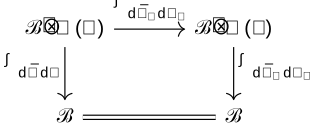
Remark. What a fermionic transfer theorem must supply [fdip-00JB]
AGENTDRAFTED
A positive determinant gives the ordinary connection law \(\nu \) of Proposition [fdip-00IP]. It does not establish positivity or reflection positivity of the full Grassmann functional, a physical fermion Hilbert space, or electron time evolution. Those conclusions require a fermionic transfer construction with its actual spin projectors, adjoint and reflection conventions, boundary conditions, gauge constraint and observable correspondence.
Lüscher supplies such a construction for his four-dimensional Wilson \(SU(N)\) theory [luscher1977transfer, DESY 76/54 preprint, printed p. 1]. In the DESY 76/54 preprint, printed pp. 6–9, the spatial matrix \(B\) in (13) satisfies \(B\geq 1-6|\kappa |\), and the transfer construction uses \(0<\kappa <1/6\). Proposition 1 gives its bounded self-adjoint, gauge-invariant, strictly positive transfer operator. Printed pp. 10–11, (28) and Proposition 2, identify time-ordered Euclidean insertions with normally ordered operators under periodic spatial and gauge-time boundaries and anticyclic fermion-time boundaries. See [luscher1977transfer, DESY 76/54 preprint, printed pp. 6-11, Propositions 1-2]. The finite-periodic temporal-gauge qualification in footnote 3, printed p. 16, remains part of that comparison [luscher1977transfer, DESY 76/54 preprint, footnote 3, printed p. 16]. These are the hypotheses behind The scope of the finite gauge construction.
Example [fdip-00JA] checks its numerical inequality in dimension \(4\) with Wilson parameter \(1\); it does not identify the full transfer construction. The present class allows every lattice dimension \(n\geq 1\) with a supplied graded spin module, all positive periods, all \(c_W\geq 0\), periodic fermions in every direction and group \(U(1)\). The source fixes different group and temporal-boundary data, as well as its spinor realization and normal ordering. Matching its transfer kernel to this class would require an explicit proof of the Abelian adaptation and the boundary/observable correspondence. None follows from the determinant sign or from a bosonic transfer theorem. The determinant, source, Ward and dressed-observable identities give finite Abelian charged-matter mathematics. Fermionic quantum reconstruction for this class, and a continuum QED limit, remain unproved.
Menotti and Pelissetto prove a site-plane reflection positivity statement for the four-dimensional Wilson action [menottipelissetto1987positivity, \S2, (2.1)–(2.3), p. 370]. The gauge part is the plaquette action. The fermion part uses a projector equal to one plus or minus the Dirac matrix of each direction, so the Wilson parameter is \(1\). The printed bound is a hopping parameter strictly below \(1/6\); the claim here is restricted to the nonnegative regime of that bound. The observable is gauge-invariant and supported at positive time coordinate. The reflection reverses the time coordinate. On the fermions it interchanges each field with the conjugate field at the reflected site and multiplies by their time Dirac matrix, which they write \(\gamma _4\) and this sentence writes \(\varepsilon _4^S\). It reverses Grassmann order [menottipelissetto1987positivity, (2.5)–(2.6), p. 370], and the following sentence extends it by antilinearity [menottipelissetto1987positivity, sentence after (2.6), p. 370]. That letter translation is not an identification of their Dirac matrices with the generators of these notes. The site-plane step uses the time projectors, which they write \(1\pm \gamma _4\) and this sentence writes \(1\pm \varepsilon _4^S\). The boundary matrix is [menottipelissetto1987positivity, (2.22), p. 372]. Equation (2.23), p. 373, is the coefficient of the mixed boundary term, and the sentence there states that the boundary matrix is positive definite for that hopping range. The integral argument is [menottipelissetto1987positivity, (2.24)–(2.25), p. 373]. The argument integrates the link matrices. It names no gauge group and gives no finite periodic boundary prescription. On p. 371 they set this argument beside the link-plane reflection of Osterwalder and Seiler, through planes that cut the time links. The site reflection \(\theta _s\) resembles their reflection in geometry only. Their argument does not treat the two fixed slices of that definition, observables on its whole closed half, or the fields and coefficient rings of these notes. [sharatchandrathunweisz1981susskind, p. 222] records that Lüscher identifies the exponentials sandwiched between the transfer operators with mass terms, while a massless theory identifies them with couplings of neighboring sites along the time axis. That mass-term identification is the one in Lüscher's transfer construction, whose hopping parameter satisfies \(0<\kappa <1/6\). [sharatchandrathunweisz1981susskind, (4.12)–(4.13), p. 223] give a one-step operator that is Hermitian and not positive definite, while its square is positive. Those pages do not discuss the Kähler–Dirac operator \(\mathbf {D}\).
For a separate cellular cochain model with sign links,
Theorem [fdip-00XY] gives a negative even gauge-invariant
reflection square under its explicitly defined anti-reflection.
Its connection marginal is nevertheless reflection positive
by Theorem [fdip-00XZ]. The Majorana and transfer comparisons
state the additional correspondences a broader reconstruction
would require.