Example. A twisted prism with a complex multiplicity block [fdip-0052]
Example. A twisted prism with a complex multiplicity block [fdip-0052]
Take two triangles with vertices \(x,x'\) indexed by \(x\in \mathbb Z/3\mathbb Z\). Give the upper triangle weight \(a=1\), the lower triangle weight \(b=2\), the edges \(\{x,x'\}\) weight \(u=1\), and the edges \(\{x,(x+1)'\}\) weight \(v=1/2\). The graph precision is \(Q=L+I\). Each edge is undirected for the energy; arbitrary chosen orientations are transported with the signed convention.
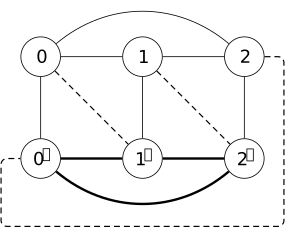
Thin solid edges have weight \(1\); the thick lower triangle has weight \(2\); dashed edges have weight \(1/2\). The outer dashed edge joins \(2\) to \(0'\), completing the shift modulo three. Crossings without a circle are not vertices.
The simultaneous rotation \(x\mapsto x+1\) generates \(C_3\). It is the entire weight-preserving vertex automorphism group. The weighted degrees \(7/2\) and \(11/2\) distinguish the two layers. The interlayer edges of weight \(1\) force the same permutation \(\pi \) on both layers, and those of weight \(1/2\) force \(\pi (x+1)=\pi (x)+1\). Thus only the three rotations remain.
The real representation is \(\mathbb R^6\cong \mathbb R^{\oplus 2}\oplus W^{\oplus 2}\), where \(W\) is the two-dimensional rotation representation and has \(D=\mathbb C\) by Proposition [fdip-0051]. The commutant is \(M_2(\mathbb R)\times M_2(\mathbb C)\), of real dimension \(4+8=12\). Its orbitals are the 4 choices of ordered layers and three differences \(y-x\). The symmetric dimension is \(3+4=7\): there are two diagonal orbits, two within-layer edge orbits and three interlayer pair orbits.
Use normalized constant vectors on the two layers for the trivial sector. For the other sector put \(\zeta =e^{2\pi i/3}\) and represent its upper values by \(f(x)=\sqrt {2/3}\operatorname {Re}(z\zeta ^{-x})\), and its lower values by the same formula with \(z'\). This is an isometry from \(\mathbb C^2\) with its real Euclidean inner product to the four-dimensional sector. Evaluating the edge energy gives \[\begin {aligned} Q_{\mathrm {triv}}&= \begin {pmatrix}5/2&-3/2\\-3/2&5/2\end {pmatrix},\\ Q_{\mathbb C}&= \begin {pmatrix} 11/2&-3/4+i\sqrt3/4\\ -3/4-i\sqrt3/4&17/2 \end {pmatrix}. \end {aligned}\] Indeed the diagonal Fourier entries are \(1+3a+u+v\) and \(1+3b+u+v\); the upper-right entry is \(-u-v\zeta ^{-1}\). The trivial eigenvalues are \(1,4\). The complex block has trace \(14\), determinant \(46\), and eigenvalues \(7-\sqrt 3,7+\sqrt 3\), each repeated twice over the reals. Hence \[\det _{\mathbb R}Q=4\cdot 46^2=8464.\] The square is required by the real determinant convention.
The imaginary entry records the shift in the declared Fourier coordinates. Rephasing one coordinate can make this single Hermitian matrix real; the intrinsic complex feature is the full commutant \(M_2(\mathbb C)\), not an obstruction to diagonalizing one positive operator. This calculation adapts the cyclic Fourier modes of Example [fdip-004W], based on [serre1977linear, Section 5.1, p. 35].