Example. The half-turn on vertex and edge fields [fdip-000J]
Example. The half-turn on vertex and edge fields [fdip-000J]
The alternating four-cycle has a symmetry for every \(t>0\), including unequal weights. Let \(C_2=\{1,r\}\) with \(r^2=1\). Its left actions on the distinct vertex and edge sets \(V=\mathbb Z/4\mathbb Z\) and \(E=\{e_0,e_1,e_2,e_3\}\) are \[r\cdot i=i+2,\qquad r\cdot e_i=e_{i+2}.\] Indices are modulo \(4\). These permutations square to the identity, preserve the endpoints \(e_i:i\to i+1\), and preserve the weights \((1,t,1,t)\). Milne's [milne2025group, Definition 4.1, p. 57] gives the left-action convention; his [milne2025group, Example 7.1(b), p. 101] constructs the associated permutation representation.
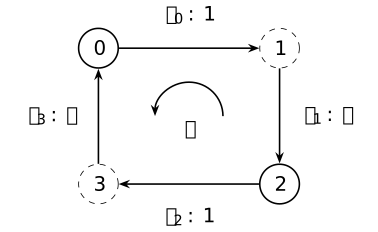
The half-turn exchanges \(0,2\) and \(1,3\), and exchanges \(e_0,e_2\) and \(e_1,e_3\). Directed arrows and their weights agree after rotation. Solid vertices form the retained set \(\{0,2\}\); the dashed vertices form its complement. Each set is preserved.
The induced maps on real fields use inverse precomposition: \[\begin {aligned} P:\mathbb R^V&\to \mathbb R^V,&(P\phi )_i&=\phi _{i-2},\\ U:\mathbb R^E&\to \mathbb R^E,&(Ua)(e_i)&=a(e_{i-2}). \end {aligned}\] Both maps have the coordinate array \[\begin {pmatrix} 0&0&1&0\\0&0&0&1\\1&0&0&0\\0&1&0&0 \end {pmatrix},\] but their domains differ. They satisfy \(P^2=I\) and \(U^2=I\). Sending \(1\) to the identity and \(r\) to these maps gives two real linear representations of \(C_2\).
Write \(\delta _i(j)=\mathbf 1_{j=i}\) for the vertex coordinate basis and \(\eta _i(e_j)=\mathbf 1_{j=i}\) for the edge coordinate basis. Then \(P\delta _0=\delta _2\ne \delta _0\) and \(U\eta _0=\eta _2\ne \eta _0\). Since \(r\) is the only nonidentity element of \(C_2\), both representations are faithful. Finite coordinate reindexing preserves the counting pairings; weight preservation gives \[\begin {aligned} P^TP&=I,\qquad U^TU=I,\\ U^TWU&=W, \end {aligned}\] where \(W=\operatorname {diag}(1,t,1,t)\). The last identity also preserves the weighted edge pairing.
The two representations interact through the incidence matrix. With its edge-by-vertex convention from [spielman2009effective, Section 2.1, p. 4], \[\begin {aligned} (BP\phi )(e_i)&=\phi _{i+1-2}-\phi _{i-2}\\ &=(UB\phi )(e_i). \end {aligned}\] Thus \(BP=UB\): the incidence map is equivariant between the vertex and edge actions.
The same formulas define linear representations over any nonzero commutative unital ring, with any period-two weights in that ring. The delta witnesses still prove faithfulness because \(1\ne 0\). Over the zero ring the two field modules have one element, so this faithfulness assertion is excluded. The positive real weights above are the specialization used for Gaussian laws.
This is the all-positive case of a signed endpoint action. The general endpoint composition, abstract orientation cocycle and weaker signed-incidence symmetry have that defining address. The loop and reversal examples explain why endpoint and sign coherence cannot be inferred from the incidence intertwiner alone.
Mathlib's Representation.ofMulAction sends a coordinate
basis vector at \(v\) to the one at \(g\cdot v\). Its finitely supported
coefficient module is identified with all functions on a finite set by
Finsupp.linearEquivFunOnFinite, giving the inverse-precomposition
convention above. Representation.IntertwiningMap bundles
a linear map with the equation \(B P_g=U_gB\). These interfaces do not
provide the particular incidence identity or the coherent signed-edge
action without their proofs.