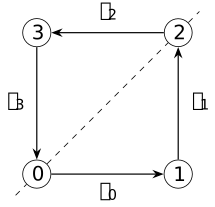
Example. The complete sector law of the alternating four-cycle [fdip-003S]
AGENTDRAFTED
For the alternating four-cycle with \(t,m>0\),
the two real half-turn sectors are independent
under the Gaussian law. Their precision and covariance blocks vary
with \(t,m\), although the action and its projectors do not. Put
\(a=m^2\) and \(s=1+t+a\). The counting quadratic form is
\[\begin {aligned}
\langle \phi ,Q\phi \rangle
&=(\phi _1-\phi _0)^2+t(\phi _2-\phi _1)^2\\
&\quad +(\phi _3-\phi _2)^2+t(\phi _0-\phi _3)^2
+a\sum _i\phi _i^2.
\end {aligned}\]
It is strictly positive for nonzero \(\phi \), since \(a>0\).
The weighted incidence construction is self-adjoint, and the
half-turn reindexes the 4 edge terms without changing their weights.
Thus \(QP=PQ\), as required by the intrinsic product law.
In vertex order \((0,1,2,3)\), the
massive precision is
\[Q=\begin {pmatrix}
s&-1&0&-t\\-1&s&-t&0\\0&-t&s&-1\\-t&0&-1&s
\end {pmatrix}.\]
Use the orthonormal vectors
\[\begin {aligned}
v_{\varepsilon ,0}&=(\delta _0+\varepsilon \delta _2)/\sqrt 2,\\
v_{\varepsilon ,1}&=(\delta _1+\varepsilon \delta _3)/\sqrt 2,
\qquad \varepsilon \in \{1,-1\}.
\end {aligned}\]
Write \(\phi =\sum _\varepsilon
(x_\varepsilon v_{\varepsilon ,0}+y_\varepsilon v_{\varepsilon ,1})\)
and \(z_\varepsilon =(x_\varepsilon ,y_\varepsilon )\). These are
normalized sector coordinates, rather than the coefficients in the
unnormalized free bases of Definition [fdip-000L]. In particular
\[\begin {aligned}
\phi _0&=(x_++x_-)/\sqrt 2,&\phi _2&=(x_+-x_-)/\sqrt 2,\\
\phi _1&=(y_++y_-)/\sqrt 2,&\phi _3&=(y_+-y_-)/\sqrt 2.
\end {aligned}\]
In the order \((v_{+,0},v_{+,1},v_{-,0},v_{-,1})\), the
precision is \(\operatorname {diag}(Q_+,Q_-)\) and its inverse is
\(\operatorname {diag}(G_+,G_-)\), where
\[\begin {aligned}
Q_+&=\begin {pmatrix}s&-(1+t)\\-(1+t)&s\end {pmatrix},\\
Q_-&=\begin {pmatrix}s&t-1\\t-1&s\end {pmatrix},\\
G_+&=\tfrac 1{a(a+2+2t)}
\begin {pmatrix}s&1+t\\1+t&s\end {pmatrix},\\
G_-&=\tfrac 1{(a+2)(a+2t)}
\begin {pmatrix}s&1-t\\1-t&s\end {pmatrix}.
\end {aligned}\]
The covariance in these coordinates is given
by the displayed inverse blocks. If \(T\phi =(z_+,z_-)\), then
\[T_*\mu _Q=\mu _{Q_+}\otimes \mu _{Q_-}.\]
The product on the right is the product probability measure.
In particular the sector random vectors \(z_+,z_-\) are independent.
[friedli2017statistical, Proposition B.55, p. 505]
gives the Gaussian covariance and coordinate-change convention.
The positive Gaussian normalization and
inverse-precision covariance apply to each block.
The product assertion follows from the explicit density calculation
below, rather than from the algebraic direct sum alone.
Retain \(R=(0,2)\). Its orthonormal sector vectors are
\[w_\varepsilon =(\delta _0^R+\varepsilon \delta _2^R)/\sqrt 2.\]
The projection satisfies
\[\begin {aligned}
\pi _Rv_{\varepsilon ,0}&=w_\varepsilon ,\\
\pi _Rv_{\varepsilon ,1}&=0.
\end {aligned}\]
Thus the retained sector coordinates are exactly \(x_+,x_-\),
with no additional factor of \(\sqrt 2\). In these coordinates, the
retained precision has positive scalar blocks
\[\begin {aligned}
\sigma _+&=s-\frac {(1+t)^2}{s}
=\frac {a(a+2+2t)}s,\\
\sigma _-&=s-\frac {(t-1)^2}{s}
=\frac {(a+2)(a+2t)}s.
\end {aligned}\]
The retained coordinates are independent centered Gaussians with
variances \(\sigma _+^{-1},\sigma _-^{-1}\). Decomposing into
sectors and taking this marginal therefore give the same law in
either order, as in the map and measure square.
Transforming the retained coordinates back gives
\[\begin {aligned}
\operatorname {Var}(\phi _0)
=\operatorname {Var}(\phi _2)
&=\tfrac 12(\sigma _+^{-1}+\sigma _-^{-1}),\\
\langle \phi _0\phi _2\rangle _Q
&=\tfrac 12(\sigma _+^{-1}-\sigma _-^{-1}).
\end {aligned}\]
For \(m=t=1\), the sector blocks and their inverses are
\[\begin {aligned}
Q_+&=\begin {pmatrix}3&-2\\-2&3\end {pmatrix},&Q_-&=3I_2,\\
G_+&=\tfrac 15\begin {pmatrix}3&2\\2&3\end {pmatrix},&G_-&=I_2/3.
\end {aligned}\]
Hence \(\sigma _+=5/3\), \(\sigma _-=3\); the retained variance
is \(7/15\) and the cross covariance is \(2/15\). Directly,
\[\begin {aligned}
S&=\tfrac 13\begin {pmatrix}7&-2\\-2&7\end {pmatrix},&
S^{-1}&=\tfrac 1{15}\begin {pmatrix}7&2\\2&7\end {pmatrix},\\
Z_Q&=\frac {4\pi ^2}{3\sqrt 5},&Z_S&=\frac {2\pi }{\sqrt 5}.
\end {aligned}\]
The eliminated factor is \(2\pi/3\). The
specified conditional kernel at eliminated field zero
instead gives precision \(A=3I_2\) and covariance \(I_2/3\),
whose zero cross covariance differs from \(2/15\).
For \(m=1,t=2\),
\[\begin {aligned}
Q_+&=\begin {pmatrix}4&-3\\-3&4\end {pmatrix},\\
Q_-&=\begin {pmatrix}4&1\\1&4\end {pmatrix},\\
G_+&=\tfrac 17\begin {pmatrix}4&3\\3&4\end {pmatrix},\\
G_-&=\tfrac 1{15}\begin {pmatrix}4&-1\\-1&4\end {pmatrix}.
\end {aligned}\]
Now \(\sigma _+=7/4\), \(\sigma _-=15/4\); the retained variance
is \(44/105\) and the cross covariance is \(16/105\). Here
\[\begin {aligned}
S&=\begin {pmatrix}11/4&-1\\-1&11/4\end {pmatrix},\\
S^{-1}&=\tfrac 1{105}\begin {pmatrix}44&16\\16&44\end {pmatrix},\\
Z_Q&=\frac {4\pi ^2}{\sqrt {105}},&Z_S&=\frac {8\pi }{\sqrt {105}}.
\end {aligned}\]
The eliminated factor is \(\pi/2\). Both examples
have the same \(P,J,E_\pm ,F_\pm \), but different covariance
matrices and hence different Gaussian states: their polynomial
functionals differ on \(\phi _0\phi _2\).
The half-turn commutant explains why these two-dimensional
precision blocks may mix coordinates while respecting the same symmetry.
Mathlib's OrthonormalBasis.measurePreserving_repr
supplies the volume-preserving passage to orthonormal coordinates.
TauCeti's
TauCeti.Probability.indepFun_sumEquivProd_multivariateGaussian_iff
characterizes independence of complementary coordinate blocks by
vanishing cross covariance. Index each sector by \(\{0,1\}\) and
the full coordinates by the disjoint union of these sets. Take mean
zero and covariance \(\Sigma =\operatorname {diag}(G_+,G_-)\).
The positive eigenvalues above make \(\Sigma \) positive definite,
hence positive semidefinite, and its cross block is zero.
After identifying the normalized sector density with this Gaussian
law, the theorem gives independence. The formalization references discussed
with the inverse-precision covariance theorem use
\(G_\pm =Q_\pm ^{-1}\) as their parameters. The concrete matrices,
density identification and sectorwise Schur calculation are supplied
by the proofs above.