Definition. The one-step Gaussian kernel [fdip-007T]
Definition. The one-step Gaussian kernel [fdip-007T]
Fix \(w>0\) and \(m>0\). On \(\mathcal H=L^2(\mathbb R,dx;\mathbb C)\), define the Gaussian transfer operator by \[\begin {aligned} K(x,y)&=\exp \left [-\frac w2(x-y)^2 -\frac {m^2}{4}(x^2+y^2)\right ],\\ (Tf)(x)&=\int _{\mathbb R}K(x,y)f(y)\,dy. \end {aligned}\] The reference measure is exactly Lebesgue measure \(dy\); no normalizing factor is included in \(K\). This is the one-coordinate instance of the slice-kernel construction in [wingate2025lattice, Eqs. (5.1)–(5.3), p. 4].
Write \(a=w/2+m^2/4\), so \(K(x,y)=e^{-a(x^2+y^2)+wxy}\) and \(2a>w\). Thus \(K\in L^2(\mathbb R^2)\). Cauchy–Schwarz makes \(T\) bounded, and symmetry of the real kernel makes it self-adjoint. An integral operator with a square-integrable kernel is Hilbert–Schmidt: in an orthonormal basis \((e_n)\), its squared norm of this kind is \(\|T\|_{\mathrm {HS}}^2=\sum _n\|Te_n\|^2\) (the value is independent of the basis). Here it equals \(\int |K|^2\). Approximation of \(K\) by finite sums of products of one-variable square-integrable functions also shows that \(T\) is compact. Operator positivity will follow from its explicit spectrum in Theorem [fdip-007U].
For \(N\ge 3\), let \(x_N=x_0\) and define the periodic chain by \[\begin {aligned} H_N(x)&=\frac w2\sum _{j=0}^{N-1}(x_{j+1}-x_j)^2 +\frac {m^2}{2}\sum _{j=0}^{N-1}x_j^2,\\ Z_N&=\int _{\mathbb R^N}e^{-H_N(x)}\,d^Nx,\qquad d\mu _N=Z_N^{-1}e^{-H_N(x)}\,d^Nx. \end {aligned}\] Each undirected edge of the ordinary cycle \(C_N\) occurs once. Splitting each onsite mass term between its two incident edges gives \[e^{-H_N(x)}=\prod _{j=0}^{N-1}K(x_j,x_{j+1}).\] Positive mass makes \(0<Z_N<\infty \). The identity \(Z_N=\operatorname {Tr}T^N\) is proved in Theorem [fdip-007V].
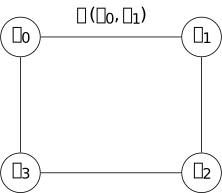
The four-cycle illustrates the kernel product. Every edge contributes the same function \(K\) of its endpoints. Each site's two mass contributions add to \(m^2x_j^2/2\); closing the last edge identifies \(x_4\) with \(x_0\).