Proposition. Adelic component maps and sign kernels [fcap-004J]
Proposition. Adelic component maps and sign kernels [fcap-004J]
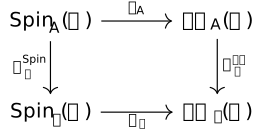
Let \(Q\) be a nondegenerate quadratic form on a rational vector space of finite dimension \(n\), with a compatible reference tuple \(U\) as in Definition [fcap-004C]. Let \(R\) be any set of primes. The local maps \(\rho _p:\operatorname {Spin}_p\to SO_p\) and \(i_p:SO_p\hookrightarrow O_p\) induce continuous group homomorphisms \[\begin {gathered} \operatorname {Spin}_f(U)\xrightarrow {\rho _f}SO_f(U)\xrightarrow {i_f}O_f(U),\\ \operatorname {Spin}_f^R(U)\xrightarrow {\rho ^R}SO_f^R(U)\xrightarrow {i^R}O_f^R(U),\\ \operatorname {Spin}_{\mathbb A}(U)\xrightarrow {\rho _{\mathbb A}} SO_{\mathbb A}(U)\xrightarrow {i_{\mathbb A}}O_{\mathbb A}(U). \end {gathered}\] The groups are defined in Definition [fcap-004F], Definition [fcap-004G] and Definition [fcap-004H]. Each \(i\) is injective, with image exactly the orthogonal tuples of determinant one at every retained place, including the real place for the full group. These maps commute with forgetting the real component and with deleting the primes in \(R\).
If \(n>0\), their Spin projection kernels are, as groups, \[\begin {aligned} \ker \rho _f&\cong \prod _p\{1,-1\},\\ \ker \rho ^R&\cong \prod _{p\notin R}\{1,-1\},\\ \ker \rho _{\mathbb A}&\cong \{1,-1\}\times \prod _p\{1,-1\}. \end {aligned}\] Every sign family occurs, with an independent real sign in the full case. These are algebraic identifications. If \(n=0\), all the groups and kernels above are singletons. If \(R\) contains every prime, the away groups and the empty sign product are singletons even when \(n>0\).
For example, in positive dimension choose \(\varepsilon _2=-1\) and \(\varepsilon _p=1\) at every other prime. This is a kernel element distinct from both constant sign families. In the full group either real sign can accompany it. These projection kernels are different from the kernel of the spinor norm in Theorem [fcap-0023]: the present maps start in Spin and record its scalar ambiguity.
The classical finite-stage functoriality is described in [conrad2011adelic, Theorem 3.6 and the paragraph following its proof, pp. 6-8]. The real scalar-kernel prototype appears in [gallier2014clifford, Section 1.8, Proposition 1.21, pp. 39-40]. Gallier's Definition 1.6 uses norm \(\pm 1\); the local input here is the norm-one field theorem in Lemma [fcap-001C]. In particular this argument makes no claim that the Spin projections are surjective.
The generic construction and its continuity are supported by
TauCeti.restrictedProductMapOfForall and
TauCeti.continuous_restrictedProductMapOfForall.
The specialized continuity results are
TauCeti.QuadraticMap.OrthogonalCompactOpens.continuous_finiteAdelicSpinToSpecialOrthogonal,
TauCeti.QuadraticMap.OrthogonalCompactOpens.continuous_awayAdelicSpinToSpecialOrthogonal
and TauCeti.QuadraticMap.OrthogonalCompactOpens.continuous_fullAdelicSpinToSpecialOrthogonal.
For SO inclusion, the image criteria are
TauCeti.QuadraticMap.OrthogonalCompactOpens.mem_range_finiteAdelicSpecialOrthogonalToOrthogonal_iff,
TauCeti.QuadraticMap.OrthogonalCompactOpens.mem_range_awayAdelicSpecialOrthogonalToOrthogonal_iff
and TauCeti.QuadraticMap.OrthogonalCompactOpens.mem_range_fullAdelicSpecialOrthogonalToOrthogonal_iff.
The displayed square is
TauCeti.QuadraticMap.OrthogonalCompactOpens.fullAdelicSpecialOrthogonalToFinite_comp_fullAdelicSpinToSpecialOrthogonal;
deletion compatibility is
TauCeti.QuadraticMap.OrthogonalCompactOpens.awayAdelicSpinToSpecialOrthogonal_comp_restrictAway.
The existing-element kernel criteria are
TauCeti.QuadraticMap.OrthogonalCompactOpens.mem_ker_finiteAdelicSpinToSpecialOrthogonal_iff,
TauCeti.QuadraticMap.OrthogonalCompactOpens.mem_ker_awayAdelicSpinToSpecialOrthogonal_iff
and TauCeti.QuadraticMap.OrthogonalCompactOpens.mem_ker_fullAdelicSpinToSpecialOrthogonal_iff.
They support the coordinate criteria; the proof that every sign
family occurs is the additional rational \(-1\) argument above.