Example. A rational Spin obstruction vanishes over the 7-adic field [fcap-004B]
Example. A rational Spin obstruction vanishes over the 7-adic field [fcap-004B]
On the rational hyperbolic plane with basis \(u,v\), put \(q(au+bv)=ab\). Its unhalved polar form has matrix \(\left (\begin {smallmatrix}0&1\\1&0\end {smallmatrix}\right )\), so it is nondegenerate over both \(\mathbb {Q}\) and \(\mathbb {Q}_7\). We construct a rational special orthogonal transformation with no rational Spin lift, then exhibit its lift over \(\mathbb {Q}_7\). This specializes the scalar-extension criterion of Theorem [fcap-003N].
For \(c\ne 0\), write \(r_c=r_{u+cv}\). The reflection formula \(r_z(w)=w-B_q(w,z)z/q(z)\) gives, in the ordered basis \(u,v\), \[\begin {gathered} r_c=\begin {pmatrix}0&-c^{-1}\\-c&0\end {pmatrix},\\ g=r_2r_1=\begin {pmatrix}1/2&0\\0&2\end {pmatrix}. \end {gathered}\] Thus \(g\) preserves \(q\) and has determinant one. Since \(q(u+2v)=2\) and \(q(u+v)=1\), its spinor norm is \[\nu _q(g)=[2]_{\mathbb {Q}}\] by Proposition [fcap-002D]. This class is nontrivial: if \((a/b)^2=2\) for coprime integers \(a,b\) with \(b\ne 0\), then \(a^2=2b^2\) first makes \(a\) even and then makes \(b\) even, a contradiction. The image/kernel theorem Theorem [fcap-0023] therefore rules out a rational Spin lift of \(g\).
In \(\mathbb {Z}_7\), take \(f(T)=T^2-2\). We have
\(f(3)=7\) and \(f'(3)=6\), a unit. Hensel's lemma
[lam2005quadratic, VI.2, Theorem 2.18, p. 161] gives
\[\begin {gathered}
\alpha \in \mathbb {Z}_7,\qquad \alpha ^2=2,\\
\alpha \equiv 3\pmod {7}.
\end {gathered}\]
Indeed, in the theorem use the ideal \(7\mathbb {Z}_7\) and
\(e=f'(3)=6\): since \(e\) is a unit,
\(f(3)\in e^2(7\mathbb {Z}_7)\). In Mathlib's norm formulation
hensels_lemma, the same input satisfies
\(|f(3)|_7=1/7<1=|f'(3)|_7^2\).
In particular \(\alpha \ne 0\) and \([2]_{\mathbb {Q}_7}=1\).
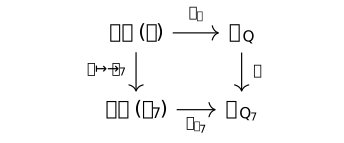
Identify \(\mathbb {Q}_7\otimes _{\mathbb {Q}}V\) with the hyperbolic plane over \(\mathbb {Q}_7\), and denote the extended form and transformation by \(q_7,g_7\). Put \(\mathcal {S}_K=K^{\times }/(K^{\times })^2\). The square in Theorem [fcap-003N] becomes
Suppress the Clifford inclusion symbols and use
\(u^2=v^2=0\), \(uv+vu=1\) in \(\mathcal {C}\kern -2pt\ell (q_7)\). Set
\(p=uv\) and \(x=(u+2v)(u+v)\). Then
\[\begin {gathered}
p^2=u(vu)v,\\
u(vu)v=u(1-uv)v=p,\\
x=uv+2vu=2-p,\\
\operatorname {rev}(x)=(u+v)(u+2v),\\
\operatorname {rev}(x)=1+p,\\
\operatorname {rev}(x)x=(1+p)(2-p),\\
(1+p)(2-p)=2.
\end {gathered}\]
Define
\[s=\frac {x}{\alpha }
=\left (\frac {u+2v}{\alpha }\right )(u+v).\]
Both displayed vector factors have quadratic value one. They are
Clifford units in the vector-generated Lipschitz carrier; their even
product has reverse norm \(2/\alpha ^2=1\). On an even element the
star and reverse norms agree by Remark [fcap-0028]. Thus \(s\) lies
in the actual \(\operatorname {Spin}(q_7)\), by the product-square construction
Theorem [fcap-000C]. Rescaling a nonisotropic vector leaves its
reflection unchanged, so the Spin action of \(s\) is
\[r_{(u+2v)/\alpha }\,r_{u+v}=r_2r_1=g_7.\]
This is the normalized-pair construction
CliffordAlgebra.spinReflectionPair and its action
CliffordAlgebra.spinToOrthogonal_spinReflectionPair:
the constructor assumes both quadratic values are one, and the
action identity also assumes that two is invertible. These declarations
certify the general pair construction; the arithmetic specialization
above is proved here.
The extension \(\mathbb {Q}\subset \mathbb {Q}_7\) has killed this particular square-class obstruction. The quadratic-extension example Proposition [fcap-003O] exhibits the same class becoming trivial over \(\mathbb {Q}(\sqrt {2})\) for a different quadratic form. Here the Hensel root and the displayed Clifford product give a lift at the single completion \(\mathbb {Q}_7\).